Putting Green Rules: Marking, Repairing and the Flagstick
Rule 13 in plain English: marking and lifting, repairing ball and spike marks, the flagstick, a ball that moves, caddie limits and the 10-second rule.

The putting green is where the Rules of Golf get personal. You are close to other players, the ball is moving slowly, and small actions such as marking, cleaning, repairing a mark or leaving the flagstick in can have rules consequences. The good news is that the 2019 modernization of the rules made the green much friendlier: many actions that once carried penalties are now allowed, and accidental movement is rarely penalized.
This guide walks through Rule 13 (Putting Greens) and the related rules on lifting, replacing and caddie help, as they stand in the current Rules of Golf jointly published by The R&A and the USGA. For the broader principles behind the rules, see our Rules of Golf essentials.
When Is Your Ball on the Green?
The putting green is one of the five defined areas of the course, as explained in our guide to the parts of a golf course. Under Rule 13.1a, your ball is on the putting green when any part of it touches the green, or when it lies on or in something (such as a loose impediment or an obstruction) that is inside the edge of the green.
That definition matters because several special freedoms apply only once the ball is on the green, most notably the right to lift and clean it. A ball sitting on the fringe, even an inch from the putting surface, is in the general area, and the putting green rules do not apply to it.
Marking, Lifting and Cleaning
Rule 13.1b allows you to lift and clean your ball whenever it is on the putting green. Before lifting it, you must mark its spot, and after cleaning it you must replace it on that original spot.
How to mark properly
Rule 14.1a says the spot is marked by placing a ball-marker right behind or right next to the ball, or by holding a club on the ground right behind or next to it. A coin or purpose-made marker is standard. The marker must be removed before you play your next stroke.
Failing to mark before lifting, marking in the wrong way, or playing with the marker still on the ground each costs one penalty stroke.
Who may lift the ball
Under Rule 14.1b, only you or someone you authorize may lift your ball. Authorization normally has to be given each time. There is a useful exception: your caddie may lift your ball on the putting green without specific permission. If someone lifts the ball when they were not allowed to, you get one penalty stroke.
Replacing the ball
The ball must be set down by hand on its original spot and released so it stays there (Rule 14.2). If it will not stay on the spot after two attempts, for example on a severe slope, it is placed on the nearest spot where it will stay at rest, not nearer the hole.
Moving your marker out of another player’s line
If your marker is on another player’s line, you can move it a set number of clubhead lengths to one side, using a reference point such as a tree. Remember to move it back before replacing your ball. Forgetting to do so means playing from a wrong place, which brings the general penalty: two strokes in stroke play, loss of hole in match play.
Repairing Damage, Including Spike Marks
Rule 13.1c is one of the most significant changes from the 2019 modernization. You may repair damage on the putting green whether your ball is on the green or not, and you may remove sand and loose soil from the green without penalty.
“Damage” is broadly defined. It includes:
- Ball marks (pitch marks).
- Shoe damage such as spike marks.
- Scrapes or indentations caused by equipment or the flagstick.
- Old hole plugs, turf plugs and seams of cut turf.
- Scrapes or indentations from maintenance tools or vehicles.
- Animal tracks or hoof indentations.
- Embedded objects such as stones, acorns or tees, and the indentations they leave.
What is not damage? Natural surface imperfections, normal maintenance effects such as aeration holes and grooves from verticutting, damage from irrigation, rain or other natural forces, weeds, bare or diseased patches, uneven growth, and the natural wear of the hole.
The repair must be reasonable. You can use your hand, foot or other body part, a normal ball-mark repair tool, a tee, a club or similar normal equipment, and you must not unreasonably delay play. You may only restore the green as nearly as possible to its original condition. Going further, such as creating a channel toward the hole or pressing down areas that were not damaged, brings the general penalty under Rule 8.1a.
Before 2019, golfers could repair ball marks and old hole plugs but not spike marks. Allowing spike mark repair removed a long-standing source of frustration and confusion.
Touching the Line and Testing the Surface
Under the old rules, touching the line of putt was generally a breach. Today there is no penalty for simply touching your line, for example while pointing out a target or removing a loose impediment, as long as you do not improve the conditions affecting your stroke. Pressing down the turf on your line or brushing it to change the surface remains a breach under Rule 8.1a.
Rule 13.1e prohibits deliberately rubbing the surface of the green or rolling a ball on it to test the surface during a round. There is an exception between holes: you may rub or roll a ball on the green of the hole you just completed and on any practice green, unless the Committee has adopted a Local Rule prohibiting rolling a ball on the completed green. The penalty for testing is the general penalty.
When Your Ball or Marker Moves
Rule 13.1d deals with movement on the green, and here the rules are generous.
- Accidental movement: if you, your opponent or another player in stroke play accidentally moves your ball or ball-marker on the green, there is no penalty. You simply replace the ball on its original spot, estimating it if necessary.
- Natural forces after you have lifted and replaced: if your ball had already been lifted and replaced, and wind or gravity then moves it, you replace it on the spot it moved from, without penalty.
- Natural forces before you have lifted it: if the ball had not yet been lifted and replaced and it moves due to natural forces, you play it from its new spot.
- During the stroke: if the ball starts moving after you begin your backswing and you complete the stroke, you play it as it lies.
The lifted-and-replaced distinction is important on windy days with fast greens. Once you have marked and replaced, a gust that blows your ball away does not cost you, and you put it back.
The Flagstick: In or Out?
Since 2019 you may putt with the flagstick left in the hole. Rule 13.2 gives you three options for any stroke, from anywhere on the course: leave the flagstick in the hole, have it removed, or have someone attend it.
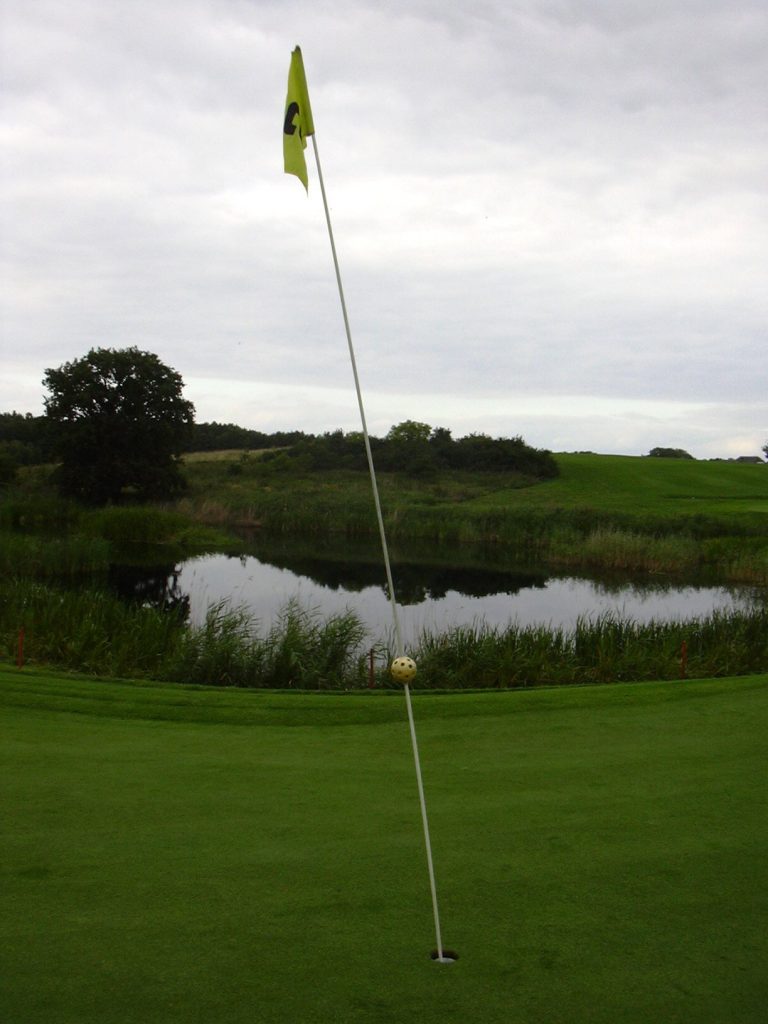
Flagstick left in
- If your ball hits the flagstick, there is no penalty and you play the ball as it lies.
- The flagstick should be centered in the hole. Deliberately positioning it off-center to gain an advantage, and then hitting it, brings the general penalty.
- Once you have played, you or your caddie must not deliberately move or remove the flagstick to affect where your moving ball comes to rest.
Flagstick removed or attended
- You can have the flagstick removed before playing, or authorize someone to attend it and remove it during or after the stroke.
- You are treated as having authorized attendance if your caddie is holding the flagstick or standing right beside the hole when you play, or if you see someone attending and play without asking them to step away.
- If your ball accidentally hits an attended flagstick or the person attending it, there is no penalty and you play it as it lies.
Ball resting against the flagstick
Under Rule 13.2c, if your ball comes to rest against the flagstick and any part of the ball is below the surface of the putting green, the ball is holed, even if it is not completely below the surface. If no part of the ball is below the surface, it is not holed. If the ball then moves when the flagstick is removed, you replace it on the lip of the hole without penalty.
The Ball Overhanging the Hole: The 10-Second Rule
Golf’s most suspenseful moment is a putt that stops on the lip. Rule 13.3 sets the timeline. You are allowed a reasonable time to reach the hole, plus ten seconds to wait and see whether the ball falls in.
- If it falls in during that time, you have holed out with your previous stroke.
- If it does not fall in within that time, the ball is treated as at rest. If it falls in afterwards, before you play it, you have still holed out with the previous stroke, but you add one penalty stroke, effectively meaning no benefit from waiting.
- If an opponent in match play deliberately lifts or moves your ball before the waiting time ends, your ball is treated as holed with the previous stroke. In stroke play, another player who does this gets the general penalty, and your ball is replaced on the lip.
Caddies and Helpers on the Green
Caddies can do a lot: mark and lift your ball on the green, repair damage, attend the flagstick and discuss the read. But Rule 10.2b sets limits:
- No standing behind you to help with aim: once you have at least one foot in position for your stance, your caddie must not stand on an extension of the line of play behind the ball to help you aim. This applies on the green too. There is no penalty if you back away and the caddie moves before you take your stance again.
- No setting down objects to show you a line, even if they are removed before the stroke.
- No standing as a target: while the stroke is being made, a caddie must not stand where you are aiming, though standing near the hole to attend the flagstick is fine.
The penalty for breaching these restrictions is the general penalty.
Wrong Green
If your ball lies on a green other than the one you are playing, Rule 13.1f requires you to take free relief: you must not play from the wrong green. Find the nearest point of complete relief in the same area of the course and drop within one club-length, not nearer the hole. Relief is also required if a wrong green interferes with your intended stance or swing.
Quick Reference
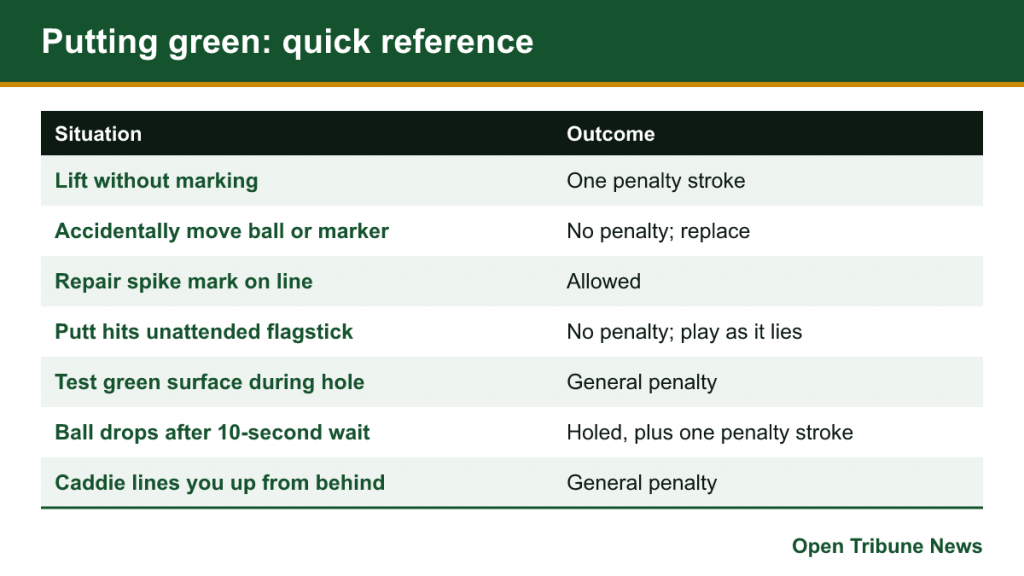
| Situation | Outcome |
|---|---|
| Lift without marking | One penalty stroke |
| Accidentally move ball or marker on green | No penalty; replace |
| Repair spike mark on line | Allowed |
| Putt hits unattended flagstick in hole | No penalty; play it as it lies |
| Test green surface during the hole | General penalty |
| Ball drops after 10-second wait | Holed with previous stroke, plus one penalty stroke |
| Caddie lines you up from behind | General penalty |
For technique once you are standing over the ball, see our guide to putting fundamentals.