Free Relief: Cart Paths, Ground Under Repair and Other Abnormal Conditions
Rule 16 explained: abnormal course conditions, the nearest point of complete relief, the one-club-length relief area, embedded balls and dangerous animals.
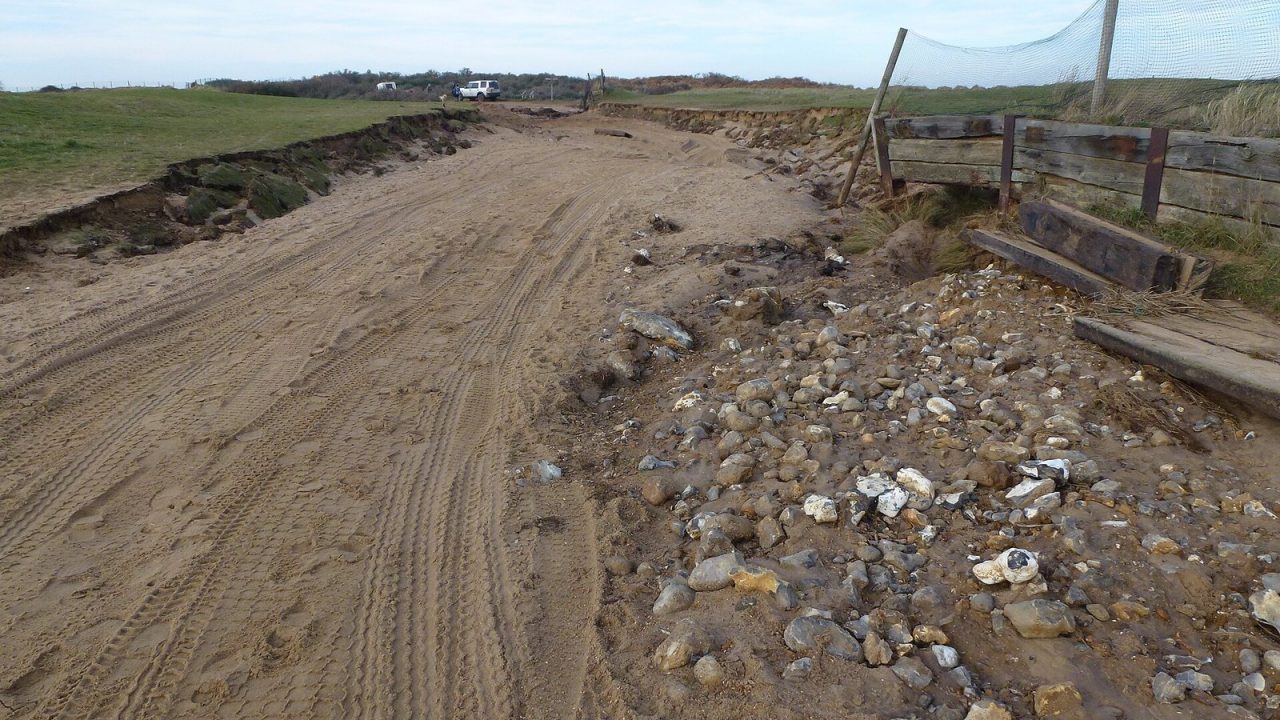
Most of the Rules of Golf ask you to play the ball as it lies and the course as you find it. But golfers are not expected to play off a concrete cart path, out of a rabbit hole or from a puddle left by last night’s rain. For these situations, the Rules provide free relief: you move the ball without a penalty stroke.
The key rule is Rule 16, which covers abnormal course conditions, dangerous animal conditions and embedded balls. This guide explains what qualifies, how to find the nearest point of complete relief, how to drop correctly, and the exceptions that catch golfers out. It complements our guide to the unplayable ball rule, which covers situations where relief costs a stroke.
What Is an Abnormal Course Condition?
The Rules group four things together as abnormal course conditions. Each has its own definition:
- Animal holes: holes dug in the ground by an animal, along with the material it dug out and any tracks leading into the hole. Holes made by animals that are themselves loose impediments, such as worms and insects, do not count.
- Ground under repair (GUR): any part of the course the Committee marks as ground under repair, often with white lines or blue stakes. Some things are GUR even if not marked, including holes made by the Committee or maintenance staff while working on the course, and piles of material removed for later collection.
- Immovable obstructions: artificial objects that cannot be moved without unreasonable effort or without damaging the object or the course. Cart paths with an artificial surface, sprinkler heads, drainage covers, maintenance buildings and shelters are typical examples.
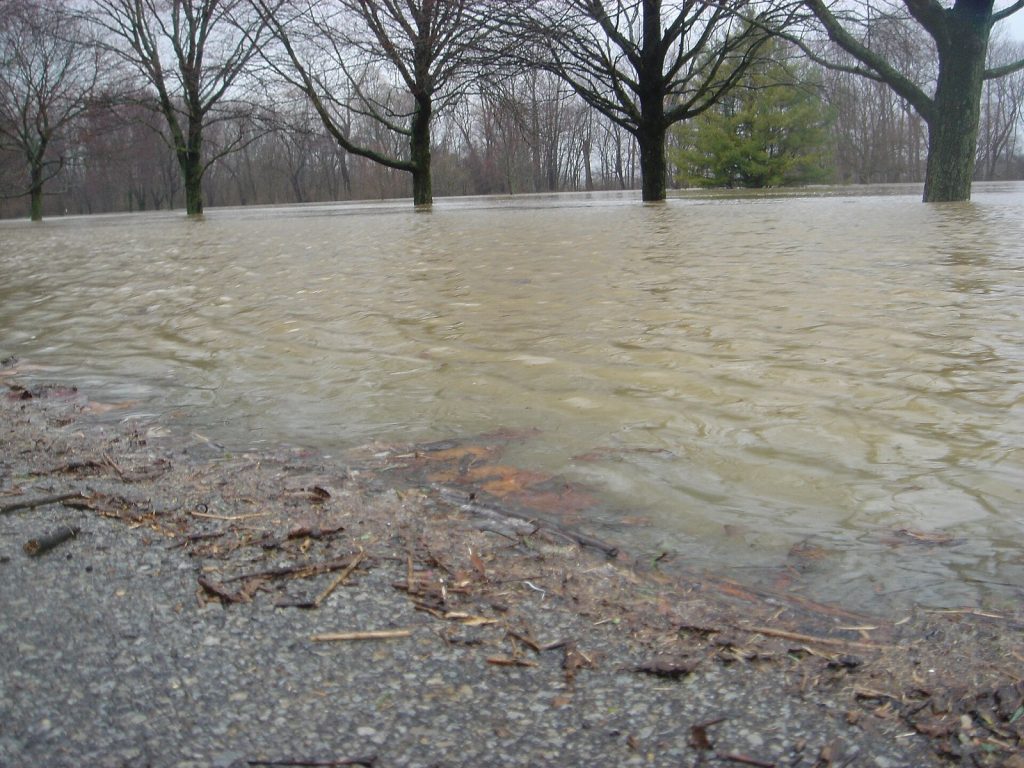
- Temporary water: any temporary accumulation of water on the surface of the ground, such as a puddle from rain or irrigation, that is not in a penalty area and can be seen before or after you take your stance without pressing down excessively with your feet. Dew and frost are not temporary water.
Note what is not covered by Rule 16.1. Movable obstructions, such as rakes and drinks cans, are dealt with separately under Rule 15.2: you simply remove them. Boundary objects, such as out-of-bounds stakes and walls, and integral objects, which the Committee has designated as part of the challenge of the course, give no free relief at all. Natural features such as trees, roots and rocks are not obstructions either.
When Relief Is Allowed: Interference
Rule 16.1a says interference exists when:
- your ball touches or is in or on the condition;
- the condition physically interferes with the area of your intended stance or swing; or
- on the putting green only, a condition on or off the green intervenes on your line of play.
Being merely close to a condition, or having it in your line of play anywhere other than on the putting green, is not interference. A sprinkler head 20 yards in front of you in the fairway does not give relief.
Relief is available anywhere on the course except in a penalty area. If your ball is in a penalty area, you must play it as it lies or take penalty relief under Rule 17. Our guide to penalty areas, out of bounds and lost balls covers those options.
There are two further exceptions. You do not get relief if playing the ball as it lies is clearly unreasonable because of something that does not give free relief, for example if your ball is in a bush and also touching a sprinkler head. And you do not get relief if the interference exists only because you chose a clearly unreasonable club, stance, swing or direction of play.
Committees can also adjust the rule through Local Rules. For example, a Committee may adopt a Local Rule denying relief when an abnormal condition interferes only with your stance, a common choice on courses where animal holes are widespread.
Finding the Nearest Point of Complete Relief
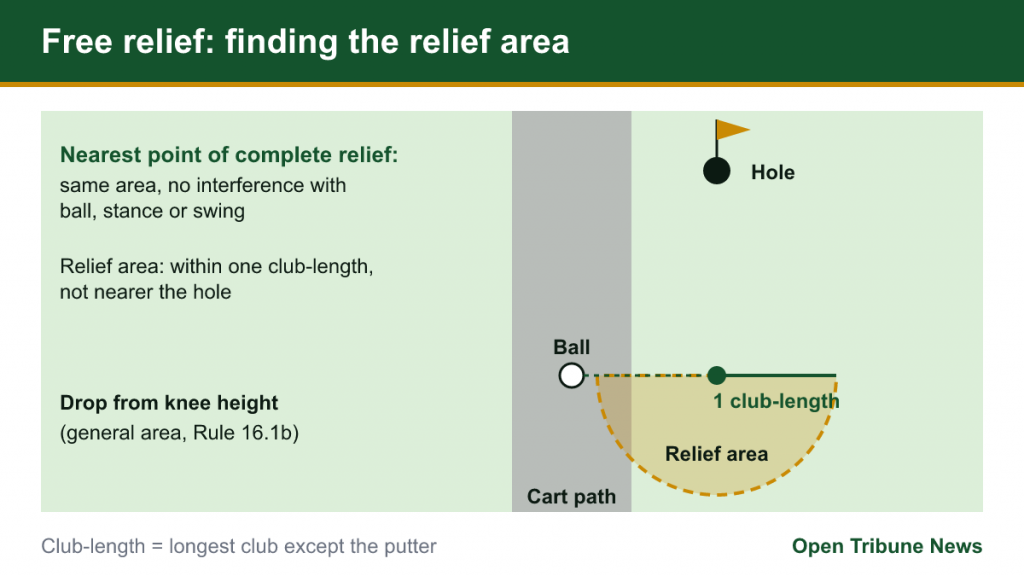
The heart of the procedure is the nearest point of complete relief: the point closest to where your ball lies, not nearer the hole, where the condition no longer interferes with your ball, stance or swing for the stroke you would have made.
Finding it correctly takes a little care:
- It must be in the same area of the course as required by the rule (for a ball in the general area, it must be in the general area).
- It must give complete relief. If you are standing with one foot on a cart path, the point is where neither foot nor your swing is affected.
- It is based on the stroke you would have made: the same club, stance, swing and direction of play.
- It is the nearest such point, which may be on either side of the condition. It is not necessarily the most favorable side. On a cart path, the nearest point might be in thick rough rather than on the fairway side.
Many players find it helpful to take their address position with the club they would use, at the point they think is correct, to confirm there is no remaining interference.
Taking Relief in Each Area of the Course
General area (Rule 16.1b)
You drop the original ball or another ball in a relief area measured one club-length from the nearest point of complete relief. The relief area must be in the general area, not nearer the hole than the reference point, and must give complete relief from the condition. A club-length is measured using the longest club in your bag other than your putter. Drops are made from knee height.
Bunker (Rule 16.1c)
You have two choices:
- Free relief in the bunker: follow the general-area procedure, but the reference point and relief area must be in the bunker. If complete relief is not possible in the bunker, you may use the point of maximum available relief, still in the bunker.
- Relief outside the bunker for one penalty stroke: drop a ball outside the bunker on a line that keeps the original spot between the hole and the drop point, with no limit on how far back you go. This is useful when a bunker is flooded with temporary water.
Putting green (Rule 16.1d)
You place the ball, rather than dropping it, on the nearest point of complete relief. That point may be on the green or in the general area. If complete relief is not possible, you use the point of maximum available relief. On the green, relief is also available for conditions that intervene on your line of play, which is why you may move a ball away from a puddle lying between it and the hole.
Ball not found in the condition (Rule 16.1e)
If your ball is not found but it is known or virtually certain that it came to rest in an abnormal course condition, you may take relief using the estimated point where the ball last crossed the edge of the condition. If that is not known or virtually certain, the ball is lost and you must use stroke-and-distance relief.
Dangerous Animal Conditions
Rule 16.2 protects players from danger. A dangerous animal condition exists when a dangerous animal near the ball could cause serious physical injury if you had to play the ball as it lies. The Rules give examples such as poisonous snakes, stinging bees, alligators, fire ants and bears.
Unlike other abnormal conditions, this relief is available anywhere on the course, including in a penalty area:
- Outside a penalty area, you use the normal relief procedure for the area your ball is in.
- In a penalty area, you may take free relief within the penalty area, or take penalty relief under Rule 17 outside it.
The rule does not cover other natural hazards such as cactus, which are part of the challenge of playing the course.
Embedded Ball
Rule 16.3 gives free relief when your ball is embedded in the general area. A ball is embedded only if it is in its own pitch-mark made as a result of your previous stroke and part of the ball is below the level of the ground.
To take relief, you drop within one club-length of the spot right behind where the ball is embedded, in the general area and not nearer the hole.
Important limitations:
- A ball embedded in sand in an area not cut to fairway height or less does not get relief.
- A ball is not embedded if it was pressed into the ground by someone stepping on it, or driven into the ground without going through the air.
- Committees may use a Local Rule limiting embedded-ball relief to areas cut to fairway height or less.
- On the putting green, you simply mark, lift and clean the ball, repair the damage and replace the ball.
- There is no free relief for an embedded ball in a bunker or penalty area under this rule.
Lifting to Check: Rule 16.4
Sometimes you cannot tell whether your ball is in a condition that gives relief, for example whether it is in its own pitch-mark or sitting in an animal hole. Rule 16.4 lets you lift the ball to check, as long as you reasonably believe relief may be available. You must mark the spot first and you must not clean the ball, except on the putting green. If relief turns out not to be available, you replace the ball. Lifting without a reasonable belief costs one penalty stroke.
Common Mistakes
- Choosing the “better” side. The nearest point of complete relief is not optional; you must use the nearest point, even if it is in the rough.
- Taking partial relief. Your stance and swing must be completely clear of the condition after the drop. If the ball rolls back to where interference exists, relief is not complete.
- Claiming relief for a cart path in the line of play. Line-of-play relief only exists on the putting green.
- Taking relief in a penalty area from anything other than a dangerous animal condition.
- Measuring with the putter. Use the longest club in the bag other than the putter.
- Playing from a wrong place. Playing from outside the relief area incurs the general penalty under Rule 14.7a.
Free relief is one of the Rules’ most generous provisions, but it has precise conditions. Learn the four abnormal course conditions, find the nearest point of complete relief honestly, and you will save strokes and avoid disputes. For context on how the Rules divide up the course, see our guide to the parts of a golf course.