Team Golf Formats: Scramble, Best Ball, Foursomes and More
How scramble, four-ball, foursomes, greensomes, Chapman and shamble work, when to use each, and the World Handicap System's recommended allowances.

Golf is usually described as an individual game, but some of its most enjoyable rounds are played with a partner or as part of a team. Club competitions, charity days, corporate outings and the Ryder Cup all lean heavily on team formats. Each format changes the rhythm of the round: some let a team pick the best shot every time, others make partners share a single ball, and some combine the two.
This guide explains how the most common team formats work, the strategy behind each, and the handicap allowances recommended under the World Handicap System (WHS). If you are new to handicaps, start with our explainer on how the World Handicap System works.
Why Handicap Allowances Exist
A player’s Course Handicap reflects their ability in individual stroke play. In team formats, though, that number can give a team too many or too few strokes. In a scramble, for example, the team chooses the best shot every time, so a team of four high handicappers would be heavily favored if each player received their full handicap. Handicap allowances fix this by applying a percentage to each player’s Course Handicap to produce a Playing Handicap that is fair for the format.
The recommended allowances are published in Appendix C of the Rules of Handicapping. They are recommendations, and the Committee running a competition can adjust them for field size or the make-up of the field. For reference, the baseline individual allowances are:
- Individual stroke play (including Stableford and par/bogey): 95% for medium-sized net events (roughly 30 to 100 players). For smaller fields, 100% could be considered.
- Individual match play: 100%, with the higher handicapper receiving the difference in Playing Handicaps from the lower one.
Four-Ball (Best Ball)
How it works. Two players form a side, and each plays their own ball throughout. On each hole, the side’s score is the lower of the two partners’ scores. The format is governed by Rule 23 of the Rules of Golf. In stroke play, both partners’ gross scores go on one scorecard, and each score must clearly identify which partner made it.
“Best ball” is the common American name for four-ball; strictly speaking, older terminology used “best ball” for one player against the better ball of two or three others, but in everyday use the terms are interchangeable.
Strategy. Four-ball rewards aggression. If your partner has already found the green in regulation, you can attack a tucked flagstick knowing a safe par is already in hand. Partners often decide in advance who plays safe and who goes for it on difficult holes.
Recommended allowances.
- Four-ball stroke play: 85% of each player’s Course Handicap
- Four-ball Stableford: 85%
- Four-ball par/bogey: 90%
- Four-ball match play: 90%, with strokes calculated from the lowest Playing Handicap in the match
Four-ball is one of the session formats used at the Ryder Cup, where it is often called fourballs.
Foursomes (Alternate Shot)
How it works. Two partners play one ball as a side, taking alternate strokes until the hole is completed. The partners also alternate who tees off: one partner hits the tee shots on the odd-numbered holes, the other on the even-numbered holes. Penalty strokes do not affect the order of play. This is Rule 22.
If the wrong partner plays in stroke play, the side must correct the mistake by having the right partner play from where the wrong stroke was made, and the wrong stroke does not count; failing to correct the mistake before starting the next hole leads to disqualification.
Strategy. Foursomes is all about matching skills to holes. Teams often decide who tees off on odd holes by looking at which par 3s and long par 4s fall to each player, or which player is better positioned for the long approaches that will follow. Because only one ball is in play, consistency matters more than brilliance.
Recommended allowance. 50% of the side’s combined Course Handicaps. In match play, the side with the higher combined handicap receives 50% of the difference between the two sides’ combined Course Handicaps.
Foursomes is the other partner format at the Ryder Cup, and it is a staple of club matches and amateur team events.
Greensomes and Chapman (Pinehurst)
These formats are hybrids of four-ball and foursomes, both played by two-person sides.
Greensomes
Both partners tee off. The side chooses the better drive, and from there they play alternate shots until the hole is finished. If player A’s drive is chosen, player B plays the second shot, and so on. Greensomes is gentler than straight foursomes because a poor drive can be discarded.
Chapman (Pinehurst)
Both partners tee off, then each plays the other’s ball for the second shot. After the second shots, the side chooses one ball and continues with alternate shots, starting with the player whose ball was not chosen. It is a sociable format with plenty of decisions and is popular in mixed and club events.
Recommended allowance for both: 60% of the lower Course Handicap plus 40% of the higher Course Handicap. The heavier weighting on the lower handicap reflects the fact that the better player’s shots will often be chosen.
The Scramble (Texas Scramble)
How it works. Every team member tees off. The team chooses the best tee shot, and all players play their next shot from that spot, usually within a set distance such as a club-length and not nearer the hole. The process repeats until the ball is holed. Teams of two, three or four are common, and four-person scrambles are the classic format for charity days and corporate outings.
Many events add conditions such as a minimum number of drives that must be used from each player, so the team cannot rely entirely on its longest hitter. Some UK clubs use the name “Texas scramble” for this format.
Strategy. Order of play matters. On the tee, the most reliable player often goes first to get a ball in play, freeing others to swing more aggressively. On the green, the first putter reveals the line and speed for everyone else, so a good lag putter is valuable early in the order.
Recommended allowances. Because the team picks the best shot every time, scramble allowances are much lower and weighted toward the better players:
| Team size | Allowance (from lowest to highest Course Handicap) |
|---|---|
| 4 players | 25% / 20% / 15% / 10% |
| 3 players | 30% / 20% / 10% |
| 2 players | 35% / 15% |
The resulting percentages are added together to produce a single team Playing Handicap.
Shamble and Other Variations
Shamble. A shamble starts like a scramble: everyone tees off and the team picks the best drive. From there, each player plays their own ball into the hole, and the team score is usually the best one or two individual scores on the hole. It combines the fun of a scramble off the tee with the individual responsibility of four-ball. Allowances for shambles are not a separate category in the WHS table, so Committees typically set them based on the scoring method used for the rest of the hole.
Best X of 4. In team stroke play, a four-player team may count the best one, two or three scores on each hole. The recommended allowances are:
- Best 1 of 4: 75%
- Best 2 of 4: 85%
- Best 3 of 4: 100%
- All 4 scores: 100%
The allowance rises as more scores count, because the advantage of picking the best score shrinks.
Choosing the Right Format
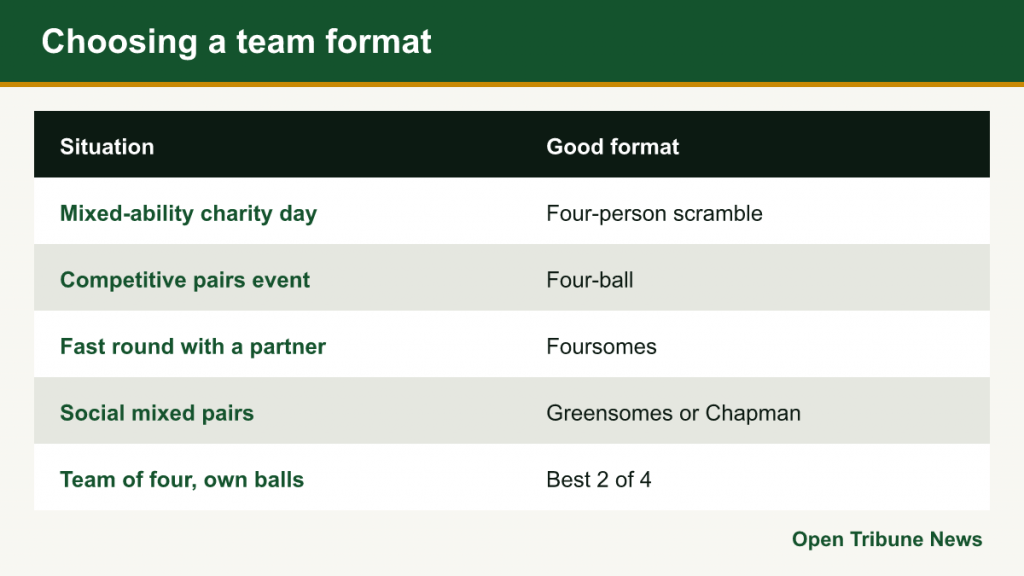
| Situation | Good format | Why |
|---|---|---|
| Charity or corporate day with mixed abilities | Four-person scramble | Fast, inclusive, everyone contributes |
| Competitive pairs event | Four-ball | Everyone plays their own ball; aggressive play rewarded |
| Fast round with a partner | Foursomes | One ball per side means fewer shots and quicker play |
| Social mixed pairs | Greensomes or Chapman | Both players tee off and stay involved |
| Team of four, still individual | Best 2 of 4 | Rewards individual play while keeping a team element |
Practical Tips for Organizers and Players
- Publish the rules in advance. Make clear how drives are chosen, how far a ball may be placed or dropped in a scramble, whether drive minimums apply and how ties are broken.
- Apply allowances to Course Handicap, not Handicap Index, and decide in advance how to round decimals.
- Know the match-play basics. Many team events are match play, and the difference between holes won and strokes counted affects strategy. Our guide to stroke play vs match play explains the scoring.
- Remember the 14-club limit. In partner formats, partners may share clubs as long as the total they have between them is 14 or fewer.
- Agree on pace. Scrambles in particular can be slow if every player putts every ball; many events use ready golf and limit the number of attempts on each putt.
Common Mistakes in Team Events
- Using full handicaps in a scramble. Without allowances, teams of higher handicappers receive far more strokes than the format justifies, and the results become predictable.
- Playing out of turn in foursomes. Forgetting whose turn it is after a penalty drop is a classic error. Remember that penalty strokes do not change the alternating order; the partner who did not play the previous stroke plays next.
- Unclear scorecards in four-ball stroke play. Each gross score must be attributed to the partner who made it. A card that simply lists the better score without identifying the player can lead to disqualification.
- Assuming “best ball” means the same thing everywhere. Clarify whether one, two or more scores count on each hole, and whether scoring is gross, net or Stableford.
- Forgetting that partners can help. In four-ball, a partner may take actions on your ball that you could take, such as marking and lifting it on the green, which can save time when used sensibly.
The right format can turn an ordinary round into a memorable one. Matching the format to the group, and applying fair allowances, keeps the competition close and the day enjoyable for everyone.