How the World Handicap System Works
The World Handicap System explained: Handicap Index, best 8 of 20, Course and Slope Rating, Course vs Playing Handicap, net double bogey and how to get one.
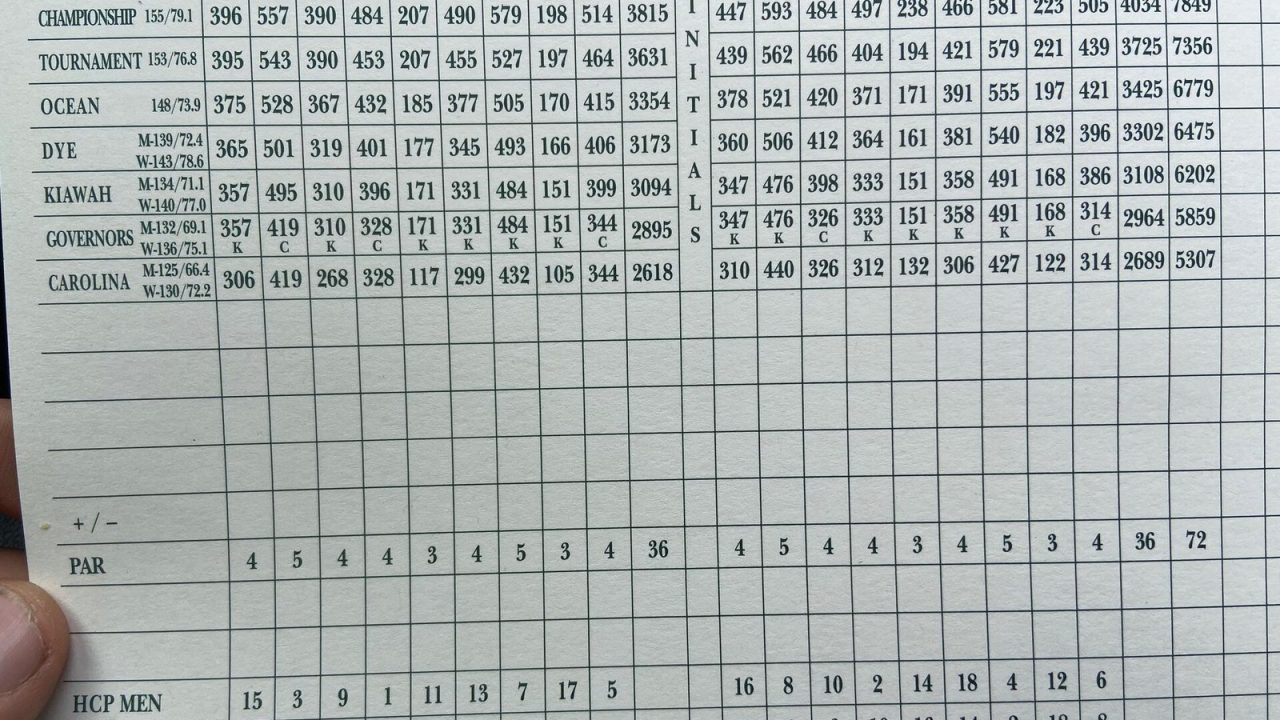
A handicap is what makes golf unusual among sports: it lets a beginner and a scratch player compete on equal terms in the same event. Since 2020, golfers in most of the world have measured their ability with a single framework, the World Handicap System (WHS). It replaced six different systems that had been used in different regions, so a Handicap Index earned in one country now means the same thing in another.
This guide explains the main parts of the system: what your Handicap Index represents, how it is calculated, how course difficulty is built in, how it turns into the strokes you actually receive on the first tee, and what you need to do to get one. Details can differ slightly between national associations, so always check with your own golf club or federation.
Where the WHS came from
The WHS was developed by the USGA and The R&A together with the existing handicapping authorities, including the USGA, the Council of National Golf Unions (CONGU) in Great Britain and Ireland, the European Golf Association, Golf Australia, the South African Golf Association and the Argentine Golf Association. Before 2020, each of these ran its own system, with its own calculations and limits.
The rollout was phased during 2020. The United States, Canada, Mexico, Australia, South Africa and a number of other countries launched in January 2020; others joined during the year, and Great Britain and Ireland switched in November 2020. More than 120 national associations now use the system.
Your Handicap Index: a measure of potential
The core number is your Handicap Index, a figure to one decimal place such as 14.2. It is not your average score. It reflects your demonstrated potential, what you can shoot on a good day, adjusted for the difficulty of the courses where you played.
Under the WHS, your Handicap Index is the average of the best 8 of your most recent 20 score differentials. Older systems in some countries had used the best 10 of 20, or different approaches entirely. The maximum Handicap Index is 54.0 for all golfers, men and women alike, which is higher than the limits in many earlier systems and was set to welcome newer and higher-handicap players into the game.
Indexes are updated frequently, typically daily once scores are posted, so your handicap reacts quickly to your current form.
Course Rating and Slope Rating
Every set of tees on a rated course has two numbers that describe how hard it is.
- Course Rating is the score a scratch golfer is expected to shoot on that course from those tees in normal conditions, for example 71.8. It can be above or below par.
- Slope Rating measures how much harder the course plays for a bogey golfer than for a scratch golfer. It ranges from 55 to 155, and 113 is the standard (average) value. A higher slope means the course is relatively tougher for higher-handicap players.
These ratings are what make a score from a short, easy course comparable with a score from a long, difficult one.
Score differentials: turning a round into a number
Each acceptable score you post is converted into a score differential, which expresses how well you played relative to the difficulty of the course that day. For an 18-hole score, the formula is:
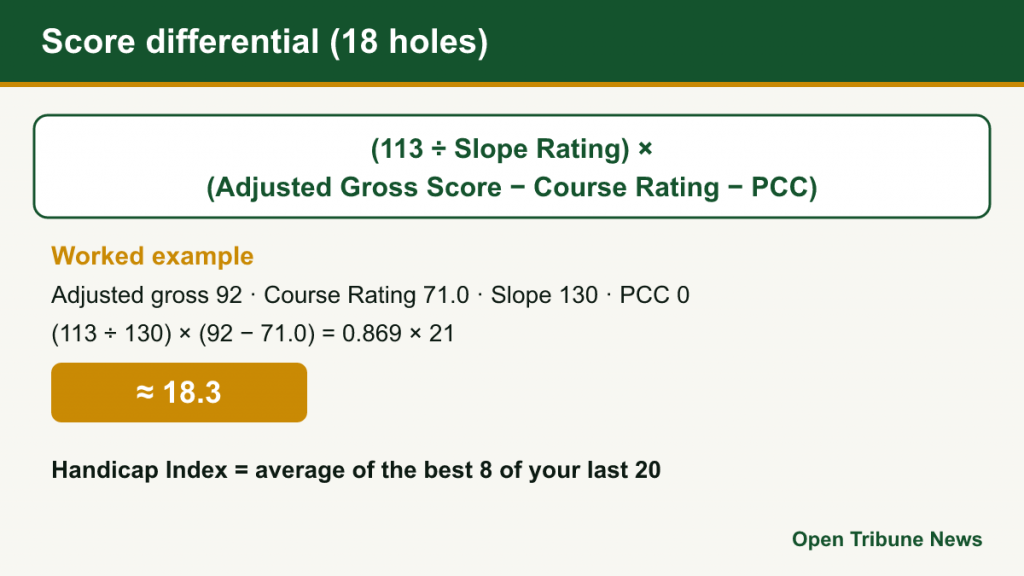
Score Differential = (113 ÷ Slope Rating) × (Adjusted Gross Score − Course Rating − PCC adjustment)
Two parts need explaining:
- Adjusted Gross Score is your score after capping any very bad holes (see net double bogey, below).
- PCC is the Playing Conditions Calculation, an automatic adjustment that accounts for days when weather or course setup made scoring significantly easier or harder than normal. Reported ranges run from -1.0 to +3.0, and on most days the adjustment is zero.
A worked example
You shoot an adjusted gross score of 92 on a course with a Course Rating of 71.0 and a Slope Rating of 130, and the PCC is zero. Your differential is (113 ÷ 130) × (92 − 71.0) = 0.869 × 21 ≈ 18.3. Repeat that for your last 20 rounds, average the best eight, and you have your Handicap Index.
Net double bogey: the hole-score cap
To stop one disastrous hole from distorting your handicap, the WHS limits the score you record on any hole for handicap purposes. The maximum is a net double bogey: par for the hole, plus two, plus any handicap strokes you receive on that hole.
For example, on a par 4 where you receive one handicap stroke, your maximum is 4 + 2 + 1 = 7. If you actually took 9, you record 7 for handicap purposes. In many regions this replaced older systems such as Equitable Stroke Control. It applies only to the score used for handicap calculations, not to the result of a stroke-play competition.
When you are establishing your first handicap and do not yet have a Course Handicap, the cap for each hole is par plus five.
Course Handicap vs Playing Handicap
Your Handicap Index is portable, but on the day you need to know how many strokes you get on the specific course and tees you are playing. That is the Course Handicap:
Course Handicap = Handicap Index × (Slope Rating ÷ 113) + (Course Rating − Par), rounded to the nearest whole number.
Example: a Handicap Index of 14.2 on tees with a Slope of 125, a Course Rating of 70.5 and a par of 72 gives 14.2 × (125 ÷ 113) + (70.5 − 72) = 15.71 − 1.5 = 14.21, so a Course Handicap of 14. On a harder set of tees with a higher slope, the same player would receive more strokes.
The Playing Handicap is what you actually use in a competition. It is your Course Handicap with a handicap allowance applied for the format being played, plus any other adjustments set by the competition terms. Recommended allowances include:
| Format | Recommended allowance |
|---|---|
| Individual stroke play, Stableford, par/bogey | 95% |
| Individual match play | 100% |
| Four-ball stroke play / Stableford | 85% |
| Four-ball match play | 90% |
| Foursomes | 50% of the combined team handicap |
The 95% allowance in individual stroke play exists because, without it, higher-handicap players would be more likely to win large fields. Allowances are applied only in competitions; they do not change the score differential that goes into your record. Some jurisdictions have refined when rounding happens in these calculations, so check how your national body applies them.
Putting it together on the first tee
Imagine two friends playing a singles stroke-play competition from the same tees. Player A has a Handicap Index of 8.4 and Player B has 21.7. The tees have a Slope Rating of 128, a Course Rating of 71.2 and a par of 72.
- Player A’s Course Handicap: 8.4 × (128 ÷ 113) + (71.2 − 72) = 9.52 − 0.8 = 8.72, rounded to 9.
- Player B’s Course Handicap: 21.7 × (128 ÷ 113) − 0.8 = 24.58 − 0.8 = 23.78, rounded to 24.
Applying the 95% stroke-play allowance gives Playing Handicaps of roughly 8 and 23 (depending on the rounding procedure your association uses). If A shoots 82 and B shoots 96, their net scores are about 74 and 73, and B wins narrowly. That is the system working as intended: two golfers fifteen strokes apart in ability having a genuinely close contest.
In a match between the same two players, the allowance is 100%, and the lower player gives the higher player the difference in Course Handicaps, received on the holes ranked hardest by the scorecard’s stroke index.
Safeguards: caps and exceptional scores
The WHS includes mechanisms that keep a Handicap Index realistic over time:
- Soft cap and hard cap: your Index is compared with your lowest Index over the previous 365 days. If it rises more than 3.0 strokes above that low point, further increases are reduced by 50% (soft cap), and it cannot rise more than 5.0 strokes above it in total (hard cap). This limits the effect of a temporary slump.
- Exceptional score reduction: if you post a score that is far better than your Handicap Index, around seven strokes or more, your Index is cut by an extra amount automatically.
- Committee review: handicap committees at clubs can review records and adjust an Index where it does not reflect a player’s ability.
How to get a handicap
The process varies by country, but the general steps are similar:
- Join a golf club or an authorized handicap provider. Handicaps are administered through national associations, so the route in depends on where you live; your local club or golf federation can tell you the options.
- Play and post scores from rated courses, in an acceptable format and under the Rules of Golf. Both 18-hole and 9-hole rounds can count.
- Reach the minimum. The recommended minimum to receive an initial Handicap Index is scores totaling 54 holes, made up of any combination of 9- and 18-hole rounds.
- Keep posting. Your Index becomes more stable as your record fills toward 20 scores.
Rules on which casual rounds are acceptable, including whether rounds played alone count and whether optional local rules such as the alternative to stroke and distance are allowed, vary by jurisdiction. Your national association’s guidance is the final word.
Common misunderstandings
- “My handicap is what I usually shoot over par.” Not quite. Because the Index uses your best 8 of 20 differentials, most golfers score a few strokes worse than their Course Handicap on a typical day. That is by design.
- “I get the same strokes everywhere.” No. Your Course Handicap changes with the Slope Rating, Course Rating and par of the tees you choose.
- “Net double bogey changes my score in a competition.” It does not. It only caps hole scores for handicap posting.
- “Handicaps are only for competitions.” They are equally useful for friendly matches, letting players of different levels enjoy a close game.
If you want to understand how handicap strokes work hole by hole in a match, our guide to stroke play vs match play explains how strokes are allocated by stroke index, and golf scoring explained covers gross and net scores.