Golf Scoring Explained: Par, Birdies, Bogeys and Beyond
How a golf score is counted: strokes, par for a hole and a course, birdies, eagles and bogeys, penalty strokes, and what -4 or E means on a leaderboard.
Golf has one of the simplest scoring ideas in sport: count every stroke it takes to get the ball from the tee into the hole, and the lowest total wins. Yet a first look at a tournament leaderboard can be confusing. Why is one player listed at -7 and another at E? What separates an eagle from an albatross? And how do penalty strokes find their way onto the card? This guide walks through the whole system, from a single stroke on a single hole to a four-round total on a Sunday afternoon.
The basic unit: the stroke
Every score in golf is built from strokes. A stroke is any forward movement of the club made to strike the ball. If you swing and miss completely while trying to hit it, that still counts as a stroke, because you intended to hit the ball. A practice swing that is never meant to strike the ball does not count.
The Rules of Golf, written jointly by The R&A and the USGA, describe the game in one line: a round is played over 18 holes (or fewer) by striking a ball with a club, and each hole starts at the teeing area and ends when the ball is holed on the putting green. Your score for a hole is simply the number of strokes you made, plus any penalty strokes you incurred along the way.
In stroke play, the most common format, Rule 3.3 makes this explicit: the player with the fewest total strokes, including penalty strokes, over all rounds is the winner. That total is called the gross score. When handicaps are applied, the handicap strokes are subtracted to produce a net score.
What par means
Every hole has a par: the number of strokes an expert, or scratch, golfer is expected to need to complete it. Par is set mainly by length, with terrain, elevation and hazards also playing a part. Almost every hole you will ever play is a par 3, par 4 or par 5, and par is built on the assumption of two putts once the ball reaches the green.
- Par 3: a short hole where a good player expects to reach the green with the tee shot and then two-putt.
- Par 4: a tee shot, an approach shot to the green, then two putts.
- Par 5: three shots to reach the green, then two putts. Strong players often try to reach par 5s in two.
USGA guidance links par to yardage. For men, holes under about 260 yards are generally par 3s, par 4s run roughly 240 to 490 yards, and par 5s roughly 450 to 710 yards. The women’s ranges are shorter: par 3s under about 220 yards, par 4s roughly 200 to 420, and par 5s roughly 370 to 600. The ranges overlap on purpose, because a 470-yard hole that plays steeply downhill might be a par 4 while an uphill hole of the same length is a par 5. Par 6 holes exist but are rare.
Add up the par of all 18 holes and you get the par for the course. Most 18-hole courses are par 70, 71 or 72, typically built from a mix of four par 3s, four par 5s and ten par 4s for a par 72, though designers vary the mix freely. A four-round tournament on a par-72 course therefore has a total par of 288.
The names for scores relative to par
Golf’s colorful vocabulary describes how a hole score compares with par. These terms are used whether you are a beginner or a major champion, and they are the language of every broadcast.
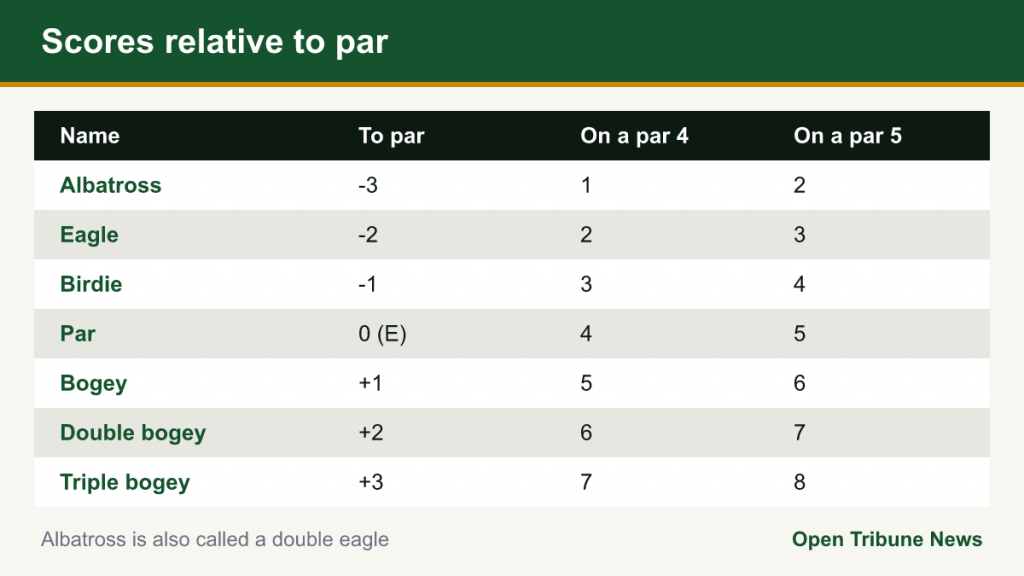
| Name | Relative to par | Example on a par 4 | Example on a par 5 |
|---|---|---|---|
| Condor (very rare, informal) | -4 | Not possible | Hole-in-one |
| Albatross (double eagle) | -3 | Hole-in-one | 2 |
| Eagle | -2 | 2 | 3 |
| Birdie | -1 | 3 | 4 |
| Par | 0 | 4 | 5 |
| Bogey | +1 | 5 | 6 |
| Double bogey | +2 | 6 | 7 |
| Triple bogey | +3 | 7 | 8 |
Beyond triple bogey, golfers usually just say “quadruple bogey” or give the number (“I made an eight”). A hole-in-one, or ace, is its own category: on a par 3 it is also an eagle, on a par 4 an albatross.
The bird theme is simple to remember: the better the score, the bigger and rarer the bird. A birdie is something every regular golfer makes now and then, an eagle is a highlight of the season, and an albatross is a once-in-a-lifetime shot for most players. “Albatross” is the term most used in Britain and much of the world, while “double eagle” is common in the United States; they mean exactly the same thing. “Condor” for four under is informal and so rare that many golfers never hear it used.
Reading a leaderboard: -4, E and +2
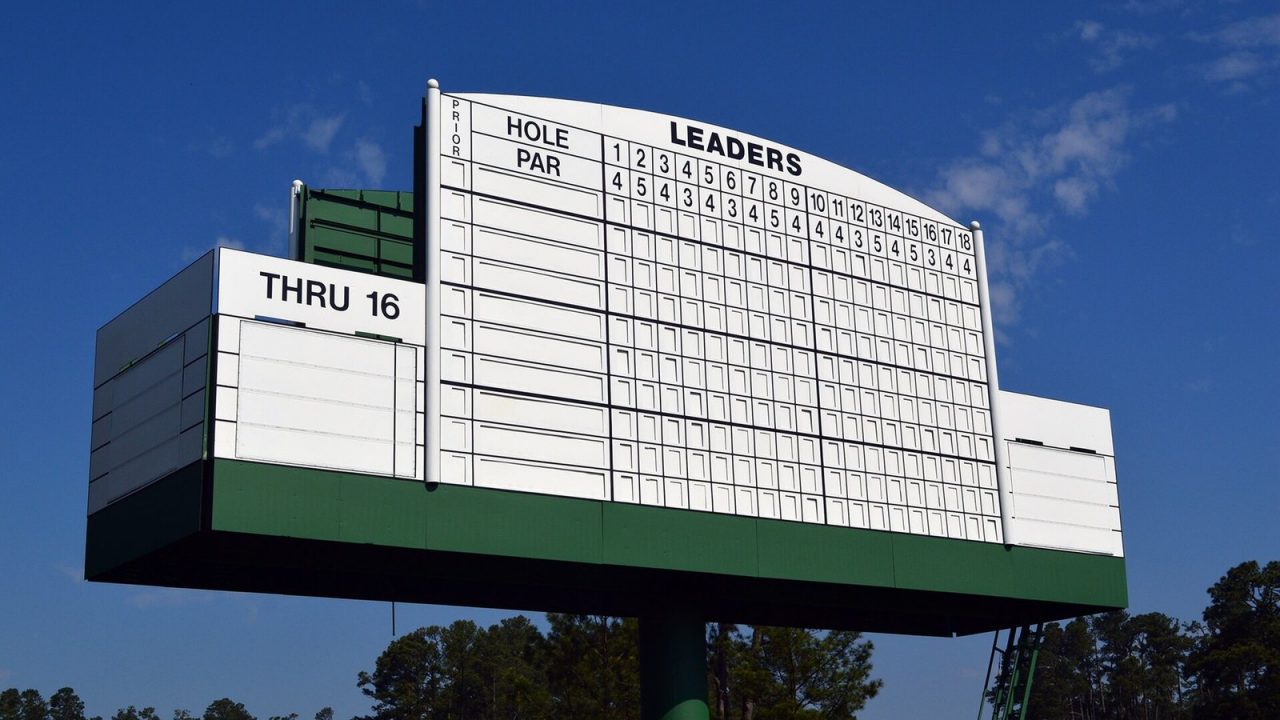
Tournament leaderboards rarely show raw stroke totals first. Instead, they show each player’s score relative to par for the holes they have completed. This makes it possible to compare a player who has finished 18 holes with one who has played only six.
- -4 (often said “four under”) means the player has taken four fewer strokes than par for the holes played.
- E means “even” (in Britain often “level”): exactly at par.
- +2 (“two over”) means two strokes more than par.
Some leaderboards print under-par scores in red and over-par scores in black or blue; it is a convention, not a rule. Next to the to-par figure you will usually see “Thru” (the number of holes completed in the current round, or F for finished) and the score for today’s round.
A worked example
Imagine a player on a par-72 course who shoots 68, 70, 73 and 69. The total is 280 strokes. Par for four rounds is 288, so the player is 8 under par, shown as -8. Round by round, that line reads -4, -2, +1, -3, which also adds up to -8.
Now imagine she is in the middle of round three, has played 11 holes, and has made two birdies and one bogey so far today. For today she is -1, and her tournament total updates in real time to -7 (her -6 from the first two rounds plus -1). That live running figure is what television graphics show.
How penalty strokes are added
Penalty strokes are added to the score for the hole on which they happen. They are not swings; they are strokes added by the Rules. The Rules use three levels of penalty:
- One penalty stroke for certain breaches and for most kinds of penalty relief, such as taking relief from a penalty area or declaring a ball unplayable.
- The general penalty: two penalty strokes in stroke play, or loss of the hole in match play. Hitting a wrong ball or playing from a wrong place are typical examples.
- Disqualification for serious misconduct or breaches that could give a significant advantage.
Here is how the arithmetic works on a par 4. You hit your tee shot out of bounds. Under stroke-and-distance relief you add one penalty stroke and play again from the tee, so your next shot from the tee is your third stroke. Hit that one in play, reach the green with your fourth, two-putt, and you have made a 6, a double bogey. The out-of-bounds swing counted as stroke one, the penalty as stroke two.
A second example: your ball finishes in a red penalty area. You take lateral relief for one penalty stroke and drop. If your ball went in with your second shot, your next stroke after the drop is your fourth. Penalty strokes always count toward the hole score just like a swing would.
Keeping score on a card
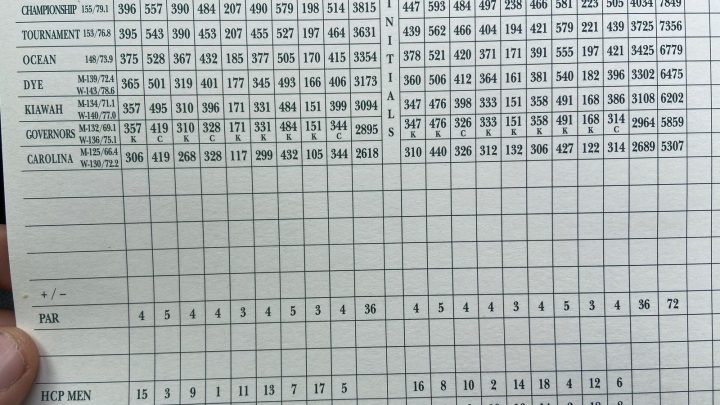
In casual golf, you write your number in the box for each hole and total the front nine (“out”), the back nine (“in”) and the full 18. Many players also track putts, fairways hit and greens in regulation in spare rows.
In a stroke-play competition, the scorecard is a formal document. Under Rule 3.3b, your marker, usually a playing partner, records your score on each hole and certifies the card, and you certify it too and return it to the Committee promptly. You are responsible for the hole-by-hole scores being correct, not for the additions; the Committee handles totals and handicap calculations.
Mistakes are treated strictly. If you return a score for a hole that is higher than you actually made, the higher score stands. If you return a score that is lower, or leave a hole blank, you are disqualified. There is an important exception: if the lower score happened only because you did not know about a penalty, the Committee adds the penalty strokes rather than disqualifying you, unless the penalty was itself disqualification or you were aware a penalty might apply.
Scoring outside standard stroke play
Not every round is about adding up every stroke. A few other systems use the same building blocks in different ways:
- Match play: you win, lose or halve individual holes, so the total number of strokes does not matter. A player can be “3 up” while having taken more strokes overall.
- Stableford: points are awarded per hole based on the score relative to par (net or gross), so one disaster hole costs you only that hole’s points.
- Maximum score: a stroke-play form where your score for a hole is capped at a figure set by the Committee, which keeps pace moving.
- Handicap rounds: net scores let golfers of different abilities compete, and for handicap records a maximum hole score of net double bogey applies.
Each of these deserves its own explanation, but they all depend on understanding the stroke and par first.
Common scoring mistakes beginners make
- Forgetting the whiff. A complete miss is a stroke if you meant to hit the ball.
- Not counting penalty strokes. Lost balls, out of bounds and penalty-area relief each add strokes. Count them as you go, not at the end of the hole.
- Counting a tap-in you did not play. In stroke play competitions you must hole out on every hole; there are no “gimmes.” In casual rounds groups often agree otherwise, but such scores should be recorded honestly.
- Mixing up gross and net. Write the actual number of strokes on the card. Handicap strokes are applied afterward.
- Confusing par with a target. Par is the expert’s standard. For most recreational golfers, bogey golf (about 90 on a par-72 course) is a realistic and respectable goal.
Quick FAQ
Is a hole-in-one on a par 3 an eagle?
Yes. One stroke on a par 3 is two under par, so it is both an ace and an eagle.
Can a course be par 69 or par 73?
Yes. Par for a course is just the sum of its holes. Par 70 and 71 are common at championship venues, and par 73 exists, though less often.
Does the order of scores matter in stroke play?
No. Only the total matters, and ties for a title are decided under the Terms of the Competition, usually by a playoff.
Once you can read a card and a leaderboard fluently, everything else in golf, from handicaps to match play to tournament cut lines, becomes much easier to follow.