Women’s Golf Majors and the LPGA Tour Explained
How the LPGA Tour works, the five women's majors and their history, the season-ending CME Group Tour Championship and the link with the Ladies European Tour.
Women’s professional golf has its own rich structure of tours, majors and season-long races, and it is distinct enough from the men’s game that it deserves its own explainer. The centerpiece is the LPGA Tour, the world’s leading women’s tour, and the five championships it recognizes as majors. Around it sit developmental tours, the Ladies European Tour and team events such as the Solheim Cup.
This guide covers how the LPGA Tour is organized, what each of the five majors is and where it fits in the calendar, how the season reaches its finale, and how players find their way onto the tour. Details are given as of the 2026 season.
The LPGA Tour in Brief
The Ladies Professional Golf Association was founded in 1950 by 13 founding players, succeeding an earlier organization, the Women’s Professional Golf Association, which had ceased operating at the end of 1949. Patty Berg served as its first president. The LPGA is headquartered at LPGA International in Daytona Beach, Florida, and its commissioner, as of 2026, is Craig Kessler.
The tour is genuinely global. Its 2026 schedule contains 33 events, including the five majors, with tournaments in North America, Asia, Europe and the Middle East. Players come from all over the world, and the tour has long had particularly strong representation from South Korea, Japan, Thailand and other Asian nations alongside the United States and Europe.
Like the PGA Tour (see our PGA Tour explainer), most LPGA events are 72-hole stroke-play tournaments, and most full-field events use a 36-hole cut.
The Five Women’s Majors
The men’s game has four majors; the women’s game has five. As of 2026, they are:
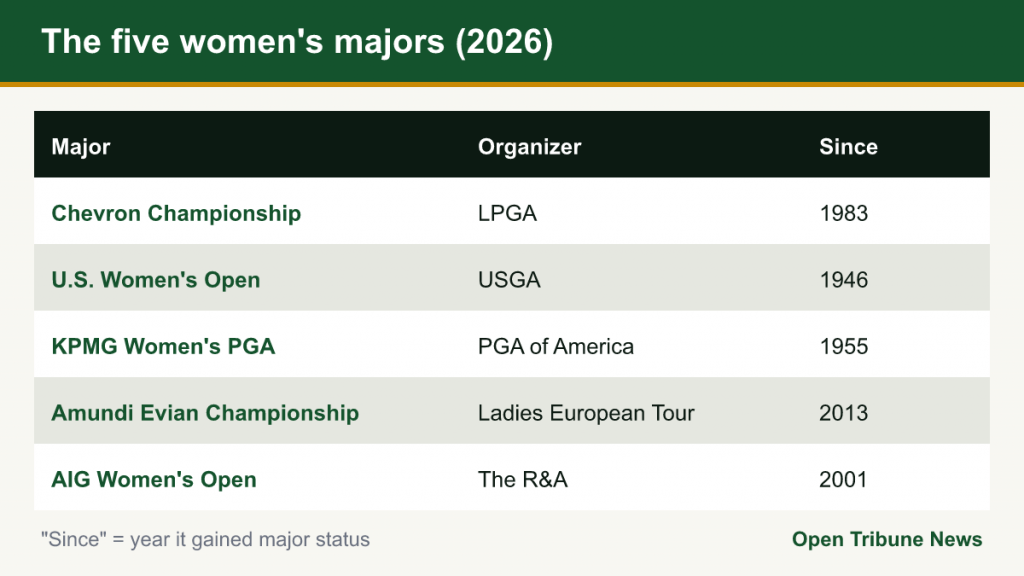
| Major | Organizer | Major status since | 2026 dates |
|---|---|---|---|
| The Chevron Championship | LPGA | 1983 | April 23–26, Memorial Park Golf Course, Houston |
| U.S. Women’s Open | USGA | 1946 | June 4–7, California |
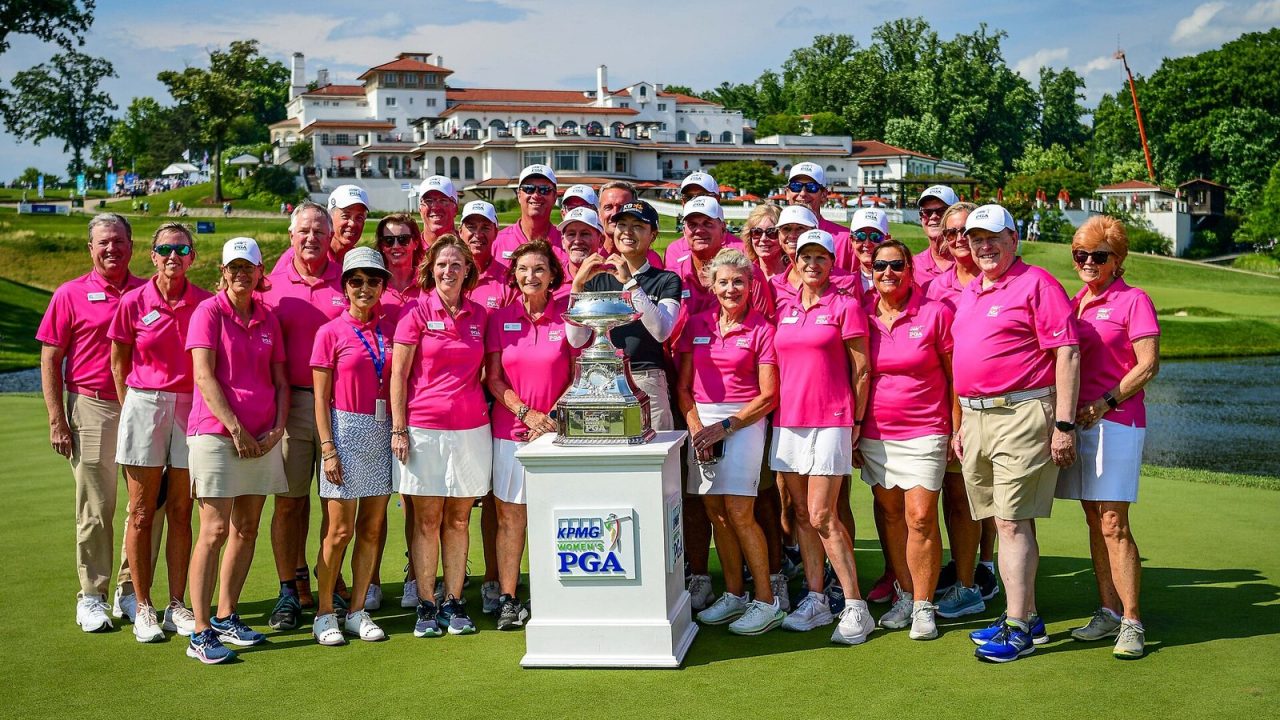
| KPMG Women’s PGA Championship | PGA of America (with the LPGA) | 1955 | June 25–28 |
| The Amundi Evian Championship | Ladies European Tour (co-sanctioned with the LPGA) | 2013 | July 9–12, Évian-les-Bains, France |
| AIG Women’s Open | The R&A | 2001 | July 30–August 2, Royal Lytham & St Annes |
The order can change from year to year. In 2026 the U.S. Women’s Open came before the Women’s PGA, and the Evian and the Women’s Open were played in consecutive summer windows in Europe.
The Chevron Championship
The season’s first major was founded in 1972 by Colgate-Palmolive chairman David Foster and entertainer Dinah Shore, and became a major in 1983, when it was known as the Nabisco Dinah Shore. It was played at Mission Hills Country Club in Rancho Mirage, California, from its inception through 2022. Amy Alcott started the tradition of the winner jumping into the pond beside the 18th green in 1988, and the pond was later named Poppie’s Pond. The event has carried several sponsor names, including the Kraft Nabisco Championship and the ANA Inspiration, before becoming the Chevron Championship in 2022. It moved to The Club at Carlton Woods in The Woodlands, Texas, from 2023 to 2025, and to Houston’s Memorial Park Golf Course in 2026, where a temporary pool was planned for the champion’s jump.
The U.S. Women’s Open
Run by the USGA, the U.S. Women’s Open has been a major since 1946 and is the women’s counterpart of the U.S. Open: a demanding setup, a field that includes qualifiers through open qualifying, and a venue that moves around the United States. It is often regarded as the most prestigious title in the women’s game.
The Women’s PGA Championship
Originally the LPGA Championship, this event has been a major since 1955. In 2015 the PGA of America took over as organizer and the event was renamed the Women’s PGA Championship; it is currently played as the KPMG Women’s PGA Championship. Like the men’s PGA Championship, it tends to visit major championship-caliber parkland courses in the United States.
The Evian Championship
Played on the shores of Lake Geneva in the French Alps, the Evian was formerly known as the Evian Masters. The LPGA announced in 2011 that it would become a major, and it was first played as one in 2013, giving the women’s game its fifth major. As of 2026 it carries the name the Amundi Evian Championship.
The Women’s Open
The Women’s British Open, now the AIG Women’s Open, became a major in 2001, replacing the du Maurier Classic in Canada. The event has been run by The R&A since its merger with the Ladies’ Golf Union in 2016, and it increasingly visits courses from the men’s Open rota, such as Royal Lytham & St Annes in 2026.
How the List of Majors Has Changed
The women’s major list has changed more often than the men’s, which is worth remembering whenever career records are compared across eras.
- Women’s Western Open (1930–1967): counted by the LPGA as a major, even though it predates the LPGA’s 1950 founding.
- Titleholders Championship: played in several spells between 1937 and 1972, also counted as a major.
- du Maurier Classic (1979–2000): a Canadian major that lost its tobacco sponsorship after Canada restricted tobacco advertising; it was replaced by the Women’s British Open in 2001.
- The Evian Championship: added as the fifth major in 2013.
Because the set of majors and their number have shifted, the women’s “career Grand Slam” has meant different things in different decades. The record for most women’s majors belongs to Patty Berg with 15, followed by Mickey Wright with 13; Annika Sörenstam won ten, the most of the modern era of the list.
The Race to the CME Globe and the Season Finale
The LPGA’s season-long points competition is the Race to the CME Globe. Players earn points at official events throughout the year, and the standings determine qualification for the season-ending CME Group Tour Championship. When the race was introduced in 2014, the top 72 in the standings qualified for the finale; the format has been adjusted since, so check the LPGA’s current regulations for the exact field size and points structure.
In 2026 the CME Group Tour Championship is scheduled for November 19–22 at Tiburón Golf Club in Naples, Florida.
Alongside the race, the LPGA presents season awards including:
- Player of the Year, decided on points for top-10 finishes, with points doubled at the majors. Jeeno Thitikul of Thailand won the award in 2025.
- The Vare Trophy, for the lowest scoring average of the season, named after Glenna Collett-Vare. Thitikul also won it in 2025.
- Rookie of the Year, for the best first-year member.
How Players Reach the LPGA Tour
There are two main routes onto the LPGA Tour:
- The Epson Tour. Owned by the LPGA, this is its official developmental tour. Players at the top of the season-long standings earn LPGA playing privileges for the following year.
- LPGA Qualifying School. Held annually in stages, with the final stage determining who earns full or partial status for the next season.
Winning an LPGA event as a non-member, typically via a sponsor invitation or qualifying, can also earn membership. Many international players build their careers on other strong tours first, notably the Ladies European Tour, the Japan LPGA and the Korea LPGA, before moving to the LPGA.
The Ladies European Tour and the Solheim Cup
The Ladies European Tour (LET) is Europe’s main women’s tour. As of 2025 it co-sanctions three events with the LPGA: the Women’s Open, the Evian Championship and the Women’s Scottish Open. That gives European-based players direct access to some of the biggest events in the women’s game and creates a natural pathway between the tours.
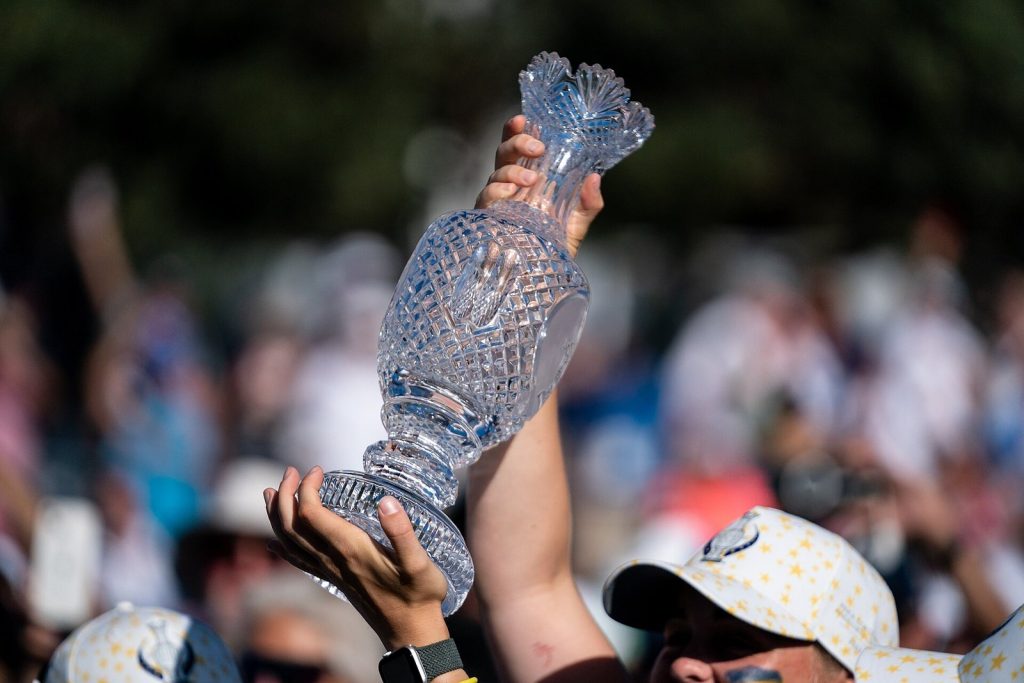
The most visible link between the two sides of the Atlantic is the Solheim Cup, a biennial team match between the United States and Europe, broadly comparable to the men’s Ryder Cup. The 2026 Solheim Cup is scheduled for September 11–13 at Bernardus in the Netherlands, with Anna Nordqvist captaining Europe.
Common Misunderstandings
- “The women’s majors are just the men’s majors for women.” Only partly. The U.S. Women’s Open and the Women’s Open are run by the same governing bodies as their men’s counterparts, and the Women’s PGA is run by the PGA of America, but the Chevron and the Evian have no direct men’s equivalent, and there is no women’s version of the Masters among the majors.
- “There have always been five.” No. The fifth major was added in 2013, and the list itself has been rebuilt several times since the 1930s.
- “The Ladies European Tour is a feeder tour.” It is a full professional tour in its own right, with its own members, schedule and season-long rankings; it simply shares some of the biggest events with the LPGA.
- “Ranking points and Race points are the same thing.” They are separate systems. The Rolex Rankings measure performance worldwide over a rolling period, while the Race to the CME Globe tracks LPGA results in the current season only.
How to Follow the Women’s Game
A few tips for new fans:
- Learn the major calendar. The majors are spread from April to August, so there is a big championship almost every month of the main season.
- Watch the Rolex Rankings. Officially the Women’s World Golf Rankings, introduced in February 2006, they are used to allocate places in some events, including the Women’s Open, and in Solheim Cup team selection.
- Follow both tours. Many top players compete on the LPGA and LET, and the co-sanctioned events in Europe each summer are a highlight.
- Use the official sources. The LPGA’s site carries schedules, leaderboards and the Race to the CME Globe standings; the USGA and The R&A publish details for their championships.
Understanding the five majors, the season-long race and the pathways between tours turns a crowded schedule into a coherent story that builds from spring in Texas to the finale in Florida each November.