The PGA Tour Explained: Season Structure, FedExCup and Playoffs
How the PGA Tour season works as of 2026: regular and signature events, the FedExCup points race, the three-event playoffs and how players keep their cards.
The PGA Tour runs the most prominent men’s professional golf schedule in the world, with tournaments nearly every week from January to the late summer and a shorter fall stretch afterward. Following it is much easier once you understand the structure behind the weekly events: a season-long points race called the FedExCup, a set of elevated “signature events,” three playoff tournaments and a system of status categories that decides who gets to play where.
This guide explains how the season fits together as of the 2026 season. The Tour adjusts its formats regularly, so details below are phrased for the current setup.
The shape of the season
The season runs on a calendar-year basis, beginning in January. It falls into three broad phases:
- The regular season, from January to August, including the full-field weekly events, the signature events, The Players Championship and the four major championships (which the Tour does not run but which award FedExCup points).
- The FedExCup Playoffs, three events in August that decide the season champion.
- The FedExCup Fall, a series of events after the playoffs in which players outside the top of the standings compete for status and access for the following year.
Within the regular season, not every event is equal. Fields, prize money and FedExCup points vary according to the tier of the tournament.
The FedExCup: a season-long points race
The FedExCup was introduced in 2007 as the first playoff system in men’s professional golf, and Tiger Woods won the inaugural title. The idea is simple: players earn points at every official event based on where they finish, with the most points going to winners and to the biggest events. The points list, often called the standings, decides who qualifies for the playoffs and, eventually, who is crowned champion.
The points available depend on the event. Signature events award 700 points to the winner as of 2026, and the majors and The Players carry high point values too, while standard full-field events award fewer. Opposite-field events, played the same week as a bigger tournament, carry reduced points. Points also run deep into the field, so consistently making cuts adds up even without wins.
The FedExCup standings are about more than the trophy. Your position on the list determines your access to signature events the following year, your exempt status and even your place in the playoffs, which is why players chase points all year long.
Signature events
Signature events are the Tour’s elevated regular-season tournaments, designed to bring the top players together more often. As of 2026 there are eight, each with a $20 million purse and 700 FedExCup points for the winner. Because The Sentry is not being contested in 2026, the AT&T Pebble Beach Pro-Am is the season’s first signature event.
Two formats
- Player-hosted events, namely the Genesis Invitational, the Arnold Palmer Invitational and the Memorial Tournament, have a 36-hole cut to the top 50 and ties plus anyone within 10 shots of the lead.
- The other signature events have smaller fields and no cut, so every player competes for four rounds.
Who gets in
Signature event fields are built in a priority order, broadly:
- The top 50 from the previous season’s FedExCup standings.
- The Aon Next 10: the top 10 players in the current FedExCup standings not otherwise eligible.
- The Aon Swing 5: the top five points earners in the events between signature events who are not already exempt.
- Winners of full-points PGA Tour events during the current season.
- PGA Tour members inside the top 30 of the Official World Golf Ranking who are not otherwise eligible.
- A small number of sponsor exemptions.
The Aon Next 10 and Swing 5 categories exist to give players who start hot during the year a path into the biggest events, so the fields are not locked solely by last season’s results.
The FedExCup Playoffs
At the end of the regular season, the standings are cut down over three events in August:
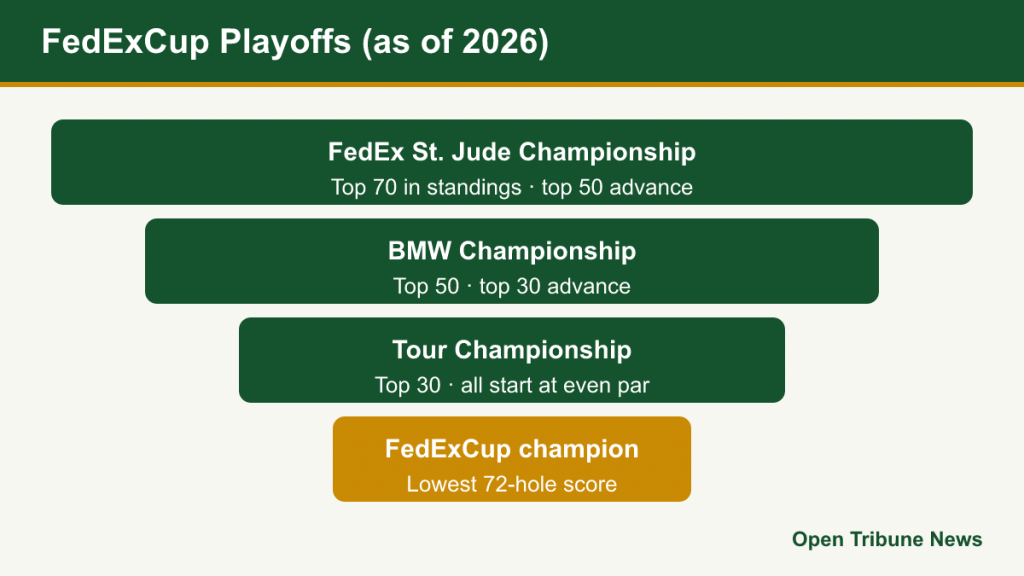
| Event | Field (as of 2026) | Purpose |
|---|---|---|
| FedEx St. Jude Championship | Top 70 in the standings | Playoff points; top 50 advance |
| BMW Championship | Top 50 | Playoff points; top 30 advance |
| Tour Championship | Top 30 | Decides the FedExCup champion |
The first two playoff events award boosted points, so a strong week can move a player sharply up the list. Finishing inside the top 50 after the regular season and playoffs has a further reward: it is the main route into the following season’s signature events.
The Tour Championship
The season finale is played over 72 holes of stroke play, and the winner is the FedExCup champion. For several seasons from 2019, the Tour used “Starting Strokes,” in which the points leader began the week at 10 under par and the rest of the field started on a sliding scale down to even par. As of 2026, that system is gone: all 30 players start at even par, and the lowest 72-hole score wins both the tournament and the FedExCup. The change made the finale easier for viewers to follow, since the leaderboard shows actual scores.
Rory McIlroy holds the record for most FedExCup titles, with three.
The FedExCup Fall
After the Tour Championship, the season continues with the FedExCup Fall, a run of full-field events for players who are not in the top 50. These events matter for two reasons:
- Keeping a card. The final standings after the Fall decide who is fully exempt for the next season. As of 2026, that is the top 100.
- Earning signature event access. Players ranked from 51 down can still play their way into some of the early signature events of the following season.
For a player hovering around 100th, the fall events can be the most important weeks of the year.
Membership and status
Being a PGA Tour member does not mean you can play every event. Each player has a status category, and fields are filled in priority order. Key categories, as of 2026:
- Top 100 in the FedExCup: fully exempt for the next season, with access to full-field events and a spot in The Players Championship. This was reduced from the top 125 for the 2026 season.
- Nos. 101 to 125: conditional status, which brings fewer starts.
- Tournament winners: victories bring multi-season exemptions, with longer exemptions for the biggest titles.
How new players earn cards
- Korn Ferry Tour: the Tour’s developmental circuit. As of 2026, 20 PGA Tour cards are awarded after each Korn Ferry Tour season.
- DP World Tour: under the strategic alliance between the tours, 10 PGA Tour cards go to the leading players in the Race to Dubai who do not already hold PGA Tour status.
- Q-School: the top five finishers at the Final Stage earn PGA Tour membership; others earn Korn Ferry Tour status.
- Special Temporary Membership: non-members who earn enough FedExCup points through starts (for example via sponsor invitations) to match No. 150 on the previous season’s standings can become special temporary members.
- Monday qualifying: several events offer a few spots through an 18-hole qualifier, a classic long-shot route.
How the majors fit in
The four majors are run by Augusta National, the PGA of America, the USGA and The R&A, not by the PGA Tour, but they count as official events with high FedExCup points. They sit in the regular season, between April and July, and their invitation criteria are set by each organizer. Our guide to the four men’s major championships covers how each one works.
The Players Championship, the Tour’s flagship event, sits in March. It is not a major, but its strong field and status make it one of the most important weeks of the season, and top-100 status guarantees a place in it.
Quick answers to common questions
Is the PGA Tour the same as the PGA of America?
No. The PGA Tour is the organization that runs the tour for touring professionals. The PGA of America is a separate association of club and teaching professionals, and it organizes the PGA Championship and the U.S. side of the Ryder Cup.
Do signature events count more than regular events?
For points and prize money, yes. A signature event win is worth more FedExCup points than a standard full-field event win, and the purses are larger. A win at any full-points event still brings valuable exemptions, including entry to the following signature events of that season.
Why does a player outside the top 70 still play in August?
Players who miss the playoffs move on to the FedExCup Fall, where they can still improve their standing, secure a top-100 finish and keep full status for the next year.
Can a player win the FedExCup without winning a tournament?
Since the Tour Championship now starts everyone at even par and its winner takes the FedExCup, the champion is by definition a tournament winner.
Following a season: what to watch
- The top 50 line after the BMW Championship, because it controls next year’s signature event access.
- The Aon Next 10 and Swing 5 during the spring, as in-form players try to break into elevated events.
- The playoff bubble at No. 70 heading into the final regular-season event.
- The No. 100 line during the FedExCup Fall, where cards are won and lost.
- The Tour Championship leaderboard, now a straightforward 72-hole race among the top 30.
Every weekly event is still a normal 72-hole stroke-play tournament, so reading a leaderboard works exactly as described in our guide to golf scoring. The season-long structure simply adds a second story underneath: where each result leaves a player in the race.