How the Official World Golf Ranking Works
How OWGR points are earned, the two-year window and divisor, the 2022 Strokes Gained-based method, LIV Golf's 2026 status and why rankings matter.

Every Monday, a new list sorts the world’s men’s professional golfers from No. 1 to several thousand. The Official World Golf Ranking (OWGR) looks like a simple league table, but behind it sits a complex system that has to compare results from dozens of tours on several continents, played by fields of very different strength. The ranking matters a great deal: it opens the gates to majors and other elite events, and it shapes how the public judges who is the best player in the world.
This guide explains where the ranking came from, how points are calculated under the current method, how the rolling two-year window and the divisor work, and why a player’s number can change even in a week he does not play. Details are given as of 2026.
A Short History of the World Ranking
The first official list was published just before the 1986 Masters. It was initially known as the Sony Ranking, after its sponsor, and was renamed the Official World Golf Ranking in 1997. The initiative came from The R&A’s Championship Committee, and the system grew out of the unofficial world rankings that sports agent Mark McCormack had published from 1968 to 1985. McCormack became the first chairman of the ranking’s International Advisory Committee.
Today the ranking is run by a UK company limited by guarantee, governed by a board with a chairman and directors drawn from its member organizations, which include the governing bodies of the majors and leading professional tours. The number of tours whose events earn points grew from six when the ranking began to 23 by the time the 2022 changes were announced.
The Basic Formula: Points Divided by Events
At its core, a player’s world ranking is an average:
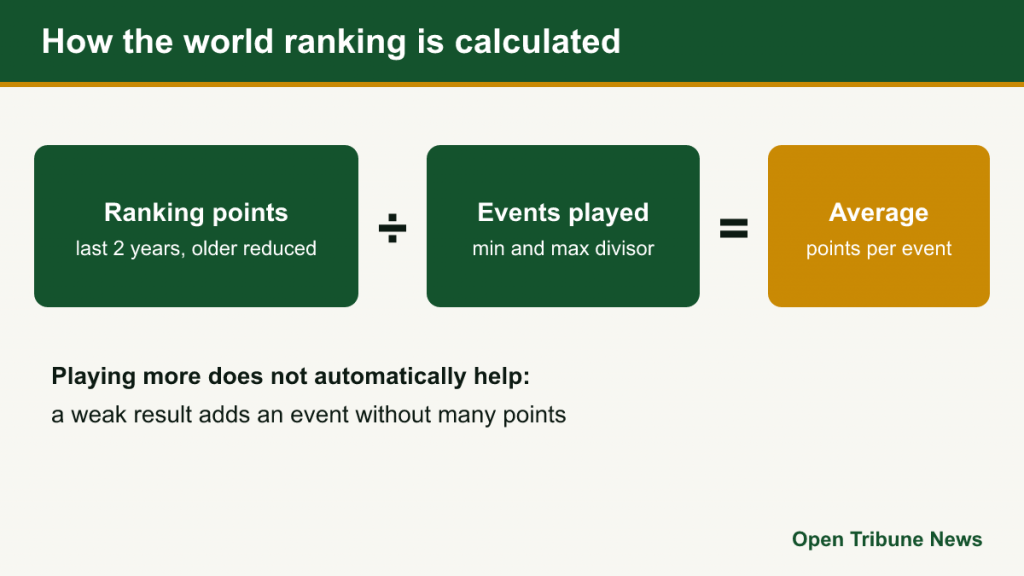
- Each eligible tournament awards ranking points to players based on where they finish and how strong the field was.
- All points earned over the previous two years are added together, after reducing older points (more on that below).
- The total is divided by the number of events the player has played in that period, subject to a minimum and a maximum.
The result is the player’s average points per event, and that average determines his position on the list. Because it is an average rather than a running total, playing more often does not automatically help; a weak result adds an event to the divisor without adding many points.
The Two-Year Window and Weighting
The ranking uses a rolling period of roughly two years, or 104 weeks. To reward current form, points do not keep their full value for the whole period:
- Points earned in the most recent 13 weeks count in full.
- After that, their value is reduced in equal weekly steps (by 1/92 of the original value each week) over the remainder of the two-year period.
- In week 104 a result is worth only about 1 percent of its original value, and it drops out of the calculation entirely after that.
This explains a common source of confusion: a player can move up or down the ranking in a week when he does not tee it up. As his own older points lose value, and as rivals earn or lose points, the averages shift. A player who won a big event about three months earlier will start to see that win gradually decline in value even if he is playing well.
The Minimum and Maximum Divisor
The divisor is the number of events used to calculate the average, and it is limited at both ends:
- Minimum of 40 events. A player who has played fewer than 40 events in the two-year period is still divided by 40. This prevents someone with a single great week from shooting to the top of the list on a tiny sample.
- Maximum of 52 events. For a player who has played more than 52 events in two years, only the 52 most recent count toward the divisor. This avoids penalizing players with very busy schedules too heavily.
The minimum divisor is particularly relevant to young players turning professional, players returning from long injuries, and those who play limited schedules, because their averages are diluted until they accumulate enough starts.
How Tournaments Earn Points: The 2022 Method
The biggest change in the ranking’s history took effect in August 2022, after three years of analysis and consultation with the governing bodies and tours. The new method applies to tournaments from the week beginning August 8, 2022, and older events were not recalculated, so its effects phased in gradually as the two-year window rolled forward.
The modern system has three linked ideas:
Strokes Gained World Rating
Every player has a Strokes Gained World Rating (SGWR), calculated from his actual stroke-play scores over a rolling two-year period, adjusted for how difficult each round was relative to the rest of the field. Like the ranking itself, it is weighted toward recent rounds. In simple terms, it measures how many strokes better or worse than a baseline a player tends to score.
Performance Points and Field Rating
A player’s SGWR determines the Performance Points he brings into a tournament. Add up the Performance Points of every player in the field and you get the Field Rating. The Field Rating replaced the old “strength of field” calculation, which had looked mainly at how many top-ranked players entered, and it is evaluated using every player in the field rather than only the world’s top 200.
Ranking points on offer
The Field Rating determines how many ranking points are available at an event and how they are distributed down the leaderboard. Under the 2022 announcement, every player who makes the cut receives ranking points. Some events received fixed values: the winner of a major receives 100 points, and the winner of The Players Championship receives 80. At the same time, the built-in minimum point values that some other “flagship” events used to enjoy were removed, so those tournaments now earn points according to the strength of their actual field.
The stated reason for the overhaul was to remove the bias created by assigned values such as tour minimums, which had led to some performances being over- or undervalued.
Why the Ranking Matters So Much
World ranking positions are used throughout the professional game as an objective, worldwide measure of form. The most important uses are:

- Major championship exemptions. The top 50 in the ranking at set cut-off dates have long been a key exemption category for the Masters and The Open, and the U.S. Open has used a top-60 category. The PGA Championship has no single fixed ranking exemption but has traditionally invited players inside the top 100. Our guide to the majors explains how qualifying works more broadly.
- Elite events. The Players Championship has used a top-50 category, and many other invitational events use ranking positions to fill or rank their fields.
- Selection and seeding. Because it is an independent, worldwide measure, the ranking is a common reference point for team selection debates, invitations and tournament seedings.
- Prestige. Weeks at world No. 1 are one of the measures historians use to compare great players across eras. Scottie Scheffler finished 2023, 2024 and 2025 as the year-end No. 1.
Because so many doors open at specific cut-off dates, the race to get inside the top 50 before the Masters invitation deadline is one of the most closely watched storylines of the early season.
Which Tours Earn Points?
To be eligible, a tour has to meet OWGR’s eligibility standards, which cover areas such as minimum field size (75 players under the current regulations), meritocratic entry pathways and the use of cuts. Recognized tours range from the PGA Tour and the DP World Tour, which usually offer the most points week to week, to regional and developmental tours around the world; the OWGR’s list of tours has continued to grow, with additions such as the Clutch Pro Tour and the Tartan Pro Tour in 2024. Every eligible tournament has its points determined by the same Field Rating method, which is how the ranking can compare a win in Asia with a top-10 in Florida.
For how the main U.S. circuit fits into this picture, see our explainer on the PGA Tour season and the FedExCup.
LIV Golf and the Ranking in 2026
LIV Golf launched in 2022 and applied for world ranking recognition, which was a long-running point of contention. On February 3, 2026, the OWGR Governing Board announced that LIV Golf events would earn world ranking points for the 2026 season, with immediate effect, but on a restricted basis:
- Only the top 10 finishers and ties in LIV’s individual stroke-play competition receive points.
- Points that would have gone to players finishing lower are not redistributed to those inside the top 10.
- LIV events are classified as “Small Field Tournaments” with a ranking points distribution cutoff.
The board explained that LIV did not meet OWGR eligibility standards in several areas. Its average 2026 field of 57 players is well below the OWGR minimum of 75; its events have no cuts; and the board cited restrictive entry pathways and players being recruited rather than earning places. The board said it would keep evaluating LIV against its standards, and that points could increase, decrease or be withdrawn in future seasons depending on changes LIV makes.
Common Misconceptions
- “Winning more money means a higher ranking.” The ranking ignores prize money entirely; only finishing positions and field strength matter.
- “All wins are worth the same.” A win against a strong field earns far more points than a win in a weak one.
- “Rankings only change when you play.” The weekly decline of older points and other players’ results move everyone every week.
- “Playing every week helps your ranking.” Only if you play well. Extra events increase the divisor, up to the maximum of 52.
Understanding these mechanics makes the Monday ranking far more meaningful: it is a carefully weighted, two-year average of performance, adjusted for the quality of the opposition, and it is the closest thing men’s golf has to an official answer to the question of who is best.