Parts of a Golf Course Explained: Tee to Green
A hole-by-hole tour of a golf course: teeing areas, fairways, rough, bunkers, penalty areas, the green and how the Rules of Golf divide it all up.

Every golf hole tells the same basic story. You start in a small prepared area, move the ball along a mown corridor while avoiding sand, water and long grass, and finish by rolling it into a cup on a smooth putting surface. The scenery changes from course to course, but the building blocks are remarkably consistent.
This guide walks from the tee to the hole, explaining what each part of a course is, how it tends to affect play and, where it matters, how the Rules of Golf treat it. If you are brand new to the game, it pairs well with our walkthrough of how a round of golf works.
The Five Areas of the Course in the Rules of Golf
Golfers use dozens of informal words for parts of a course: fairway, rough, apron, collar, first cut, waste area. The Rules of Golf, written jointly by The R&A and the USGA, keep things much simpler. Rule 2 says there are exactly five areas of the course:
- The general area – everything on the course that is not one of the four specific areas below. Fairway, rough, trees, paths and most of what you walk across are all “general area.”
- The teeing area of the hole you are playing.
- Penalty areas – bodies of water and other areas the Committee marks as penalty areas.
- Bunkers – specially prepared areas of sand.
- The putting green of the hole you are playing.
Why does this matter? Because the rule that applies to your ball depends on the area it lies in. A ball in a bunker or a penalty area has different relief options from a ball in the general area, and some actions that are fine on the green (such as marking, lifting and cleaning the ball) are not allowed elsewhere. Rule 2.2c also settles borderline cases: a ball is always treated as lying in only one area. If it touches both the general area and a specific area, it is treated as being in the specific area; if it touches two specific areas, the order of priority is penalty area, then bunker, then putting green.
Anything outside the boundaries the Committee sets is out of bounds, which is not part of the course at all.
The Teeing Area: Where Every Hole Begins
Each hole starts from a teeing area, often still called the “tee box” or simply “the tee.” Most holes have several sets of tee-markers at different distances from the green so that players of different lengths can enjoy the same hole. Scorecards list the yardage from each set, and the markers are usually color-coded, though the colors and names vary from club to club.

Under the Rules, the teeing area is a rectangle defined by two tee-markers: its front edge is a line between the forward-most points of the markers, and it extends two club-lengths back from there. Rule 6.2 explains that a ball is in the teeing area when any part of it touches or is above any part of that rectangle. You may stand outside the teeing area to play, as long as the ball is inside it.
Two other teeing details trip up beginners:
- You may play from a tee peg or straight off the ground, but only within the teeing area of the hole you are starting.
- Playing from outside the teeing area costs the general penalty (two strokes) in stroke play, and you must correct the mistake by playing from inside it. In match play there is no penalty, but your opponent may cancel the stroke and make you replay it.
Tee-markers are placed by the Committee, and moving them to improve your position before playing from the teeing area also costs the general penalty.
Fairway and Rough: The General Area
Between tee and green lies the bulk of the hole. The fairway is the strip of short, evenly cut grass that offers the best lies; the ball sits up, and the club can make clean contact.
On either side sits the rough, grass that is allowed to grow longer and often coarser. Many courses use a graduated cut: a narrow “first cut” just off the fairway, then longer grass farther out. Long rough grabs the club and makes distance harder to judge.Championship setups take this to extremes; at U.S. Opens, rough several inches deep is a long-standing feature of the event’s reputation for difficulty.
From a Rules point of view, fairway and rough are the same thing: both are part of the general area. There is no special rule for the fairway, and your relief options for an unplayable lie, an abnormal course condition or an embedded ball are those for the general area. (The embedded-ball rule does allow Committees to limit relief to areas cut to fairway height or less, which is one place where the mowing height matters.)
Bunkers: Sand by Design
A bunker is a specially prepared area of sand, usually a hollow from which turf or soil has been removed. Fairway bunkers catch drives and long approaches; greenside bunkers guard the putting surface. Some are shallow and forgiving; others have steep faces, revetted walls of stacked turf, or lips that demand a very high shot.
Bunkers are one of the four specific areas, and Rule 12 governs them. The key restrictions are that you must not deliberately touch the sand with your hand, club or rake to test its condition, and you must not touch the sand with your club right in front of or behind the ball, in a practice swing or in your backswing. You may remove loose impediments (such as leaves and stones) and movable obstructions (such as a rake).
It helps to know what is not part of a bunker. A grass-covered lip or face, a wall of stacked turf, and sand that has spilled outside the prepared edge are not part of the bunker. Large natural sandy areas on some courses, often called waste areas, are generally treated as general area rather than bunkers unless the Committee says otherwise.
Penalty Areas: Water and Beyond
Ponds, lakes, streams, ditches and other areas the Committee chooses to mark become penalty areas, governed by Rule 17. They are marked with red or yellow stakes or lines, and the color matters:
| Marking | Relief options (each costs one penalty stroke) |
|---|---|
| Yellow | Stroke-and-distance (play again from where you last played) or back-on-the-line relief, keeping the point where the ball last crossed the edge between the hole and where you drop |
| Red | Both yellow options, plus lateral relief within two club-lengths of where the ball last crossed the edge, not nearer the hole |
You are also allowed to play the ball as it lies in a penalty area without penalty, if you can reach it and think it is worth the risk. Penalty areas do not have to contain water: a Committee can mark desert, jungle, lava rock or steep ravines as penalty areas, which speeds up play compared with sending players back under stroke and distance. Our guide to penalty areas, out of bounds and lost balls walks through each option in detail.
The Putting Green, Fringe, Flagstick and Hole
The putting green is the area of very closely mown grass prepared specially for putting. Greens vary enormously in size, shape and contour: some are almost flat, others have tiers, ridges and false fronts that throw weak approach shots back down the slope.
Around most greens is a ring of slightly longer grass known as the fringe, collar or apron. It is cut between green height and fairway height and slows balls that run off the putting surface. This is a common source of confusion: in the Rules, the fringe is not part of the putting green. A ball resting on the fringe is in the general area, so you may not mark, lift and clean it as you would on the green.
On the green, Rule 13 gives you extra freedoms. You may mark, lift and clean your ball, and you may repair almost any damage on the green, including pitch marks and spike marks, though not natural surface imperfections such as aeration holes in their normal state.
The hole itself is 4¼ inches (108 mm) in diameter and must be at least 4 inches deep. The flagstick sits in it so the hole can be seen from a distance. Since the 2019 rules modernization, you may putt with the flagstick left in the hole with no penalty if the ball hits it, or have it removed or attended, as you prefer.
Par 3, Par 4 and Par 5 Holes
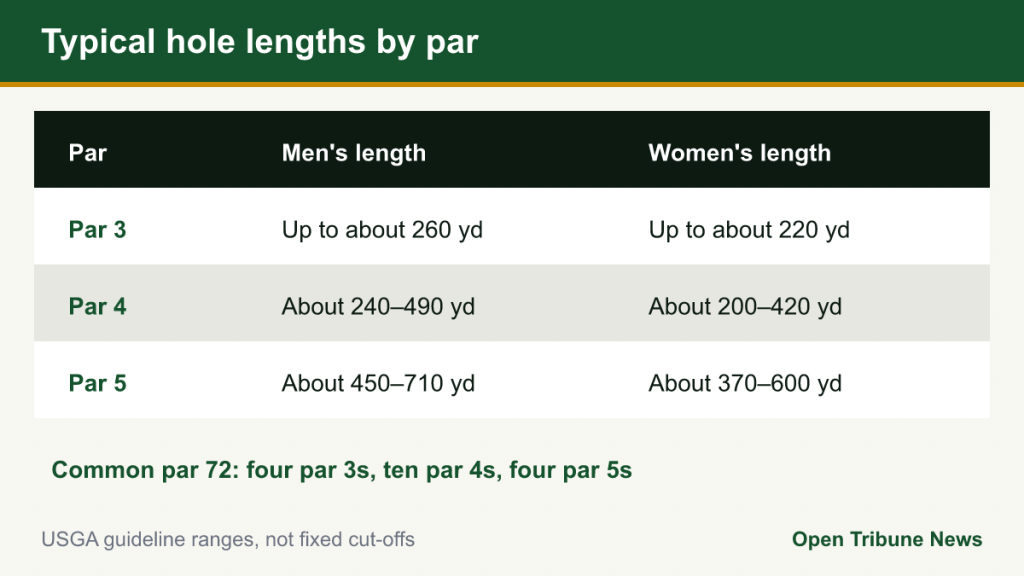
Every hole has a par, the score an expert player is expected to make. Par is based mainly on length, with adjustments for terrain, elevation and the way the hole plays. The USGA’s guidelines for typical lengths, as summarized in the reference sources, are broad ranges rather than fixed cut-offs:
| Par | Typical men’s length | Typical women’s length |
|---|---|---|
| 3 | Up to about 260 yards | Up to about 220 yards |
| 4 | About 240–490 yards | About 200–420 yards |
| 5 | About 450–710 yards | About 370–600 yards |
The overlaps are deliberate: a short, uphill par 5 and a long par 4 can be similar lengths, and the designer chooses par based on how the hole is meant to play.
Par 3s are reachable with one shot from the tee, so the teeing area often faces the green directly, frequently over water or bunkers. Precision and correct club selection matter most. Par 4s are the backbone of most courses; the drive sets up the approach, and designers use doglegs, bunkers and fairway angles to create choices about how aggressive to be from the tee. Par 5s are three-shot holes for most golfers, but longer hitters may try to reach them in two. They often feature layup areas, cross-hazards and greens defended to punish an ambitious second shot.
A standard 18-hole course typically has a total par between the high 60s and low 70s, with par 72 (often four par 3s, ten par 4s and four par 5s) a common configuration. For more on how par turns into a score, see golf scoring explained.
Yardage Markers and Other Course Furniture
Most courses build distance information into the layout. Common examples include:
- Distance posts or plates in the fairway or rough, often marking 200, 150 and 100 yards. Many clubs use a consistent color code, but conventions differ between countries and courses, so check the scorecard or ask in the pro shop.
- Sprinkler-head yardages, numbers stamped on irrigation heads.
- Measuring point: courses usually measure to the front or the center of the green. Again, the scorecard or local information should tell you which.
- Pin-position indicators, such as a colored flag or a marker on the flagstick showing whether the hole is cut at the front, middle or back of the green.
Other items you will meet include ball washers, benches, directional signs, cart paths and out-of-bounds stakes (commonly white). In Rules terms, artificial objects such as cart paths, signs and sprinkler heads are obstructions, while boundary stakes and walls defining out of bounds are boundary objects, which give no free relief.
Learning these terms takes a round or two, and it pays off quickly. Once you can identify which of the five areas your ball is in, the right rule, and usually the best shot, becomes much easier to find.