Penalty Areas, Out of Bounds and Lost Balls: Your Relief Options
Red and yellow penalty areas, stroke-and-distance for out of bounds and lost balls, the provisional ball and the optional Local Rule E-5, explained clearly.
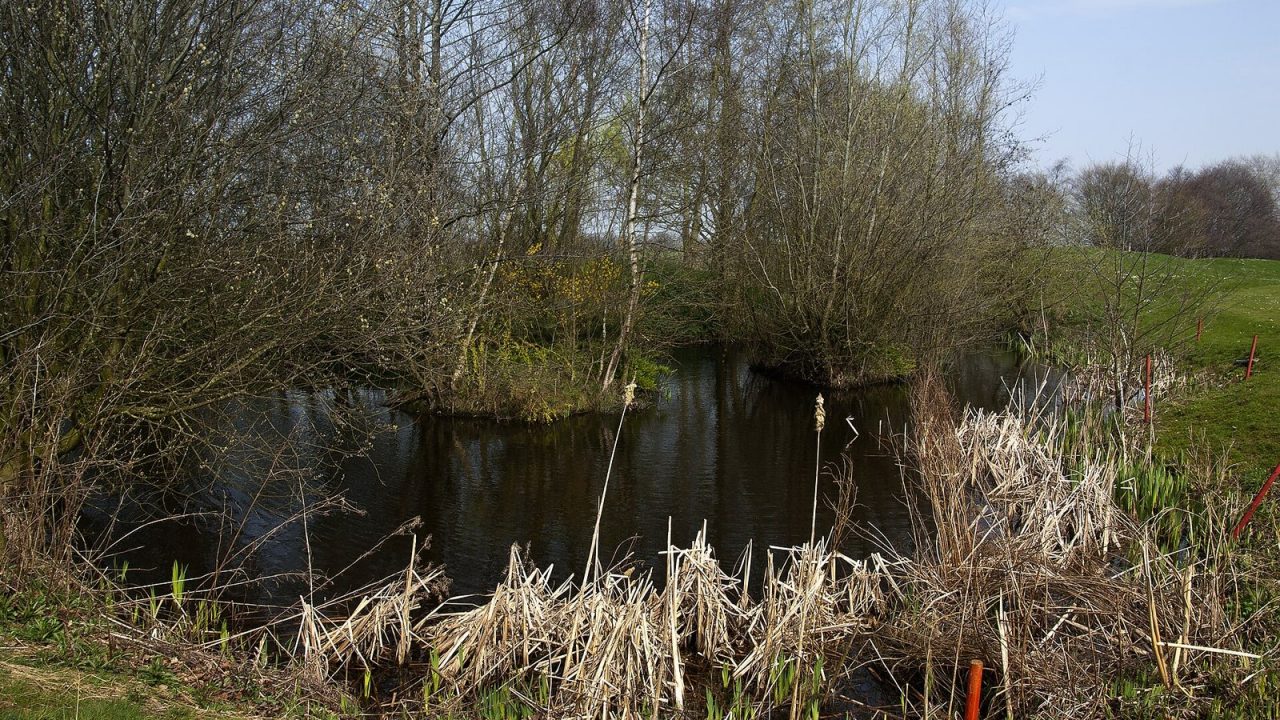
Few moments in golf are more common, or more confusing, than watching a ball disappear into water, trees or over a fence. What happens next depends on where the ball went: a penalty area, out of bounds, or simply somewhere it cannot be found. The Rules of Golf treat these situations differently, and choosing the right option can save strokes and time.
This guide explains Rule 17 (penalty areas), Rule 18 (stroke and distance, lost ball, out of bounds and the provisional ball) and the optional Local Rule many clubs use as an alternative to walking back to the tee.
First, which situation are you in?
| Situation | How it is marked or defined | Basic outcome |
|---|---|---|
| Ball in a penalty area | Red or yellow stakes or lines | Play it as it lies free, or take relief for one penalty stroke |
| Ball out of bounds | White stakes, fences or lines | Stroke and distance: one penalty stroke, replay from the previous spot |
| Ball lost (not found in 3 minutes) | Anywhere outside a penalty area | Stroke and distance |
The key distinction is simple: penalty areas give you options near where the ball went; out of bounds and lost balls normally send you back to where you last played.
Penalty areas: red and yellow
A penalty area is an area from which relief with a one-stroke penalty is allowed. Most are bodies of water such as lakes, streams and ditches, but a Committee can also mark other areas, such as deserts, jungle or lava rock, as penalty areas. They are marked either red or yellow, and the color decides which relief options you have.
A ball is in a penalty area when any part of it touches the ground or anything else inside the edge, or is above the edge or any other part of the area.
Option 1: play it as it lies
You never have to take relief. If you can play the ball from the penalty area, you may do so without penalty. Since 2019 there are no special rules limiting how you play a ball in a penalty area; you may remove loose impediments and ground your club, just as you would in the general area. A few situations override this, such as a “no play zone” marked by the Committee.
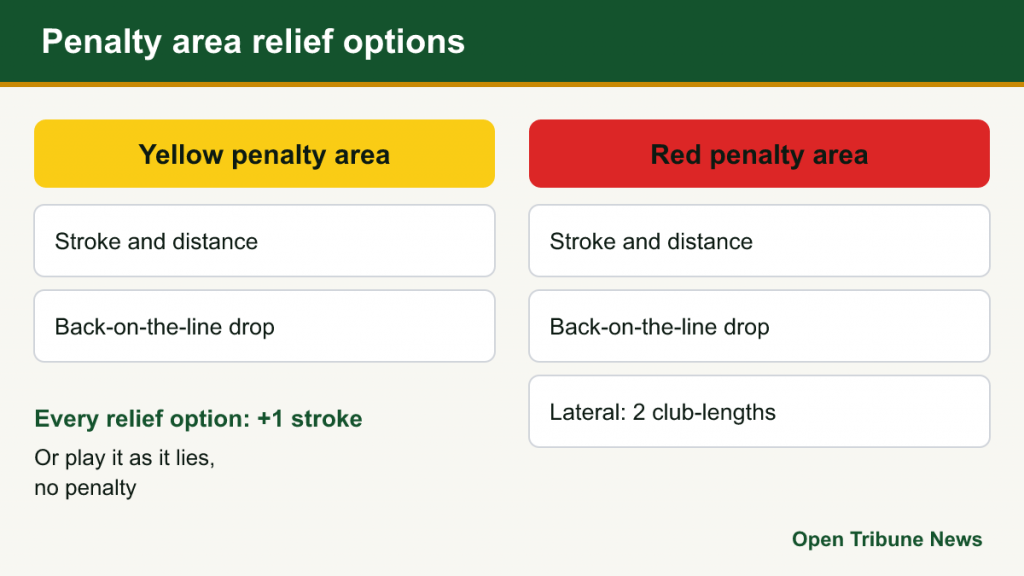
Relief from a yellow penalty area
For one penalty stroke, you have two options:
- Stroke-and-distance relief: play again from where you made the previous stroke.
- Back-on-the-line relief: drop a ball outside the penalty area, keeping the point where the ball last crossed the edge of the penalty area directly between the hole and the spot where you drop. There is no limit on how far back on that line you may go.
Relief from a red penalty area
You have the same two options as for yellow, plus a third, also for one penalty stroke:
- Lateral relief: the reference point is where the ball last crossed the edge of the red penalty area. Drop within two club-lengths of that point, not nearer the hole, and outside that same penalty area.
Red penalty areas are typically used where going back on the line would be impractical, such as water running along the side of a hole. Some Committees also adopt a Local Rule allowing relief on the opposite side of a red penalty area.
Knowing the ball is in the penalty area
To take penalty-area relief for a ball you cannot find, it must be known or virtually certain that the ball is in the penalty area. “Virtually certain” means that, although you have not seen it there, all the reasonably available information leaves little doubt. If it is not known or virtually certain, and the ball is not found, it is a lost ball and stroke and distance applies.
A worked example: water on a par 4
Your second shot on a par 4 splashes into a red penalty area that runs along the right of the green. You saw the ball cross the edge about 20 yards short of the green.
- Lateral relief: drop within two club-lengths of the crossing point, not nearer the hole. You will be playing your fourth shot (two strokes plus one penalty stroke), probably a short pitch.
- Back-on-the-line: go back along the line from the hole through the crossing point to get a full-swing distance you prefer, again playing your fourth.
- Stroke and distance: return to where you hit your second and play again, your fourth shot from there.
Most players would choose lateral relief here, but a player who prefers a full wedge to a delicate pitch over the water might choose back-on-the-line.
Out of bounds
Out of bounds is everything outside the boundary of the course, typically shown by white stakes, white lines, fences or walls. A ball is out of bounds only when all of it is outside the boundary edge. If any part of the ball touches or is above the course side of the boundary, it is in bounds.
Under Rule 18.2, the relief for a ball out of bounds is stroke and distance: add one penalty stroke and play from where you made the previous stroke. If that previous stroke was from the teeing area, you may tee the ball up again anywhere in the teeing area.
Note that boundary objects such as fences and white stakes are fixed: you do not get free relief from them, even if they interfere with your swing. You may stand out of bounds to play a ball that is in bounds.
Lost ball and the three-minute search
A ball is lost if it is not found within three minutes after you or your caddie begin searching. If you find a ball within that time but need a moment to identify it, you are allowed a reasonable time to do so even if three minutes have passed.
A lost ball, like a ball out of bounds, means stroke and distance. And once you put another ball in play under stroke and distance, the original is no longer in play, even if it turns up later within the search time.
There is no penalty if you accidentally move your ball while searching for it; just replace it on its original spot.
The provisional ball: saving the long walk back
Because stroke and distance can mean walking all the way back, Rule 18.3 allows a provisional ball. If your ball might be lost outside a penalty area or might be out of bounds, you may play another ball under stroke and distance before going forward to look.
How to play one correctly
- Announce it. Before the stroke, you must say you are playing a provisional ball, using the word “provisional” or otherwise clearly indicating it. Just saying “I’ll hit another” is not enough; that ball would become your ball in play under stroke and distance.
- Play it before going forward to search.
- Only for lost or OB. If the only danger is a penalty area, you may not play a provisional. If the ball might be in a penalty area or lost elsewhere or out of bounds, a provisional is allowed.
What happens next
- If the original ball is found on the course outside a penalty area within the three minutes, you must play it and abandon the provisional, with no penalty for the provisional strokes.
- If the original is found in a penalty area (or is known or virtually certain to be there), you may play it as it lies or take penalty-area relief. The provisional must be abandoned.
- If the original is lost or out of bounds, the provisional becomes your ball in play, with the penalty stroke counted.
- If you play the provisional from a spot nearer the hole than where the original is estimated to be, the provisional automatically becomes the ball in play.
Example: your tee shot on a par 4 heads into thick woods near a boundary. You announce and play a provisional. Your original is not found. Your provisional, which landed in the fairway, is in play and you are lying 3 there (tee shot, penalty, provisional tee shot).
The alternative: Model Local Rule E-5
For casual golf, walking back to the tee is slow, and many players do not hit provisionals. Since 2019, the Rules have offered an optional Local Rule (Model Local Rule E-5) that Committees can adopt for general play. When it is in effect, a player whose ball is lost or out of bounds can take relief near where the ball was lost, rather than going back, for two penalty strokes.
How it works
- Find the ball reference point: where the ball is estimated to have come to rest (if lost), or where it last crossed the boundary (if out of bounds).
- Find the fairway reference point: the point on the fairway of the hole being played that is nearest to the ball reference point but not nearer the hole.
- The relief area lies between lines from the hole through those two points, not nearer the hole than the ball reference point, with an extra two club-lengths of room beyond those lines (so you can drop up to two club-lengths into the fairway).
- Drop in that area, add two penalty strokes, and continue.
In the par-4 example above, without a provisional, you would be dropping near where the ball went and playing your fourth shot, about the same as if you had walked back and hit a good second tee shot.
Limits
- It applies only when the Committee has adopted it. Stroke and distance remains the default.
- It cannot be used for a ball in a penalty area or for an unplayable ball.
- If you played a provisional, you generally cannot use it unless the provisional is also lost or out of bounds.
- It is not intended for professional or elite amateur competitions.
- Whether scores using it are acceptable for handicap purposes depends on your national association.
Common mistakes to avoid
- Assuming a ball is in the water. Without knowledge or virtual certainty, an unfound ball is lost, and stroke and distance applies.
- Forgetting to announce a provisional. An unannounced second ball becomes the ball in play.
- Taking lateral relief from yellow. Lateral relief is only for red penalty areas, unless a Local Rule says otherwise.
- Measuring from the wrong spot. For penalty areas, use where the ball last crossed the edge, not where it ended up.
- Dropping incorrectly. Drop from knee height into the relief area, as explained in our Rules of Golf essentials.
Penalty strokes from all of these situations go straight onto the score for the hole; if you need a reminder of how they are counted, see golf scoring explained.