Stroke Play vs Match Play: How the Two Main Formats Differ
How stroke play and match play decide a winner, what "3 and 2", "all square" and "dormie" mean, how strategy changes, and which big events use each.

Golf has two basic forms of competition, and the Rules of Golf treat them separately. In stroke play, every stroke over the whole round counts, and the lowest total wins. In match play, you play against an opponent hole by hole, and the side that wins more holes wins the match. The same swing, course and ball are involved, but the two formats produce very different golf, from the tactics players use to the scores you see on a board.
This guide explains how each format works under the Rules, what the match-play scoring language means, how strategy changes, and where each format shows up in professional and amateur golf.
Stroke play: every shot counts
Stroke play is defined in Rule 3.3. Each player’s strokes, including penalty strokes, are added up for each hole, for the round and, in multi-round events, across all rounds. The player with the lowest total is the winner. In a handicap competition, handicap strokes are deducted to produce net scores, and the lowest net total wins.
Because every stroke counts, a single bad hole hurts. A triple bogey costs three strokes against par for the whole tournament, not just for that hole. Players must hole out on every hole, and in competitions a marker records the score and both players certify the card at the end.
Ties in stroke play are handled according to the Terms of the Competition. At professional events this usually means a playoff, either sudden death (play continues hole by hole until one player wins one) or an aggregate playoff over a set number of holes. In club competitions, ties are often decided by comparing scores over the last nine, six, three or final hole, a method sometimes called a card playoff or countback.
Stroke play is the standard format of professional golf. Nearly all regular tour events and all four men’s major championships are 72-hole stroke-play tournaments.
Match play: winning holes, not counting strokes
Match play is covered by Rule 3.2. Two players (or two sides) compete against each other on each hole:
- You win a hole by completing it in fewer strokes than your opponent, or when your opponent concedes the hole or gets the general penalty (which in match play is loss of hole).
- A hole is halved (tied) when both sides take the same number of strokes.
- Your total number of strokes for the round does not matter. A 9 on a hole you lose costs you the same single hole as a 5.
The match is won when one side leads by more holes than remain to be played. If it is level after the last hole, the match continues hole by hole until someone wins, unless the competition’s terms allow a tied (halved) match, as in team events such as the Ryder Cup.
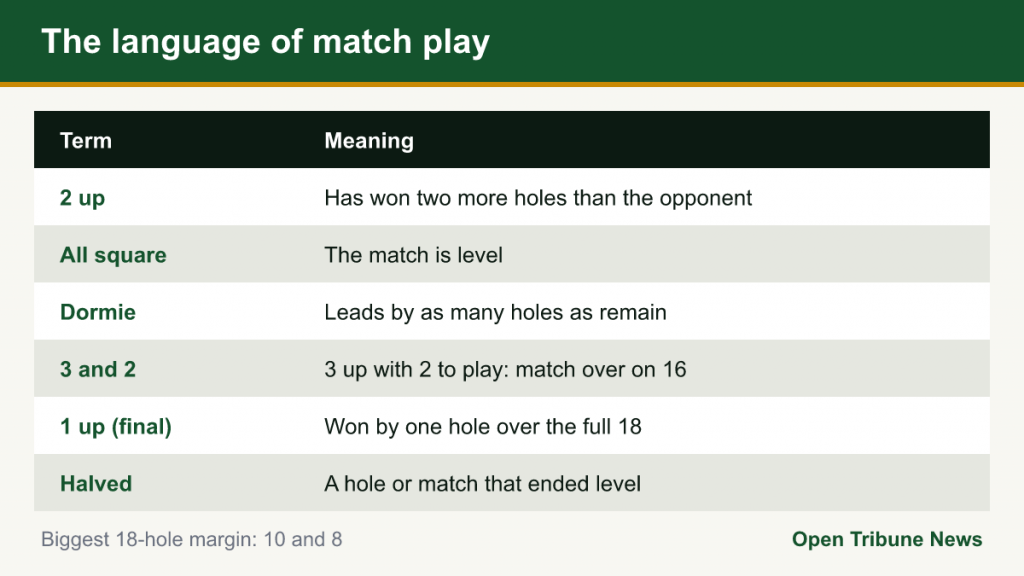
The language of match play
Match play has its own scoring vocabulary. Instead of strokes relative to par, the score describes how many holes one side is ahead.
| Term | Meaning |
|---|---|
| 1 up, 2 up… | One side has won one, two (and so on) more holes than the other so far. |
| All square (AS) | The match is level. |
| Dormie | A side leads by exactly as many holes as remain, for example 2 up with 2 to play. It cannot lose in regulation, though it can still be tied. |
| 3 and 2 | The winner was 3 up with only 2 holes left, so the match ended on the 16th green. |
| 1 up (final result) | The match went the full distance and was won by one hole. |
| Won at the 19th / 20th | The match was level after 18 and was decided on extra holes. |
| Halved | A hole or match that ended level. |
The biggest possible margin in an 18-hole match is 10 and 8, winning the first 10 holes. In 36-hole finals such as the U.S. Amateur, much bigger numbers are possible.
Concessions
Match play allows concessions. You may concede your opponent’s next stroke (the famous “that’s good” for a short putt), a whole hole, or the entire match. Under Rule 3.2b, a concession is final: it cannot be declined or withdrawn. The concession is a match-play idea only. In stroke play, every putt must be holed.
Telling your opponent
Because players are directly competing, Rule 3.2d adds duties. If asked, you must tell your opponent how many strokes you have taken on a hole, and you must let them know as soon as reasonably possible when you incur a penalty. Failing to do either, without correcting it in time, costs you the hole.
Rules that differ between the formats
Most of the Rules of Golf apply in both formats, but several play out differently:
- The general penalty is loss of hole in match play and two strokes in stroke play.
- Playing out of turn: in stroke play there is no penalty, and ready golf is encouraged. In match play, your opponent may cancel a stroke you played out of turn and make you replay it in the right order.
- Playing from outside the teeing area: in match play there is no penalty, but the opponent may cancel the stroke; in stroke play it is the general penalty and must be corrected.
- The honour: in match play, the side that won the previous hole tees off first; in stroke play it is the player with the lowest gross score on the previous hole.
- Too many clubs: in stroke play, two strokes per hole with a breach, up to four; in match play, a deduction of one hole per hole with a breach, up to two.
- Doubt about procedure: in stroke play, a player can complete a hole with two balls and let the Committee decide. That option does not exist in match play, where disputes are dealt with by making a timely request for a ruling.
How strategy changes
The scoring difference has big effects on how players think.
In stroke play
- Avoiding big numbers matters most. A conservative layup that guarantees a bogey can be smarter than an aggressive shot that risks a triple.
- You play against the course and the field, often without knowing exactly how other players are doing until you look at a leaderboard.
- Steady, mistake-free golf over 72 holes is rewarded.
In match play
- You play the person in front of you. If your opponent is in trouble, you can play safely; if they have hit it close, you may need to take risks.
- A disastrous hole only costs one hole, so aggressive play is cheaper. Match play generally rewards attacking golf, because a par will often not be enough to win a hole.
- Momentum and psychology matter. Holing a long putt to halve a hole your opponent thought they had won can swing a match.
- Concessions become tactics. Some players concede short putts early, then make their opponent putt a similar length later in the match when the pressure is higher.
Handicaps in each format
Both formats can be played with handicaps. In stroke play, each player subtracts their handicap strokes from their gross score. In match play, handicaps are applied hole by hole: the lower-handicap player typically plays off scratch, and the other player receives the difference in strokes on the holes ranked hardest by the scorecard’s stroke index. For example, if players with Course Handicaps of 10 and 19 play a match, the 10 plays off zero and the 19 receives 9 strokes, one on each of the nine hardest holes.
Handicap allowances also differ. Under the World Handicap System’s recommendations, individual stroke play often uses 95% of a player’s handicap, while individual match play uses the full handicap difference.
Where you see each format
Stroke play
- Almost all weekly professional tour events
- The four men’s majors: the Masters, PGA Championship, U.S. Open and The Open (see our guide to the four major championships)
- Most club medals and championships’ qualifying rounds
Match play
- The Ryder Cup, USA vs Europe, played entirely as match play across foursomes, four-ball and singles sessions.
- The Presidents Cup and the women’s Solheim Cup, also team match play.
- The U.S. Amateur, first held in 1895: the field plays two days of stroke play, then the leading 64 players go into a knockout match-play bracket, with 18-hole matches and a 36-hole final. Other USGA amateur championships use a similar structure.
- Club match play championships and knockout competitions at golf clubs around the world.
Match play also has deep roots in professional golf. The PGA Championship, one of the four majors, was a match-play event from 1916 until 1957 before switching to stroke play in 1958.
Which format is better for you?
Neither is better, but they suit different moods. Stroke play is the true test of a complete round and the basis of handicaps. Match play is often more fun for casual golfers, because a bad hole does not ruin the day and every hole is a fresh contest. It also tends to be quicker, since a player who is clearly beaten on a hole can concede and move on.
A good way to try both is a weekend game where you keep your own stroke score for the card while playing a match against a friend. It shows clearly how the two formats can tell different stories about the same round. If you need a refresher on how individual hole scores are counted, start with golf scoring explained.