The Rules of Golf: Essentials Every Golfer Should Know
The core principles of the Rules of Golf and the rules you will use most: the teeing area, playing it as it lies, searching, dropping, 14 clubs and the scorecard.

The full Rules of Golf run to 25 Rules plus definitions, interpretations and local rules, and very few golfers read them cover to cover. You do not need to. A handful of principles and a short list of everyday rules cover the vast majority of situations you will meet on the course. Learn those well, and you will play faster, avoid needless penalties and know when to ask for help.
The Rules are written and administered jointly by The R&A, which governs the game worldwide outside the United States and Mexico, and the USGA, which governs in those two countries. A complete rewrite took effect on January 1, 2019, making the language simpler and several procedures easier, and the Rules are revised on a regular multi-year cycle. Everything below reflects the modern Rules.
The three principles behind every rule
Almost every specific rule flows from three ideas set out in Rule 1.
1. Play the course as you find it and the ball as it lies
Rule 1.1 states the central principle directly: play the course as you find it and play the ball as it lies. You do not improve your lie, bend branches out of your way or press down the grass behind the ball. The Rules then list specific exceptions where you may lift, move or drop your ball, sometimes free and sometimes with a penalty.
2. Play by the spirit of the game
Rule 1.2 sets out standards of conduct. Players are expected to act with integrity (follow the Rules and apply all penalties honestly), show consideration for others (play at a prompt pace, look out for safety, avoid distracting others) and take good care of the course (replace divots, smooth bunkers, repair ball marks). A Committee can disqualify a player for serious misconduct.
3. Be your own referee
Golf is usually played without an official watching every shot. Rule 1.3 makes players responsible for applying the Rules to themselves, and anyone who deliberately ignores a breach or agrees with others to ignore a rule is disqualified. When the facts are unclear, such as exactly where a ball crossed into a penalty area, the Rules accept a player’s reasonable judgment, as long as the player took reasonable care.
Penalties: three levels
Before looking at specific rules, it helps to know how penalties work. There are three levels:
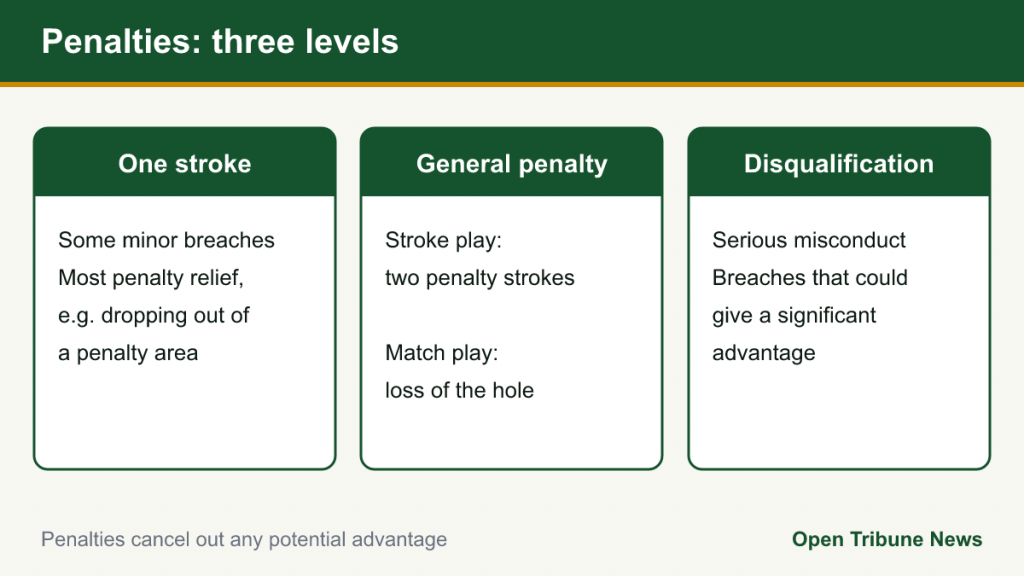
- One penalty stroke, for some minor breaches and for most forms of penalty relief (such as dropping out of a penalty area).
- The general penalty: two penalty strokes in stroke play, or loss of the hole in match play.
- Disqualification, for serious misconduct or breaches that could give a significant advantage.
As the Rules explain, penalties are meant to cancel out any potential advantage gained.
Starting the hole: the teeing area
Every hole begins in the teeing area, a rectangle two club-lengths deep whose front edge is the line between the two tee markers. A “club-length” is measured with the longest club you carry, other than the putter. Under Rule 6.1, the ball must be played from inside this area; it is in the teeing area if any part of it touches or is above it. You may stand outside.
A few points come up often:
- You may play from a tee peg or from the ground (Rule 6.2).
- Before your stroke, the ball is not in play, so if it falls off the tee you just re-tee it with no penalty.
- You must not move the tee markers to help your shot.
- Playing from outside the teeing area costs the general penalty in stroke play, and you must replay correctly. In match play, your opponent may cancel the stroke instead.
Playing through the general area
Everything on the course that is not the teeing area, a penalty area, a bunker or the putting green is the general area: fairways, rough, trees and paths. These five defined areas matter because some rules work differently in each.
In the general area, you play the ball as it lies. You may remove loose impediments such as leaves, twigs and stones, and you may move movable obstructions such as rakes. You get free relief from abnormal course conditions, such as ground under repair, temporary water, animal holes and immovable obstructions like cart paths, when they interfere with your lie, stance or swing. You do not get free relief from natural features like trees or bushes. For those, the unplayable ball rule (one penalty stroke) is your option.
Order of play and ready golf
In stroke play, the Rules both allow and encourage ready golf, playing when ready if it is safe, and there is no penalty for playing out of turn. In match play, order matters more: the player farther from the hole plays first, and an opponent may cancel a stroke played out of turn.
Searching for a ball: three minutes
When a ball goes missing, you have three minutes from when you (or your caddie) start searching. If it is not found in that time, it is lost (Rule 18.2). The time limit was reduced from five minutes in the 2019 rewrite.
If it is lost, or out of bounds, the basic relief is stroke and distance: add one penalty stroke and play again from where you hit the previous stroke. That is why the provisional ball exists. If you think your ball might be lost outside a penalty area or out of bounds, you may announce “provisional” and play another ball before going forward. If your original ball is found in bounds within three minutes, you continue with it; if not, the provisional becomes your ball in play.
Two important details: you must clearly say you are playing a provisional (just saying “I’ll hit another” is not enough), and you cannot play a provisional for a ball that might only be in a penalty area.
There is no penalty if you accidentally move your ball while searching for it; you simply replace it.
Taking relief: how to drop
Many rules give relief by dropping the ball in a relief area, which is usually one or two club-lengths from a reference point, depending on the rule. The dropping procedure in Rule 14.3 is the same in all cases:
- Only you may drop the ball. You can use the original ball or another ball.
- Drop it from knee height, meaning the height of your knee when standing, straight down, without throwing, spinning or rolling it.
- The ball must not touch you or your equipment before landing.
- It must land in the relief area and come to rest in the relief area.
- If it rolls out, drop again. If it rolls out a second time, place it on the spot where it first touched the ground on the second drop.
The knee-height drop replaced the old shoulder-height drop in 2019. Dropping the wrong way and then playing the ball costs a penalty, so take a moment to do it right.
Marking, lifting and replacing
When a rule requires you to lift and replace your ball, mark its spot first with a ball marker or a club held on the ground right behind or next to it (Rule 14.1). Failing to mark, or playing with the marker still down, costs one penalty stroke. You replace the ball on its original spot by setting it down, not dropping it.
The equipment rule: 14 clubs
Rule 4.1b limits you to 14 clubs. You must not start a round with more, or have more during the round. In stroke play, the penalty is two strokes for each hole where the breach happened, with a maximum of four strokes in the round; in match play, a hole is deducted from your match score for each hole with a breach, up to two holes. Count your clubs before teeing off; a forgotten extra wedge is a classic error.
Rule 4.3 also covers devices. Using a distance-measuring device for distance or direction is allowed, unless a Local Rule bans it, but a device may not be used to measure elevation changes or to recommend a club or line of play. For a full guide to the clubs themselves, see golf clubs explained.
Bunkers and the putting green
Bunkers
In a bunker (Rule 12), you may remove loose impediments and movable obstructions, but you must not deliberately touch the sand to test it, or touch the sand with your club right in front of or behind the ball, in a practice swing or in your backswing. Once your ball is out, you may rake the bunker to care for the course.
The putting green
On the green (Rule 13), you may mark, lift and clean your ball, and you may repair almost any damage, including ball marks and spike marks. You may leave the flagstick in when putting, have it removed, or have someone attend it, and there is no penalty if your ball hits a flagstick left in the hole. If your ball overhangs the edge of the hole, you get a reasonable time to reach it plus ten seconds to see whether it drops.
Your scorecard responsibilities
In stroke play competitions, the scorecard is part of the Rules. Rule 3.3b sets out the process:
- Your marker records your score on each hole and certifies the card.
- You check your hole scores, certify the card and return it promptly to the Committee.
- If a returned hole score is higher than your actual score, it stands.
- If it is lower, you are disqualified, unless the only reason is a penalty you did not know about, in which case the Committee adds the penalty strokes.
- You are not responsible for adding up the total or applying your handicap. The Committee does that.
You must also hole out on every hole in stroke play; if you fail to, and do not correct it before teeing off on the next hole (or, on the last hole, before returning your card), you are disqualified. For the basics of how strokes and par work, see golf scoring explained.
When in doubt
If you are not sure what to do in stroke play and no referee is available, the Rules provide a practical safety net: you can complete the hole with two balls, one under each possible procedure, and report the facts to the Committee before returning your scorecard. The Committee then decides which score counts. For everyday play, the official Rules of Golf app and website from The R&A and USGA include searchable rules with diagrams and videos.
Above all, remember the spirit behind it all: play the ball where it lies, be honest with your score, and care for the course and the people around you. Those habits will carry you through most rounds, and our beginner’s guide to a round of golf shows how they fit into the flow of a typical day on the course.