Golf Clubs Explained: Woods, Hybrids, Irons, Wedges and the Putter
A plain-English guide to every club family, typical loft ranges, which shots each club is for, and how a set is built under the 14-club limit.
Open a golf bag and you will find a surprising amount of variety: big-headed woods, compact hybrids, a row of numbered irons, a few heavily angled wedges and a putter. Each family exists because golf asks for very different shots, from a 250-yard drive to a 10-foot putt. Understanding what each club is designed to do is the first step toward building a set that suits your game and choosing the right club on the course.
This guide covers the five main families, the loft each usually carries, the shots they are meant for, and how golfers assemble a set within the Rules of Golf’s 14-club limit.
Loft: the number that explains everything
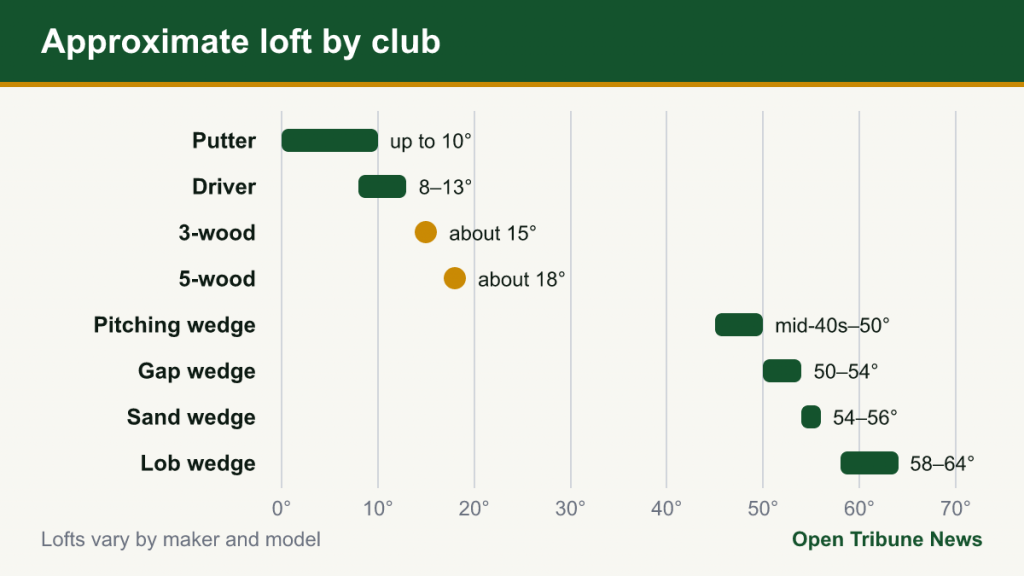
The most important specification on any club is its loft, the angle of the clubface relative to vertical. A low-lofted club, like a driver, sends the ball out lower and with less backspin, so it travels farther. A high-lofted club, like a lob wedge, sends the ball up steeply with more spin, so it lands softly and stops sooner.
Shaft length works together with loft. Longer clubs produce more clubhead speed and therefore more distance, but they are harder to control. That is why a set runs from long, low-lofted clubs for distance down to short, high-lofted clubs for precision.
Lofts vary between manufacturers and models, and many modern irons are made with stronger (lower) lofts than older designs. Treat the numbers below as approximate ranges, not fixed standards.
| Club | Approximate loft | Typical use |
|---|---|---|
| Driver | About 8° to 13° | Tee shots on long holes |
| 3-wood | Around 15° | Long tee shots, long second shots |
| 5-wood | Around 18° | Long approaches, higher launch |
| Hybrids | Varies; designed to replace long irons | Long approaches, rough, tee shots |
| Mid and short irons | Rising by a few degrees per club, with a 9-iron in the low-to-mid 40s | Approach shots |
| Pitching wedge | Roughly mid-40s to around 50° | Full shots, pitches, chips |
| Gap wedge | Roughly 50° to 54° | Filling the distance gap |
| Sand wedge | Roughly 54° to 56° | Bunker shots, short pitches |
| Lob wedge | Roughly 58° to 64° | High, soft shots near the green |
| Putter | A few degrees (not more than 10°) | Rolling the ball on the green |
Woods: the driver and fairway woods
Woods are the clubs with large, rounded heads. The name is historical: for most of golf’s history the heads were made of wood, typically persimmon, until metal heads arrived. TaylorMade introduced the first steel “wood” in 1979, and today the heads are usually titanium or a mix of titanium and carbon composite.
The driver
The driver, or 1-wood, has the lowest loft and the longest shaft in the bag. It is built for one purpose: hitting the ball as far as possible from a tee. Modern driver heads can be up to 460 cubic centimeters, the maximum allowed under the equipment rules, and that large head is designed to be forgiving on off-center strikes. Many models have adjustable hosels that let players change loft and face angle.
Because it is the longest club, the driver is also often the hardest to control. Plenty of golfers hit a 3-wood or hybrid off the tee on tight holes for accuracy.
Fairway woods
Fairway woods, usually a 3-wood and 5-wood (with 7-woods and higher also available), have smaller heads and more loft than a driver. They can be hit off a tee or directly off the grass, which makes them useful for long second shots on par 5s and long par 4s. Higher-lofted fairway woods launch the ball easily and are a popular alternative to long irons for golfers with moderate swing speeds.
Hybrids: the bridge between woods and irons
Hybrids, sometimes called rescue clubs or utility clubs, combine a compact wood-like head with the length and lofts of long irons. They are typically designed to cover the distance of a 3-, 4- or 5-iron, but they are much easier for most golfers to launch high.
The wide sole and low, deep center of gravity help the club glide through turf and get the ball airborne from the fairway, light rough and even poor lies. That is why hybrids have largely replaced long irons in many amateur bags and in a fair number of professional ones as well. They are also handy for chip-and-run shots from the fringe.
Irons: the approach clubs
Irons are numbered, usually from about 3 or 4 through 9. The lower the number, the lower the loft and the longer the shaft. Most players carry six or seven irons plus a pitching wedge, which is generally sold as part of the iron set.
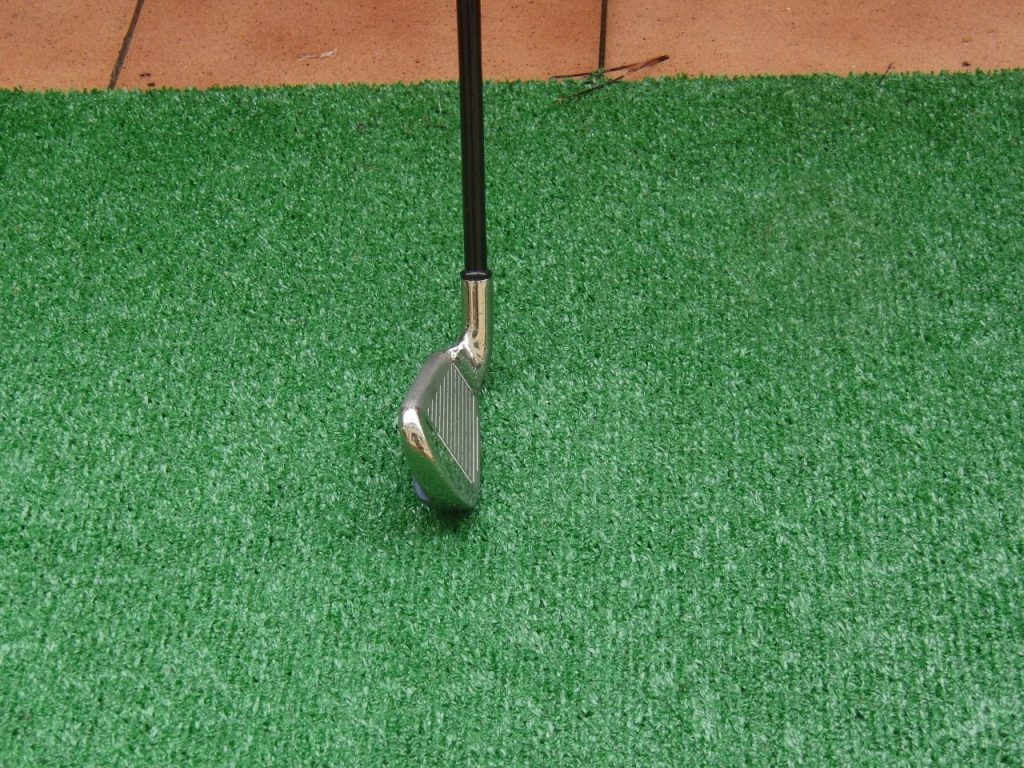
Irons are the clubs most often used to hit the ball onto the green. A golfer typically uses mid irons (5 to 7) from medium range and short irons (8 and 9) from closer in. Each club is designed to fly a fairly consistent distance, so that gaps between clubs are even.
Cavity backs vs blades
Iron heads come in two broad styles:
- Cavity-back irons remove material from the back of the head and place it around the perimeter. This lowers the center of gravity and raises the moment of inertia, so mis-hits lose less distance and accuracy. They are the usual choice for beginners and mid-handicappers, and many good players use them too.
- Muscle-back or blade irons have a solid back and a thinner topline. They are less forgiving but give skilled players precise feedback and control for shaping shots such as draws and fades.
Many modern sets blend the two, with more forgiving long irons and more compact short irons.
Wedges: scoring clubs
Wedges are the most lofted clubs in the bag and are used for shorter approach shots, pitches, chips and bunker play. Most golfers carry two to four.
- Pitching wedge: the lowest-lofted wedge, used for full shots and longer chips.
- Gap wedge (also called an approach or attack wedge): fills the distance gap between the pitching wedge and the sand wedge, which has grown as iron lofts have become stronger.
- Sand wedge: designed for bunkers, with plenty of bounce, the angle of the sole that keeps the club from digging into sand.
- Lob wedge: the highest loft, for shots that need to climb quickly and land softly, such as getting over a bunker to a close hole.
Wedges are often stamped with their loft (for example 52°, 56° or 60°) rather than a name. When choosing them, golfers usually aim for a steady loft gap of four to six degrees between each wedge so that distances are evenly spaced.
The putter
The putter is used most often in a round, usually on the green and sometimes from just off it. It has very little loft, just enough to lift the ball slightly out of its resting position and start it rolling smoothly.
Putters come in two broad head shapes. Blades are compact and traditional; mallets are larger, with weight spread around the head for stability on off-center strokes. The best choice depends on feel and how the putter matches a player’s stroke. Putting has some of its own rules too: since 2016 players may not anchor the club against the body while stroking.
The 14-club limit and how a set is built
Rule 4.1b of the Rules of Golf says a player must not start a round with more than 14 clubs or have more than 14 during the round. Fewer is fine, and many beginners play with half sets.
The penalties for carrying too many are specific:
- Stroke play: the general penalty (two strokes) for each hole on which the breach happened, up to a maximum of four penalty strokes in the round.
- Match play: the match score is adjusted by deducting one hole for each hole where the breach happened, up to a maximum of two holes in the round.
An extra club accidentally left in the bag is a common way to fall foul of this rule, so it is worth counting your clubs on the first tee.
A typical 14-club setup
There is no required mix. A common configuration looks like this:
- Driver
- 3-wood
- 5-wood or hybrid
- Hybrid (replacing a 4-iron)
- 5-iron
- 6-iron
- 7-iron
- 8-iron
- 9-iron
- Pitching wedge
- Gap wedge
- Sand wedge
- Lob wedge
- Putter
Players adjust the mix to their game. Someone who plays a windy links course might add a long iron for low shots; someone with a slower swing might swap long irons for a 7-wood and more hybrids; a strong short-game player might carry four wedges and drop a fairway wood. The goal is even distance gaps at the top and bottom of the bag, with no two clubs doing the same job.
Choosing clubs as a beginner
New golfers do not need 14 clubs. A sensible starter set might include a driver or 3-wood, a hybrid, a few irons (say 6, 8 and pitching wedge), a sand wedge and a putter. Forgiving designs such as cavity-back irons and hybrids help a lot while the swing develops. As your game improves you can add clubs to fill gaps, and a professional club fitting can help match loft, lie, length and shaft to your swing.
Whatever the bag holds, the scoring is the same: every swing with any club counts. If you are still getting to grips with the numbers on the card, see our explainer on golf scoring: par, birdies and bogeys.
Quick FAQ
Can I carry two putters?
Yes, as long as your total is 14 clubs or fewer. Each putter counts as one club.
Do numbers mean the same thing across brands?
Not exactly. A 7-iron from one manufacturer can have a noticeably different loft from another’s, so it is better to compare loft than the number stamped on the sole.
What club should I chip with?
Almost any. Many golfers chip with wedges, but lower-lofted clubs such as an 8-iron or hybrid can be easier for simple bump-and-run chips where the ball rolls most of the way.