Golf Ball Guide: Construction, Compression and Choosing the Right Ball
How golf balls are built, what compression and cover materials mean, the spin versus distance trade-off, and how to match a ball to your game.
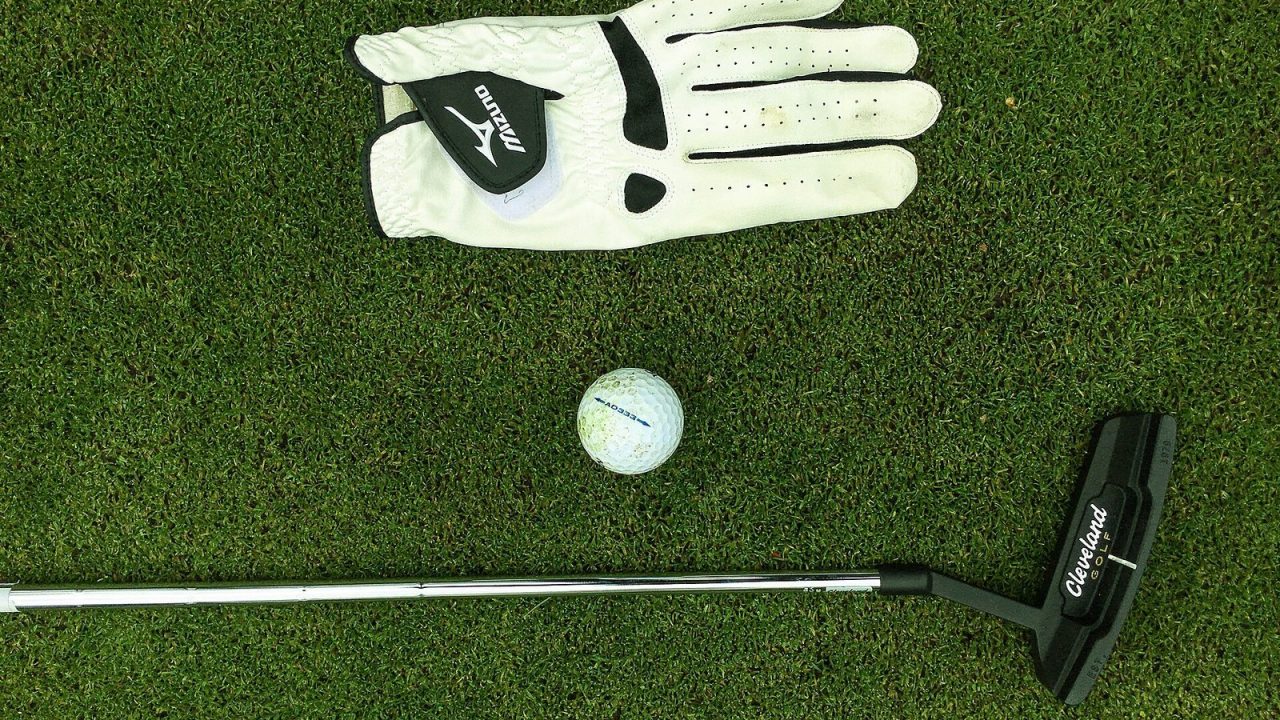
The golf ball is the only piece of equipment you use on every single shot, from the opening drive to the final putt. Yet many golfers pick one by price or packaging alone. Balls really do differ: in how they are built, how they feel, how much they spin and how they behave around the greens. You do not need a laboratory to choose well, but a basic understanding of construction and compression makes it much easier to find a ball that suits your game.
This guide explains the main types of ball, cover materials, what compression means, the trade-off between spin and distance, and how the governing bodies regulate the ball.
What the Rules require of a golf ball
Every ball used under the Rules of Golf must conform to the equipment standards set by The R&A and the USGA. The two best-known specifications are size and weight:
- A ball must weigh no more than 1.620 ounces (45.93 grams).
- Its diameter must be at least 1.680 inches (42.67 millimeters).
There are also limits on initial velocity, overall distance and symmetry, so a ball must perform consistently regardless of how it is oriented. These standards are tested by the governing bodies. Until 1990 a slightly smaller ball was permitted in events under R&A jurisdiction, but today the same minimum size applies worldwide.
The conforming ball list
The R&A and USGA publish a List of Conforming Golf Balls, covering balls that manufacturers have submitted for testing within the last 12 months and that have been ruled to conform. The list is updated on the first Wednesday of each month, and a ball stays on it for 12 months unless the manufacturer submits fresh samples.
For everyday golf, a ball that is not on the current list is generally still treated as conforming unless there is strong evidence otherwise. But many elite competitions adopt a condition requiring players to use only balls on the current list, and in those events an unlisted ball must not be used. If you play in high-level amateur events, check that your exact model, identified by the markings on the pole and seam, is listed.
How a golf ball is built
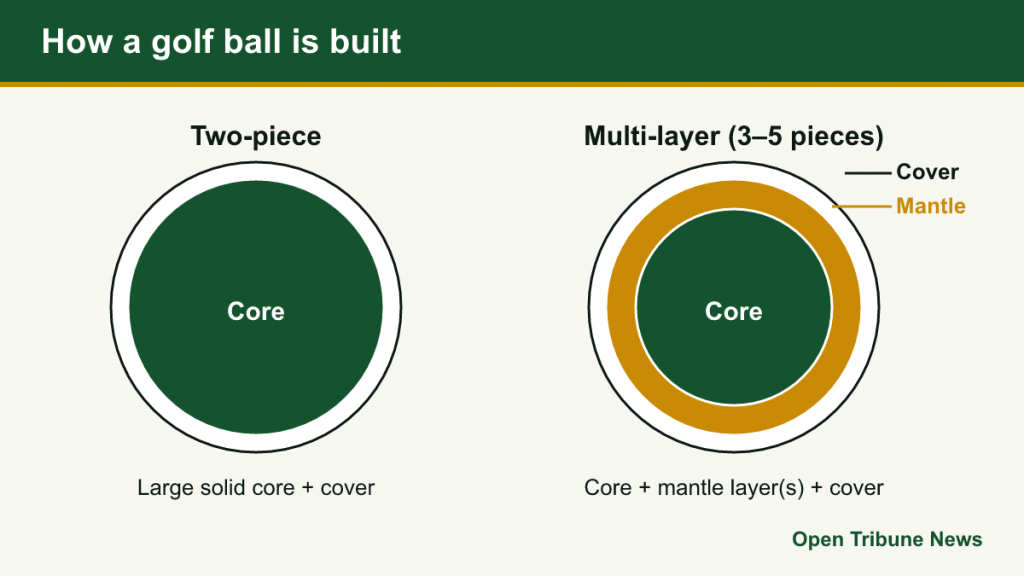
Modern balls are classified by the number of layers they contain. The innermost part is the core, usually a rubber compound; the outermost layer is the cover, which carries the dimples. Between them there may be one or more mantle layers.
Two-piece balls
A two-piece ball has a large solid core and a cover. This is the most common construction among recreational golfers. Two-piece balls tend to be durable, are often designed for distance and low spin off the driver, and are usually among the more affordable options. The lower spin can reduce the curve on mishit shots, which many higher-handicap players appreciate.
Multi-layer balls
Three-piece, four-piece and five-piece balls add mantle layers between core and cover. Each layer can be tuned to behave differently depending on how hard the ball is struck. The general idea is that with a driver, the inner layers dominate and help keep spin lower for distance, while on shorter shots, where the club compresses the ball less, the softer outer layers and cover produce more spin and control. Tour-level balls are almost all multi-layer designs.
A brief history
Golf balls have evolved a long way. Early balls were wooden, then leather stuffed with feathers (“featheries”), then made from gutta-percha, a rubbery tree sap, followed by wound balls with rubber thread wrapped around a core. Covers moved from balata, a soft natural material used on many wound balls, to the durable ionomer Surlyn, introduced by DuPont in the mid-1960s, and later to urethane blends. Solid-core multi-layer construction has since replaced wound balls at the top of the game.
Covers: ionomer vs urethane
The cover is the part of the ball in direct contact with the clubface, and its material affects feel, spin and durability.
| Ionomer (e.g. Surlyn) | Urethane | |
|---|---|---|
| Typical use | Distance and value balls, many two-piece designs | Premium and tour-level balls |
| Feel | Generally firmer | Generally softer |
| Short-game spin | Lower | Higher; more “grab” on wedges and chips |
| Durability | Very resistant to scuffs and cuts | Scuffs more easily, especially from sharp wedge grooves |
For players who regularly hit greens and want shots to check and stop near the hole, the extra greenside spin from urethane can matter. For players still working on solid contact, the difference is often less noticeable than the cost difference.
Compression explained
Compression describes how much a ball deforms when struck. It is determined largely by the hardness of the core layers. Manufacturers often describe balls as low, mid or high compression, and some print a compression figure, though the scales they use are not standardized across brands.
- Higher-compression (firmer) balls tend to feel harder and are often designed for players who generate a lot of clubhead speed.
- Lower-compression (softer) balls feel softer at impact and are often marketed toward players with moderate swing speeds. Softer balls usually produce more spin on short shots.
The popular rule of thumb that slower swingers should choose softer balls and faster swingers firmer ones is a reasonable starting point, but it is not a strict law. Feel matters too, especially in putting and chipping, where many players simply prefer a certain sound and sensation off the face. Trying a few options is the best way to find out.
Spin vs distance: the core trade-off
Every ball design balances two goals that pull in different directions:
- Low spin off the driver and long clubs tends to help distance and reduce the amount a sidespin-affected shot curves.
- High spin on wedges and short irons helps the ball stop on the green and gives control around the hole.
Premium multi-layer balls try to deliver both, using layers that respond differently to full swings and short shots. Distance-focused two-piece balls prioritize low spin across the board, which can mean the ball runs out farther after landing on approach shots and chips.
Dimples
Dimples are not decoration. They manage the air around the ball so it creates lift and less drag, letting it fly farther and more stably than a smooth ball would. Most modern balls have roughly 300 to 500 dimples, arranged in patterns that manufacturers tune for flight.
Choosing a ball for your game
There is no single best ball, but a few general guidelines help:
Beginners and high handicappers
- A durable, affordable two-piece ball is a sensible choice while you are still losing balls regularly.
- Lower spin can help keep slices and hooks a little straighter.
- Consistency matters more than the model: play the same ball every round so you learn how it behaves.
Mid handicappers
- If you are hitting more greens and chipping well, consider a mid-priced multi-layer ball or a soft-feel ball with some short-game spin.
- Test balls around the green first. That is where the differences between models are easiest to notice.
Low handicappers and competitive players
- A urethane-covered multi-layer ball offers the most control on approach and short-game shots.
- Check that your model is on the conforming ball list if you play events where the list is in force.
A simple test you can do
- Pick two or three candidate balls.
- Start on the putting green and chipping area: hit the same shots with each ball and note how they feel and how far they release.
- Move to full wedge and mid-iron shots, watching how quickly each stops on the green.
- Finish with drivers. Many golfers find little meaningful difference off the tee, which makes short-game performance the deciding factor.
A professional fitting can add launch-monitor data, but this simple routine already tells you a lot.
Used, refurbished and practice balls
Not every ball needs to come out of a new box. Many golfers play recovered or used balls, often sorted by model and condition, which can be a sensible way to try premium balls at lower cost. Check them for cuts, deep scuffs or discoloration, which can affect flight. Range balls, by contrast, are built for durability rather than performance and often fly differently from a normal ball, so do not judge your distances from them.
So-called “X-out” balls, cosmetically imperfect balls sold at a discount, are another option for casual play, but they do not appear on the conforming ball list, so they should not be used in events where the list is a condition of competition.
Practical tips and common mistakes
- Do not chase the tour ball too early. If you lose several balls a round, a premium ball mostly costs you money.
- Do not mix models mid-round without reason. Different balls fly and spin differently, which makes distance control harder.
- Replace damaged balls. Under the Rules, you may substitute a ball that is cut or cracked during the play of a hole; a scuffed or scratched ball does not qualify, but there is nothing to stop you changing balls between holes.
- Mark your ball. Put an identifying mark on it so you never play a wrong ball, which costs the general penalty.
- Buy by the model, not the box color. Many manufacturers make several balls with similar names; check the exact model and its construction.
The ball is only one part of your equipment. For an overview of the rest of the bag, see our guide to woods, hybrids, irons, wedges and the putter, and for the basic rules that apply to equipment, the Rules of Golf essentials.