The Players Championship and TPC Sawgrass
Why the Players is called golf's "fifth major": its 1974 start, the move to TPC Sawgrass, Pete and Alice Dye's design and the island-green 17th.
Every March the PGA Tour’s flagship event arrives in Ponte Vedra Beach, Florida, and golf fans start arguing about the same question: is the Players Championship a major? Officially, no. The four men’s majors are the Masters, the PGA Championship, the U.S. Open and The Open. But the Players has a deep field, a famous course, one of the most recognizable holes in the world and a history that now spans more than five decades. That combination is why it is so often called the “fifth major.”
This guide explains where the tournament came from, why it moved to TPC Sawgrass, what makes the Stadium Course distinctive and how the event fits into the modern PGA Tour season.
Origins: Deane Beman’s Idea
The Players Championship was the brainchild of Deane Beman, the PGA Tour commissioner at the time. The idea was a championship run by the tour itself, for its own members, with a field built from the best players in the professional game. The inaugural edition was played in 1974 at Atlanta Country Club in Marietta, Georgia, and Jack Nicklaus won it.
In its early years the tournament moved around:
| Years | Venue |
|---|---|
| 1974 | Atlanta Country Club, Marietta, Georgia |
| 1975 | Colonial Country Club, Fort Worth, Texas |
| 1976 | Inverrary Country Club (East Course), Lauderhill, Florida |
| 1977–1981 | Sawgrass Country Club, Ponte Vedra Beach, Florida |
| 1982–present | TPC Sawgrass, Stadium Course, Ponte Vedra Beach, Florida |
Moving to Ponte Vedra Beach in 1977 gave the event a permanent home region. The next step was more ambitious: building a course designed specifically to host it.
Building a Stadium: TPC Sawgrass
The Stadium Course at TPC Sawgrass opened in autumn 1980 and hosted the Players for the first time in 1982. It was designed by Pete Dye together with his wife, Alice Dye, herself an accomplished amateur golfer and designer.
The key concept was in the name. Most tournament courses had been built for members first and adapted for spectators later. The Stadium Course was built with spectators in mind from the start. Raised grass mounds around greens and along fairways act as natural grandstands, giving fans clear views of the action. The “TPC” (Tournament Players Club) model that followed spread to other tour venues around the United States.
TPC Sawgrass is also home to the PGA Tour’s headquarters, which reinforces the sense that the Players is the tour’s own championship. A second course at the club, Dye’s Valley Course, has been used for other events and for PGA Tour Q-School’s final stage.
Pete Dye’s Design Style
Pete Dye was known for courses that look intimidating and demand precision. The Stadium Course shows his signature features:
- Water in play on many holes, often running the length of a fairway or guarding a green.
- Railroad ties and bulkheads framing hazards, a Dye trademark.
- Small, contoured greens with steep run-offs, so missed approach shots are punished.
- Visual deception: angles and sightlines that make holes look narrower or more dangerous than they really are, pushing players to second-guess their target.
- Strategic variety: a mix of short holes that tempt aggressive play and long holes that reward accuracy over power.
Because the course does not rely purely on length, a wide range of player types has won there. Long hitters, precise iron players and short-game specialists have all lifted the trophy, which is part of why the event is seen as a complete examination.
The Island Green 17th
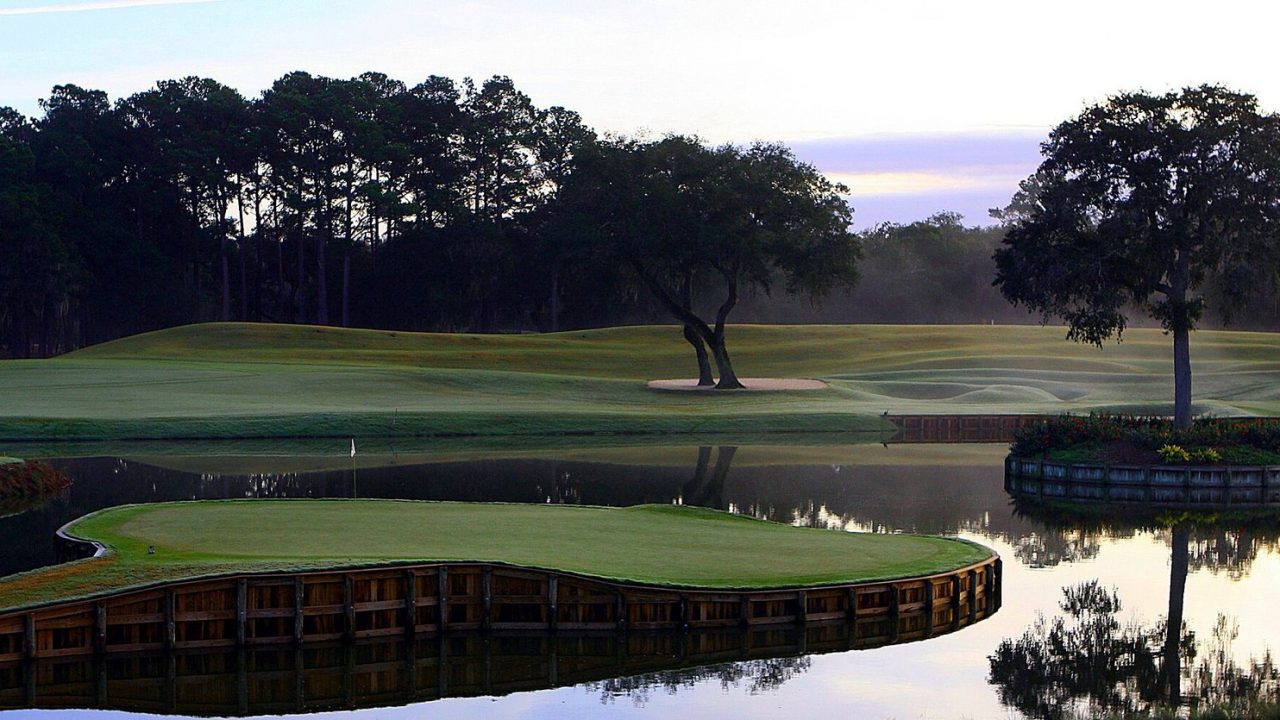
The most famous hole at TPC Sawgrass, and one of the most famous in golf, is the par-3 17th. It is a short hole, around 137 yards from the tournament tees, with a green surrounded by water on all sides except for a narrow walkway. There is a single small bunker at the front of the green, and that is it: no rough to save a slightly misjudged shot, no bank to stop a ball running long.
According to the club’s history, it was Alice Dye who suggested the island green concept, and Pete Dye went ahead with it. Reports suggest that well over 100,000 balls are retrieved from the water around the hole every year, most of them hit by everyday golfers who play the course.
For professionals, the 17th is less about distance and more about nerve and wind. The hole usually requires only a wedge, but the green is small, swirling wind off the water makes club selection tricky, and the shot comes late in the round when a tournament may be on the line. Spectators pack the slopes around the hole, and the atmosphere can be closer to a stadium than a golf course. A single swing there has decided many Players Championships.
The 18th that follows is a long par 4 with water down the entire left side, so the closing stretch of 16, 17 and 18 offers chances for both birdies and disasters.
Why It Is Called the “Fifth Major”
The PGA Tour itself has promoted the nickname, but the case rests on a few genuine strengths:
- The field. The Players has a field of around 120 players and typically includes most of the top 50 in the Official World Golf Ranking. Because it is the tour’s own event, it is built around tour status and performance, and very few of the world’s top players skip it. Our explainer on how the world ranking works covers why a strong field matters for ranking points.
- The course. A permanent, purpose-built championship venue with iconic holes gives the event a consistent identity, much like Augusta does for the Masters.
- The prize money. The purse has been one of the largest in golf, rising to $25 million from 2023, with the winner receiving $4.5 million.
- The history. Five decades of champions, including many of the best players of each era.
The counterargument is simple: the majors are defined by tradition, not by marketing, and the Players is not organized by one of the bodies that run the majors. Whatever side you take, the event’s prestige is clear. For an overview of the four official majors, see our guide to the four men’s major championships.
Calendar Changes: March, May and Back
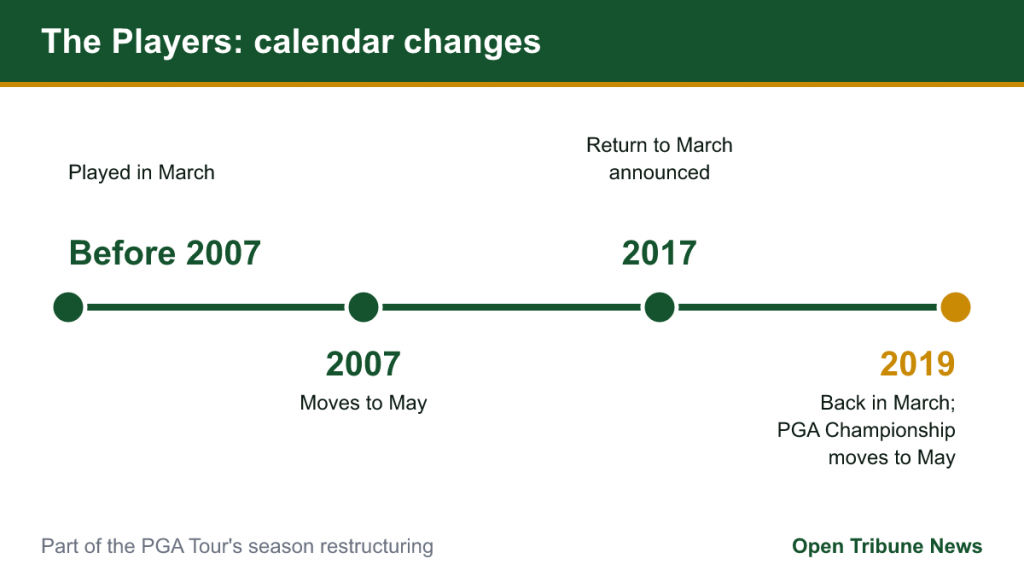
For many years the Players was played in March. In 2007 it moved to May, part of a broader reshaping of the PGA Tour schedule. The tournament returned to March from 2019, a change announced in 2017 as the tour restructured its season to finish earlier. That return also coincided with the PGA Championship moving from August to May.
In the modern PGA Tour season, the Players is one of the biggest events of the year, carrying a large share of FedExCup points. Our guide to the PGA Tour season and FedExCup explains how points and the playoffs work.
Champions and Records
A few highlights from the tournament’s record book, as of 2026:
- Most wins: Jack Nicklaus, three (1974, 1976, 1978).
- Successful title defense: Scottie Scheffler won in 2023 and 2024, becoming the only player to win the Players in back-to-back years.
- Tournament scoring record: 264 (24 under), set by Greg Norman in 1994.
Recent champions:
| Year | Champion | Score | Note |
|---|---|---|---|
| 2023 | Scottie Scheffler | 271 (−17) | Won by five strokes |
| 2024 | Scottie Scheffler | 268 (−20) | Won by one stroke |
| 2025 | Rory McIlroy | 276 (−12) | Won a playoff over J.J. Spaun |
| 2026 | Cameron Young | 275 (−13) | Won by one over Matt Fitzpatrick |
How a Players Playoff Works
Through 2013, ties after 72 holes were settled by sudden death. Since 2014 the Players has used a three-hole aggregate playoff over the closing stretch of 16, 17 and 18. If players are still level after the three holes, sudden death follows, beginning at the 17th. That means a playoff almost certainly involves at least one more trip to the island green, a fitting test for the event’s signature hole.
Watching the Players: What to Look For
- The par-5 16th: reachable in two for many players, with water to the right of the green, so it produces eagles and big numbers.
- The 17th: watch the flags on top of the grandstands and the players’ hesitation over club selection. Hole locations change daily, and a back or right pin leaves very little margin.
- The 18th tee shot: water left and trees right make it one of the most demanding drives in a closing stretch anywhere.
- Weather: a calm March week can produce low scores, while wind makes the course dramatically harder.
Quick Answers
Is the Players Championship a major?
No. It is the PGA Tour’s flagship event, and the “fifth major” label is a nickname rather than an official status. Wins there do not count toward a player’s major total.
Has the Players always been at TPC Sawgrass?
No. It was played at three other venues between 1974 and 1976 and at nearby Sawgrass Country Club from 1977 to 1981 before settling at the Stadium Course in 1982.
How hard is the 17th for an average golfer?
The distance is modest, but there is no bail-out area. For most amateurs the challenge is mental: committing to a club and making a confident swing with water everywhere. Taking one extra club and aiming for the middle of the green, rather than the flag, is the classic advice.
Who designed the course?
Pete Dye with Alice Dye, who is credited with suggesting the island green.
Whether or not you call it a major, the Players is one of golf’s annual highlights: a strong field, a dramatic finishing stretch and a hole that every golfer recognizes on sight.