How a Pro Golf Tournament Works: Fields, Cuts and Playoffs
A walk through a typical 72-hole pro event: fields, tee times and pairings, the 36-hole cut, weather delays and playoff formats, and how the majors differ.
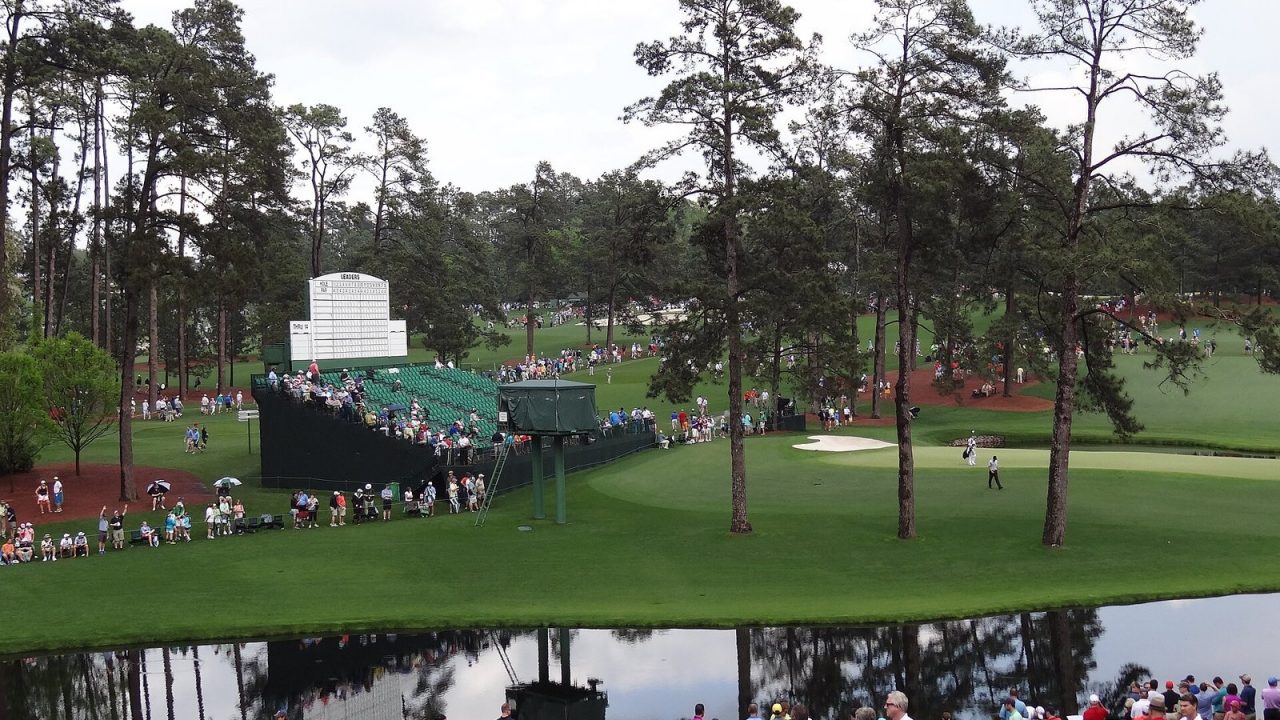
Turn on a golf broadcast on a Thursday and you will see players spread across the course, scores scrolling past and a leaderboard with dozens of names. By Sunday evening it has narrowed to a handful of contenders and, eventually, a single winner. In between lie a set of conventions that every fan picks up over time: the field, the draw, the cut, the weekend pairings and, occasionally, a playoff.
This guide walks through a typical four-day professional stroke-play event from start to finish, using the PGA Tour as the main example and noting where the majors and other events differ. Details are given as of the 2026 season.
The Basic Shape: 72 Holes of Stroke Play
The standard men’s professional tournament is 72 holes of stroke play, played as four rounds of 18 holes from Thursday to Sunday. Every stroke counts, and the player with the lowest total after 72 holes wins. That is different from match play, where players compete hole by hole; our comparison of stroke play and match play explains the distinction.
There are variations. Some events have different numbers of rounds, a few use different scoring systems, and team or match-play events follow their own formats. But the 72-hole stroke-play template covers the vast majority of tour events and all four men’s majors.
The Field: Who Gets to Play
The “field” is the list of players entered in a tournament. On the PGA Tour, events broadly fall into three types:
- Full-field events. The regular weekly tournaments, open to tour members according to their status category, plus sponsor invitations, Monday qualifiers and other exemptions. A 36-hole cut requires a field of at least 120 players.
- Limited-field events. Signature events and some invitationals have smaller fields drawn from the top players in season-long standings and other categories. Several of them have no cut at all.
- Opposite-field events. Played the same week as a major or another elite event, they give players who are not in the bigger tournament a chance to compete.
Majors build their fields differently, through long lists of exemption categories: past champions, recent major winners, players high in the Official World Golf Ranking, leading money or points earners and, for the “open” championships, players who come through qualifying. For an overview of each major’s personality, see our guide to the major championships.
Tee Times and Pairings
For the first two rounds of a full-field event, players are usually grouped in threes and sent off from both the 1st and 10th tees across a morning wave and an afternoon wave. A player who starts in the morning on Thursday typically plays in the afternoon on Friday, and vice versa, so that no one gets the better conditions for both days.
Pairings for the opening rounds are made by the tournament, often grouping players by status category, with marquee groupings of star players chosen for television. On the weekend, the field is re-paired according to scores: the leaders go out last, usually in twosomes if the field is small enough, and the players at the bottom of the leaderboard go off first. That is why the final group on Sunday is always the one that teed off last.
The Cut
The cut is the point, usually after 36 holes, where the field is reduced so that only the better-performing players continue for the weekend. Players who miss the cut go home and, on most tours, earn no prize money for the week.
PGA Tour cut rules
- Standard full-field events: the top 65 players and ties after 36 holes make the cut. This rule was introduced for the 2019–20 season; before that, the cut was the top 70 and ties.
- Player-hosted Signature Events (the Genesis Invitational, the Arnold Palmer Invitational and the Memorial Tournament): the top 50 and ties, plus anyone within 10 strokes of the lead after 36 holes.
- No-cut events: several limited-field tournaments, including the other Signature Events and the FedExCup Playoffs, have no cut. Every player completes all four rounds.
- Multi-course events: tournaments played over more than one course, such as The American Express, may use a cut after 54 holes instead of 36.
“And ties” matters. If the 65th-best score after two rounds is shared by several players, all of them make the cut, so the number of players continuing can be well above 65 in a crowded week.
A note on MDF
Older fans may remember the abbreviation MDF, “made cut, did not finish.” Under the old system, if more than 78 players made the 36-hole cut, a second cut after 54 holes reduced the field to roughly 70. Players removed by that second cut were paid and received points based on their position after 54 holes. The secondary cut no longer exists on the PGA Tour.
How the Majors Handle the Cut
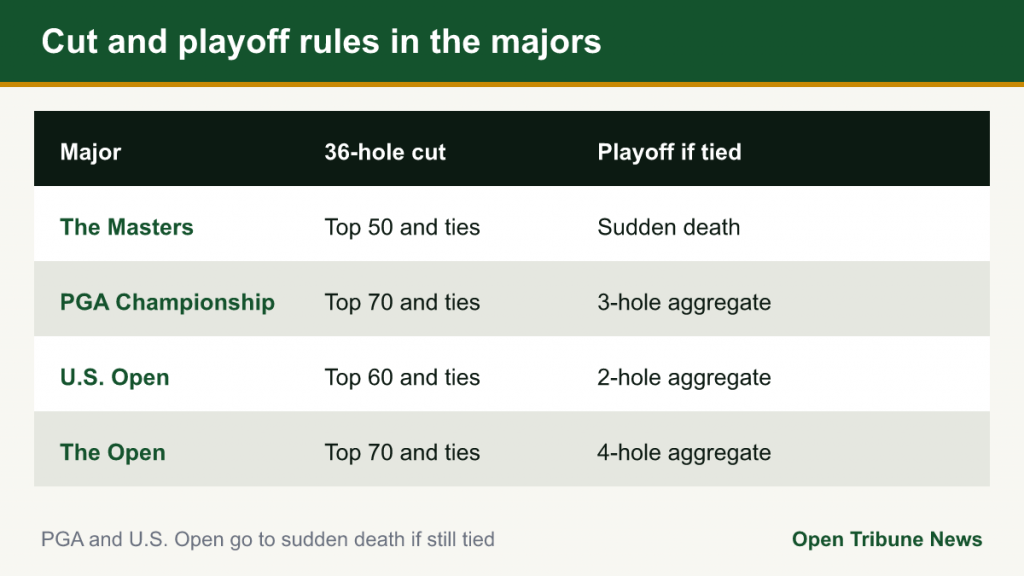
Each major sets its own cut rule, and they are not all the same:
| Major | 36-hole cut | Playoff format if tied after 72 holes |
|---|---|---|
| The Masters | Top 50 and ties | Sudden death |
| PGA Championship | Top 70 and ties | Three-hole aggregate, then sudden death |
| U.S. Open | Top 60 and ties (no 10-shot rule) | Two-hole aggregate, then sudden death |
| The Open | Top 70 and ties | Four-hole aggregate |
Amateurs count toward these numbers. At the U.S. Open, for example, the USGA treats amateurs and professionals the same for the cut; amateurs simply do not accept prize money, which affects how the purse is distributed at the bottom end of the field.
Weather and Suspensions
Golf is played outdoors over a large area, so weather is part of every event. Under the Rules of Golf, the Committee can suspend play, and when a suspension is for a dangerous situation such as lightning, players must stop immediately. When play resumes, players continue from where they stopped, which is why you sometimes see a player marking and leaving a ball overnight and returning early the next morning to complete a round.
Tournaments manage delays in several ways:
- Re-pairing and two-tee starts on the weekend to fit more players into fewer hours of daylight.
- Early restarts, with players completing earlier rounds at dawn before beginning the next one.
- Preferred lies (often called “lift, clean and place”) through a Local Rule when the fairways are saturated.
- Monday finishes when the final round cannot be completed on Sunday.
- Shortened events, where a tour can declare a result after fewer than 72 holes if the weather makes completing the event impossible. Each tour’s regulations set the minimum number of holes for an official result.
Ties and Playoffs
If two or more players share the lead after 72 holes, a playoff decides the winner. Formats vary:
- Sudden death. The standard on the PGA Tour and DP World Tour. The tied players play a designated hole (or sequence of holes) until one player scores lower than the others on a hole. The first to win a hole outright wins the event.
- Aggregate playoffs. The tied players play a fixed number of holes and add up their scores; if they are still tied, they continue with sudden death. The PGA Championship has used a three-hole aggregate playoff since 2000; the U.S. Open switched to a two-hole aggregate in 2018; and The Open uses a four-hole aggregate. The Players Championship has also used an aggregate format since 2014.
- The old 18-hole playoff. All four men’s majors originally used an 18-hole (or even 36-hole) playoff, typically played on the Monday. The Masters dropped it after 1976, adopting sudden death, and the PGA Championship moved to sudden death in 1977 before its current format. The U.S. Open’s full-round playoff lasted the longest, until the 2018 change.
Ties for positions other than first are not played off. Players tied for, say, fifth place share the combined prize money for the positions they occupy, and receive the same ranking and points credit according to each tour’s rules.
Sunday Afternoon: How a Winner Emerges
Putting it all together, a typical tournament week runs like this:
- Monday–Wednesday: practice rounds, pro-ams and, for some events, Monday qualifying.
- Thursday–Friday: rounds one and two in threesomes from two tees, with morning and afternoon waves swapping.
- Friday evening: the cut is made, and the field for the weekend is set.
- Saturday: round three, often called “moving day,” with groups re-paired by score.
- Sunday: the final round, with the leaders in the final group and, if needed, a playoff.
Quick answers to common viewer questions
- What is a Monday qualifier? A one-day qualifying event held at the start of tournament week, offering a small number of spots in the field to players without the status to enter directly.
- Why are scores shown relative to par? Because players are on different holes at any moment, “minus six through 12” is easier to compare than raw stroke totals.
- Why does the projected cut line move? It is recalculated live as scores come in. Afternoon players can push it up or down depending on conditions.
- What does “T5” mean? Tied for fifth. Ties for places other than first are not played off.
- Can an amateur win a professional event? Yes, and it does happen occasionally; the amateur simply cannot accept the prize money.
The rhythm is familiar after a few weeks of watching, but each element exists for a reason: to give everyone a fair share of the conditions, to manage a big field on a single course, and to produce a clear winner on Sunday evening.