The U.S. Open: History of Golf’s Toughest Test
From an 11-man field at Newport in 1895 to Ouimet, Hogan at Merion and Tiger's 15-shot win: the story of the U.S. Open and its brutal setups.
Every major has a personality. The Masters is the spring ritual at a single famous club, The Open is the links test shaped by wind, and the PGA Championship is the professionals’ own event. The U.S. Open’s identity is difficulty. Narrow fairways, punishing rough and firm, fast greens are its trademark, and a score around even par has often been good enough to contend. It is also the most democratic of the majors: thousands of professionals and low-handicap amateurs try to qualify every year.
This article traces the championship’s history from a modest one-day event in Rhode Island to one of the sport’s defining tests. For an overview of how the four majors fit together today, see our explainer on the four men’s major championships.
Newport, 1895: A Modest Beginning
The United States Golf Association was founded in 1894, and its national open championship followed quickly. The first U.S. Open was played on October 4, 1895, at Newport Country Club in Rhode Island, on a nine-hole course. It was a 36-hole event completed in a single day, and the field consisted of ten professionals and one amateur.
The winner was Horace Rawlins, a 21-year-old Englishman who had recently taken a job at the host club. That detail tells you a lot about American golf at the time. The game was young in the United States, and most of the best players were professionals who had emigrated from Scotland and England. For the championship’s first decade and a half, British-born professionals dominated.
The standout of that early era was Willie Anderson, a Scottish-born professional who won the U.S. Open four times, including three in a row from 1903 to 1905. More than a century later, no one has matched that run of three straight titles.
Homegrown Champions: McDermott and Ouimet
The turning point came in 1911, when John J. McDermott became the first American-born player to win the championship. He was 19 years old, and he remains the youngest U.S. Open champion on record.
Two years later came the moment many historians regard as the birth of golf as a mainstream American sport. At the 1913 U.S. Open at The Country Club in Brookline, Massachusetts, a 20-year-old amateur named Francis Ouimet, who had grown up across the street from the course, tied the great British professionals Harry Vardon and Ted Ray after 72 holes. In an 18-hole playoff the next day, played in the rain, Ouimet shot 72 to Vardon’s 77 and Ray’s 78.
Ouimet’s caddie was Eddie Lowery, a 10-year-old boy, and the image of the two of them walking the course became one of the most enduring in American sport. Ouimet was the first amateur to win the U.S. Open. His victory over two of the most famous players in the world drew huge crowds and front-page coverage, and it is widely credited with accelerating the growth of the game in the United States.
Amateurs won several more U.S. Opens in the following two decades, including Jerome Travers in 1915, Chick Evans in 1916, Bobby Jones four times, and Johnny Goodman in 1933. No amateur has won since Goodman.
Bobby Jones and the Four-Time Winners
Bobby Jones, the Atlanta amateur, won the U.S. Open in 1923, 1926, 1929 and 1930. His 1930 victory was one leg of his famous Grand Slam season, after which he retired from competitive golf at just 28. Jones went on to co-found Augusta National and the Masters.
As of 2026, four players share the record of four U.S. Open titles:
| Player | U.S. Open wins |
|---|---|
| Willie Anderson | 1901, 1903, 1904, 1905 |
| Bobby Jones | 1923, 1926, 1929, 1930 |
| Ben Hogan | 1948, 1950, 1951, 1953 |
| Jack Nicklaus | 1962, 1967, 1972, 1980 |
Nicklaus’s first professional win came at the 1962 U.S. Open at Oakmont, where he beat Arnold Palmer in a playoff, a story covered in our profile of Jack Nicklaus and his 18 majors. Nicklaus also holds the record for consecutive U.S. Opens started: 44, from 1957 to 2000.
Hogan at Merion, 1950
No U.S. Open story is more celebrated than Ben Hogan’s victory at Merion Golf Club near Philadelphia in 1950. Sixteen months earlier, in February 1949, Hogan had been badly injured when a bus collided head-on with his car. There were doubts he would walk normally again, let alone compete.
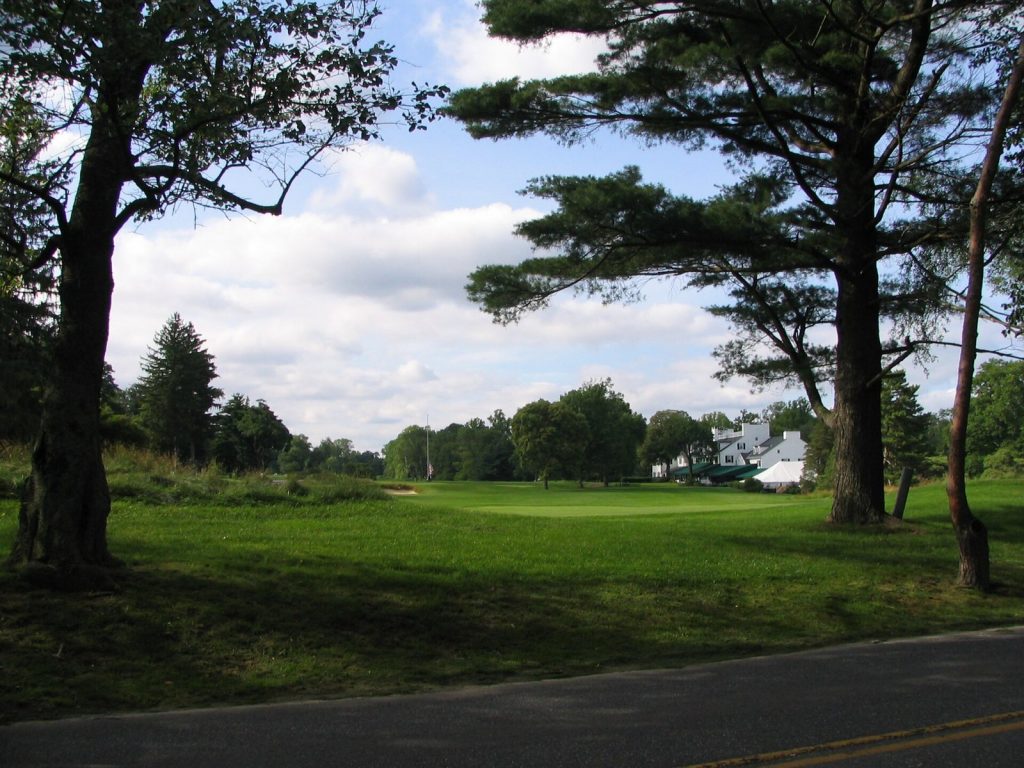
At Merion, the championship still ended with 36 holes on Saturday, a grueling test for a player whose legs were heavily bandaged. Coming to the 72nd hole in a tie for the lead, Hogan hit a 1-iron approach to the green, a shot captured in one of golf’s most famous photographs, and two-putted for par to join Lloyd Mangrum and George Fazio in a playoff at 287. The next day Hogan shot 69, beating Mangrum by four strokes and Fazio by six. The week became known as the “Miracle at Merion.”
Hogan won the U.S. Open again in 1951 at Oakland Hills and in 1953 at Oakmont, part of a 1953 season in which he also won the Masters and The Open.
Why the U.S. Open Is Known as the Toughest Test
The USGA has long set up its championship courses to examine every part of a player’s game. The traditional formula features:
- Narrow fairways that demand accurate driving.
- Thick rough bordering the fairways and greens, which makes recovering difficult and controlling spin from the long grass almost impossible.
- Firm, fast greens that punish approach shots hit to the wrong side of the hole.
- Demanding host courses, many of them classic designs such as Oakmont, Winged Foot, Shinnecock Hills, Pebble Beach, Pinehurst No. 2 and Merion.
Oakmont Country Club near Pittsburgh has hosted the championship more than any other course, ten times through 2025. Its fast greens and the famous “Church Pews” bunker are central to the U.S. Open’s image.
The emphasis on difficulty has occasionally produced controversy, when setups were seen as crossing the line from hard to unfair, particularly on greens that became too firm late in the week. Those debates are part of the championship’s character. The aim is a test where par is a genuinely good score, and over the decades the winning total has often hovered not far from it.
Tiger at Pebble Beach, 2000
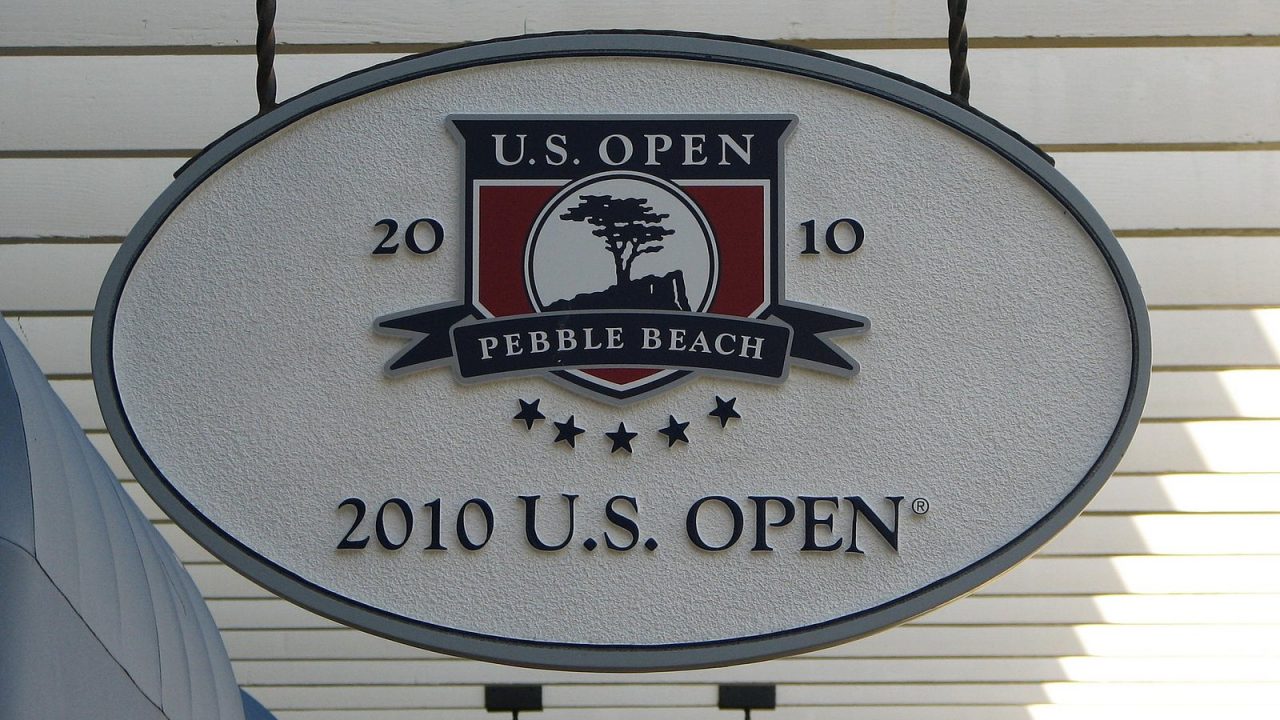
If difficulty is the U.S. Open’s identity, Tiger Woods’s performance at Pebble Beach in 2000 shows how far one player can separate himself. Woods won by 15 strokes, the largest winning margin in the history of the major championships. He was the only player under par for the week. The victory began a run in which he held all four major titles at the same time, completed at the 2001 Masters.
Woods won three U.S. Opens in all. His third, at Torrey Pines in 2008, came after an 18-hole Monday playoff against Rocco Mediate that went to sudden death, where Woods won on the first extra hole.
Records and Notable Facts
Highlights from the championship’s record book, as of 2026:
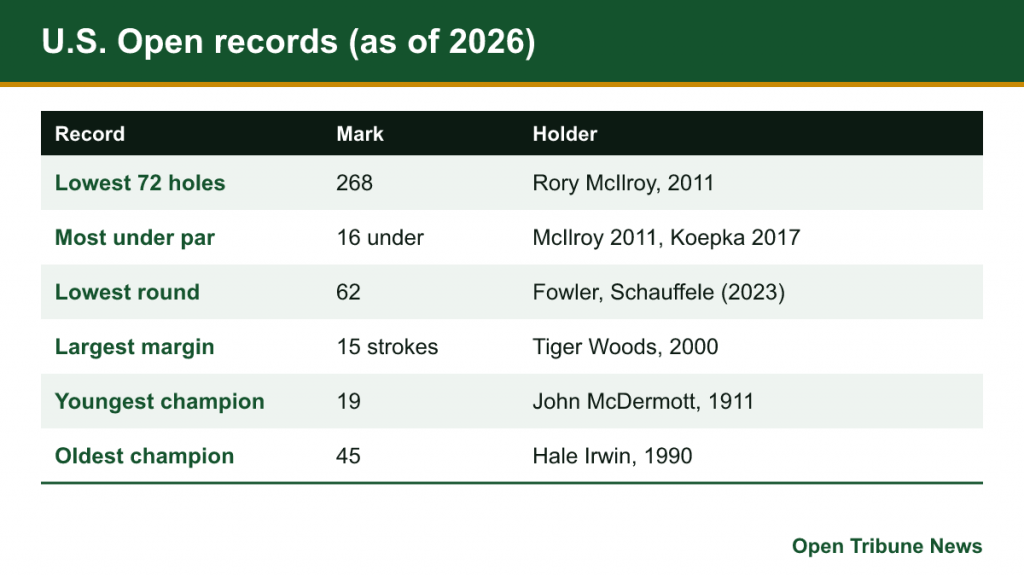
- Lowest 72-hole score: 268, by Rory McIlroy at Congressional in 2011.
- Lowest score relative to par: 16 under, shared by McIlroy (2011) and Brooks Koepka (2017).
- Lowest round: 62, shared by Rickie Fowler and Xander Schauffele, both at Los Angeles Country Club in 2023.
- Largest margin: 15 strokes, Tiger Woods, 2000.
- Youngest champion: John McDermott, 19, in 1911.
- Oldest champion: Hale Irwin, 45, in 1990.
- Most runner-up finishes: 6, Phil Mickelson, whose career major record notably lacks a U.S. Open title.
The playoff format has also evolved. For most of the championship’s history, a tie after 72 holes was settled by a full 18-hole playoff the following day. Starting in 2018, the USGA switched to a two-hole aggregate playoff, followed by sudden death if players remain tied.
Recent Champions
| Year | Champion | Venue |
|---|---|---|
| 2023 | Wyndham Clark | Los Angeles Country Club |
| 2024 | Bryson DeChambeau | Pinehurst No. 2 |
| 2025 | J.J. Spaun | Oakmont Country Club |
| 2026 | Wyndham Clark | Shinnecock Hills |
Clark’s 2026 win was his second U.S. Open title, and DeChambeau’s 2024 win was also his second, after he first won at Winged Foot in 2020.
Open to All: How Qualifying Works
The word “Open” is meant seriously. The championship field is 156 players, and roughly half are fully exempt through categories such as past champions, recent major winners and players high in the world ranking. The rest of the places are earned through qualifying.
Any professional, and any amateur with a USGA Handicap Index of 0.4 or lower, can enter. Non-exempt players typically begin with local qualifying, an 18-hole stage played at more than 100 sites, and successful players advance to final qualifying, 36 holes played in a single day. The format has produced memorable underdog stories, and in 2012 Andy Zhang of China became the youngest player ever to qualify, at age 14.
This open-entry path is part of what makes the U.S. Open distinctive. The field mixes the best players in the world with club professionals, college golfers and amateurs who survived two qualifying stages. For more on how fields, cuts and tee times work at events like this, see how a pro golf tournament works.
The Legacy
From Rawlins’s victory on a nine-hole course to modern champions battling deep rough at Oakmont and Shinnecock, the U.S. Open has kept a consistent idea at its center: the national championship should be the hardest test in golf, and anyone good enough should be able to try to win it. Ouimet’s upset, Hogan’s 1-iron and Woods’s 15-shot rout are its most famous chapters, but the championship’s real character shows up every June, when the world’s best players are pleased to make a par.