Wedges Explained: Loft, Bounce and Grind
Pitching, gap, sand and lob wedges explained: loft gapping, how bounce and sole grinds interact with turf and sand, and the 2010 groove rule.
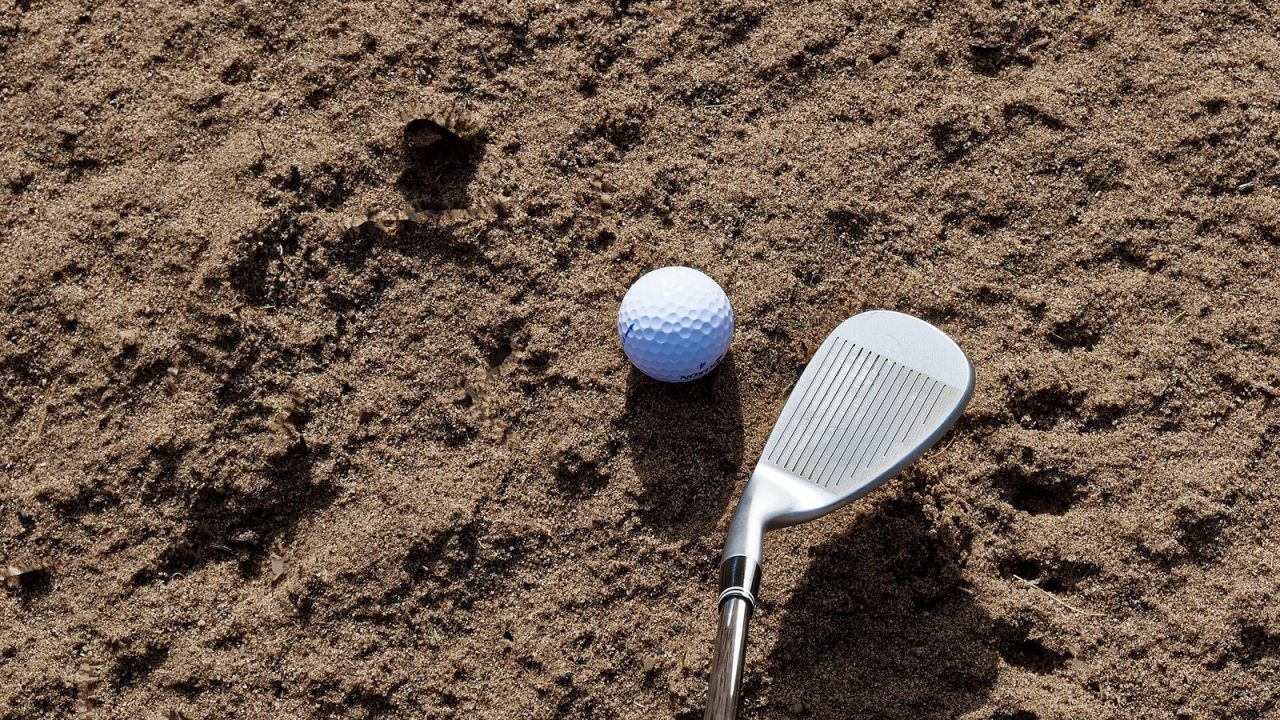
Wedges are the scoring clubs. They hit the approach shots closest to the green, play the chips and pitches around it and get you out of bunkers. Yet they are also the clubs most golfers understand least. A label stamped on the sole, something like “56-10,” carries two numbers, and many players only know what the first one means. This guide explains the wedge family, how to space their lofts, what bounce and grind actually do and why groove rules changed in 2010.
If you are still getting to know the whole set, start with our overview of woods, hybrids, irons, wedges and the putter.
The Four Wedge Types
Wedges are the highest-lofted irons, with heavier heads and wider soles than the rest of the set. They are usually grouped into four types. The lofts below are traditional approximate ranges; individual sets vary, and many modern game-improvement sets use stronger (lower) lofts in the pitching wedge than the traditional figure.
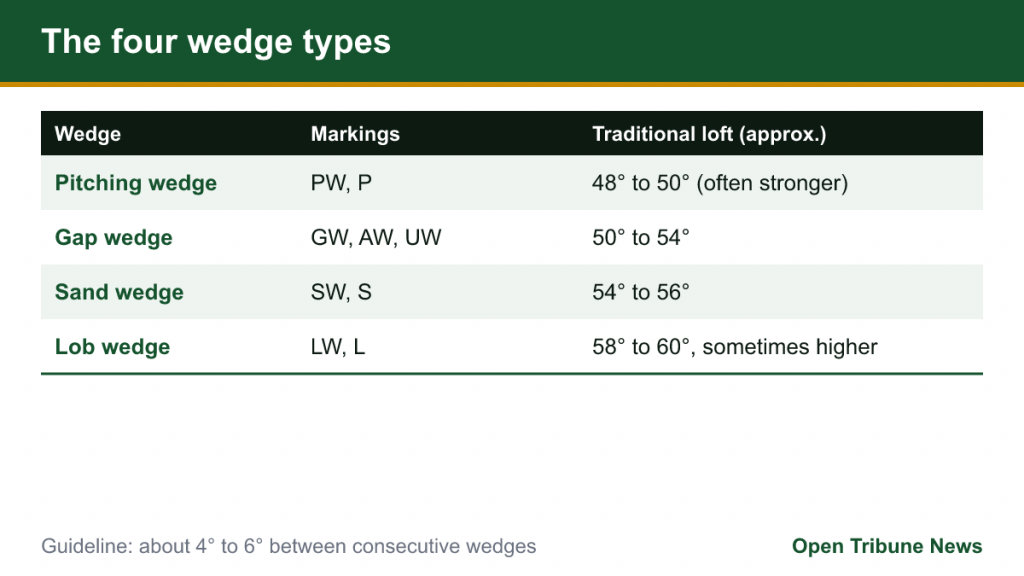
| Wedge | Common markings | Traditional loft range (approx.) | Typical uses |
|---|---|---|---|
| Pitching wedge | PW, P | Around 48° to 50°, often stronger in modern sets | Full approach shots, longer chips and bump-and-runs |
| Gap wedge | GW, AW (approach), UW | Around 50° to 54° | Fills the distance gap between pitching and sand wedge |
| Sand wedge | SW, S | Around 54° to 56° | Bunker shots, pitches, shots from rough |
| Lob wedge | LW, L | Around 58° to 60°, sometimes higher | High, soft shots over hazards; short-sided chips; some bunker play |
Most wedges are also stamped with their loft number, so many golfers simply refer to them as a 52, 56 or 60 rather than by name.
Loft Gapping: Building Consistent Distances
Gapping means spacing your wedge lofts so that each club covers a distinct distance with a full swing, without big jumps or overlaps. A common guideline is to keep roughly four to six degrees between consecutive wedges.
Here is why gapping matters. If your pitching wedge is quite strong and your next club is a traditional 56-degree sand wedge, there may be a big distance gap between them. You end up hitting awkward partial swings for a whole range of yardages. Adding a gap wedge in between solves that problem.
A practical way to build your wedge set:
- Start with your pitching wedge loft. Check the manufacturer’s specification for your set, since PW lofts vary widely.
- Add wedges in steps. Spacing of around four to six degrees keeps full-swing distances evenly separated.
- Respect the 14-club limit. The Rules of Golf allow a maximum of 14 clubs (Rule 4.1b). Adding a fourth wedge may mean dropping a long iron, hybrid or fairway wood. Our guide to building your first golf set discusses those trade-offs.
- Check on a launch monitor or range. Actual carry distances depend on your swing, the ball and strike quality, not only on loft.
Bounce: The Most Misunderstood Number
Bounce is the angle between the leading edge of the club and the lowest point of the sole when the shaft is upright at address. Put simply, on a wedge the back edge of the sole sits lower than the front edge, so the leading edge is lifted off the ground.
That angle changes how the club interacts with the ground:
- In sand: bounce lets the club slide through the sand under the ball rather than digging in. The sand, not the club, pushes the ball out. This is the principle behind the modern sand wedge.
- In soft turf or rough: bounce helps the club glide rather than dig, reducing fat (heavy) shots.
- On firm turf: too much bounce can make the club skid or bounce off the ground into the middle of the ball, causing thin shots. Lower bounce allows the leading edge to sit closer to the turf.
Bounce is usually described in three broad bands. Exact numbers vary by manufacturer, so treat these as general categories rather than fixed ranges:
- Low bounce: for firm conditions, tight lies, coarse or firm bunkers and players with shallow attack angles who sweep the ball.
- Mid bounce: the most versatile option, suited to a wide range of conditions and swing types.
- High bounce: for soft conditions, fluffy sand and players with steep attack angles who take deep divots.
The sand wedge traditionally carries the most bounce in the bag. When choosing, think about two things: your typical course conditions and your swing. A “digger” with a steep downswing generally benefits from more bounce, while a “sweeper” who barely brushes the turf often prefers less.
The Sand Wedge and Gene Sarazen
Bounce as we know it is linked with Gene Sarazen. After concave-faced wedges were banned in the early 1930s, Sarazen developed a club with a straight face and extra weight added along the sole, creating a flange that would glide through sand. He used it on his way to winning both the U.S. Open and the British Open in 1932, and the club’s popularity grew quickly afterwards. Earlier players had used lofted clubs for difficult lies, but Sarazen’s design with its heavy, angled sole is generally credited as the origin of the modern sand wedge.

Grind: Shaping the Sole
A grind is a shaping of the wedge’s sole, where material is removed from areas such as the heel, toe or trailing edge. Grinds change how much bounce the club effectively presents as you open or close the face, and how the sole interacts with the ground on different shots.
Common ideas behind different grinds include:
- Full sole or wide sole: maximum forgiveness on square-faced shots and in soft sand; less versatile when you open the face.
- Heel relief: removing material from the heel lets the leading edge stay closer to the ground when you open the face for a high, soft shot.
- Trailing-edge relief: removing material at the back of the sole helps the club sit lower on firm lies and reduces skidding.
- Toe relief: can help on certain open-faced shots and in some lies.
Each manufacturer uses its own grind names and letters, so the same letter means different things from brand to brand. The practical lesson: if you mostly play square-faced shots, a simpler, wider sole often works well. If you like to manipulate the face around the green, a grind with heel and trailing-edge relief usually feels more versatile. A fitting or trying wedges on real turf and sand is the best way to decide.
Grooves and the 2010 Groove Rule
Grooves on a wedge face help channel away grass, moisture and debris at impact so the ball contacts the face more cleanly. This influences spin, especially from the rough.
In 2010 the USGA and The R&A introduced new limits on groove volume and edge sharpness for irons and wedges, effectively phasing out the sharp-edged “square” or U-grooves that had become common. The concern was that such grooves allowed elite players to spin the ball from rough almost as well as from the fairway, reducing the reward for accurate driving.
The implementation was gradual:
- January 1, 2010: professional tour players and players in elite championship qualifying needed conforming clubs.
- January 1, 2011: manufacturers had to stop producing non-conforming clubs.
- 2014: the condition was extended to other USGA championship qualifying.
Conforming wedges are often marketed with a marking such as “CC” (Condition of Competition). Whether older grooves are allowed in a recreational competition depends on the Committee’s conditions, so club golfers who still carry older wedges should check before a qualifying event.
How Many Wedges Should You Carry?
There is no single answer. Some common setups:
- Two wedges (pitching and sand): simple, common for beginners and in many boxed sets.
- Three wedges (pitching, gap and sand, or pitching, sand and lob): the most common configuration for regular golfers.
- Four wedges (pitching, gap, sand and lob): popular with better players and tour professionals who value precise distance control inside full-swing range.
More wedges help only if you can use them. A golfer who struggles with a 60-degree lob wedge may score better by mastering a sand wedge for most short shots. Our guide to golf shafts also explains why wedge shafts are often matched to, or a little heavier than, iron shafts.
Wedge Care and Replacement
Wedges wear faster than other clubs because they are used often and strike sand and turf. Over time the groove edges become rounded, which can reduce spin, especially from wet or grassy lies. Cleaning grooves during and after a round helps keep the face working as designed. There is no fixed lifespan, but golfers who play and practice a lot often notice performance drop sooner than occasional golfers.
Common Wedge Mistakes
- Ignoring bounce: choosing a wedge only by loft and then struggling because the bounce does not suit your conditions or swing.
- Big gaps: carrying a strong pitching wedge and a sand wedge with nothing in between.
- Too much loft for your skill: high-lofted lob wedges demand precise contact; a sand wedge is often more reliable.
- Worn grooves: expecting the same spin from a heavily used wedge as from a new one.
Quick questions
What does “56-10” on a wedge mean? Usually 56 degrees of loft and 10 degrees of bounce. Some brands add a letter for the sole grind.
Can one wedge do everything around the green? Many good short-game players rely heavily on one favorite wedge and vary ball position, face angle and swing length. Learning one club well is a sound approach for most golfers before adding more.
Should my wedges match my iron set? Set-matching pitching and gap wedges blend well with the irons for full shots, while specialty wedges with more sole options often suit shots around the green. Many golfers combine both.