Golf Shafts Explained: Flex, Weight, Torque and Kick Point
What flex, weight, torque and kick point really mean, how steel and graphite differ, and how to think about matching a shaft to your swing.
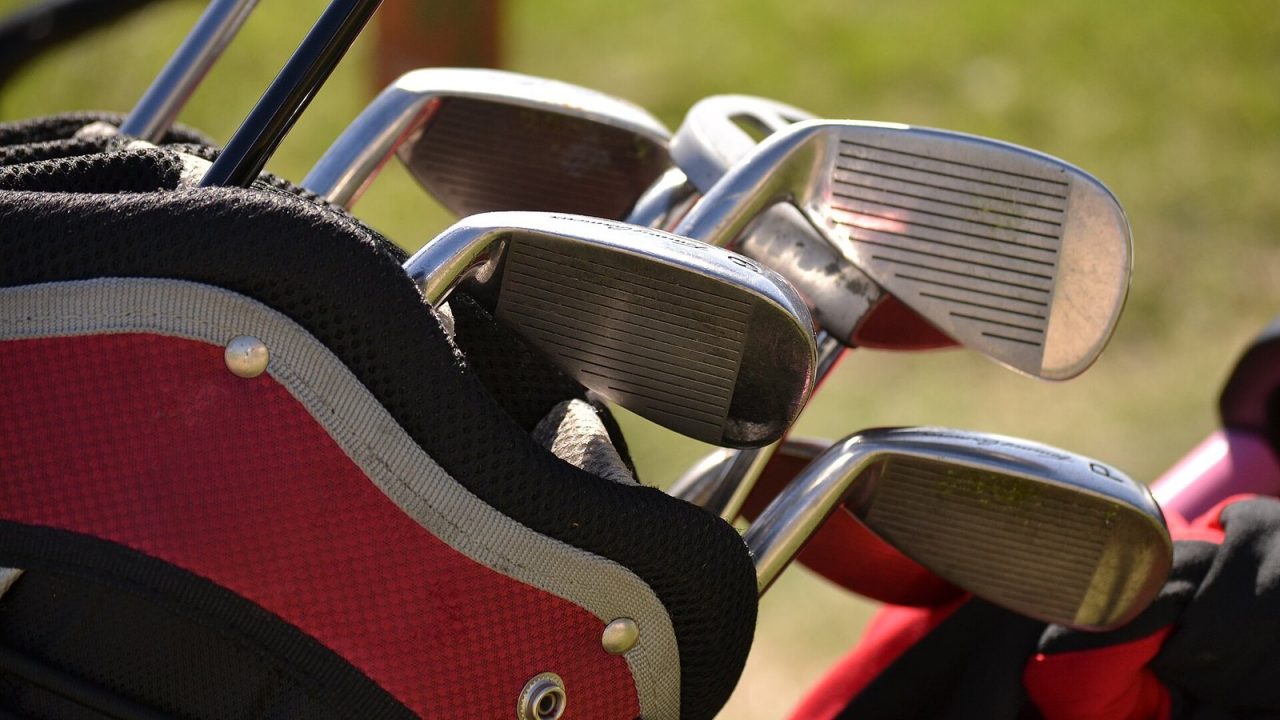
Golfers obsess over clubheads. Yet the shaft, the long tube that connects your hands to that head, has a large say in how the club feels, how the head arrives at the ball and how the ball leaves the face. Two identical heads on two different shafts can feel like completely different clubs.
This guide explains the main shaft specifications you will see on a label or a fitter’s screen: material, flex, weight, torque and kick point. It describes how each one tends to influence feel and ball flight in general terms, and why the honest answer to “which shaft should I use?” is almost always “test a few.”
What a Shaft Actually Does
A golf shaft is a tapered tube, wider at the grip end (the butt) and narrower where it enters the clubhead (the tip). According to the standard reference description of the golf club, shafts are roughly half an inch in diameter near the grip and run from about 34 to 48 inches long depending on the club, with weights ranging widely, from around 45 grams for very light graphite driver shafts to well over 100 grams for heavier steel iron shafts.
During the swing the shaft does three things at once. It bends, because the force of the swing loads it. It twists, because the clubhead’s center of mass sits behind and away from the shaft’s axis. And it transmits sensation back to your hands, which is a large part of what golfers call “feel.” The shaft does not create speed on its own. Your body and arms do that. But the way it bends and recovers affects the timing of the release, where the face points at impact and the angle at which the ball launches.
If you are new to equipment, it helps to read our overview of the different club families first, because shaft choices differ between woods, irons, wedges and the putter.
Steel vs Graphite: A Short History and the Real Differences
Shafts have not always been metal. Early clubs used shafts made from woods such as ash, and hickory became the standard material in the 19th century. Hickory had a weakness: it could twist and snap, especially at the top of the swing. Steel shafts were patented in 1910, but the governing bodies were slow to accept them. The USGA lifted its ban in 1924, and the R&A followed in 1929. Steel then became the near-universal material until graphite (carbon-fiber composite) arrived and gradually took over in woods.
Today the broad pattern looks like this:
- Drivers and fairway woods almost always use graphite shafts. Graphite is lighter, which helps golfers generate clubhead speed with longer clubs.
- Irons are split. Many better players and stronger swingers use steel for its consistency and heavier weight, while many seniors, juniors and golfers with slower swings prefer graphite for its lighter weight and the reduced vibration many players notice at impact.
- Wedges are most often steel, frequently matched to or slightly heavier than the iron shafts.
- Putters are mostly steel, though graphite and composite putter shafts exist.
The old idea that graphite is only for slow swingers is outdated. Graphite can be made heavy and stiff, and steel can be made relatively light. What matters is the profile of the specific shaft, not just the material on the label.
Flex: The Spec Everyone Knows (and Misunderstands)
Flex describes how much a shaft resists bending under load. It is the most familiar shaft spec, usually shown as a letter on the shaft or in the product name. The common designations are:
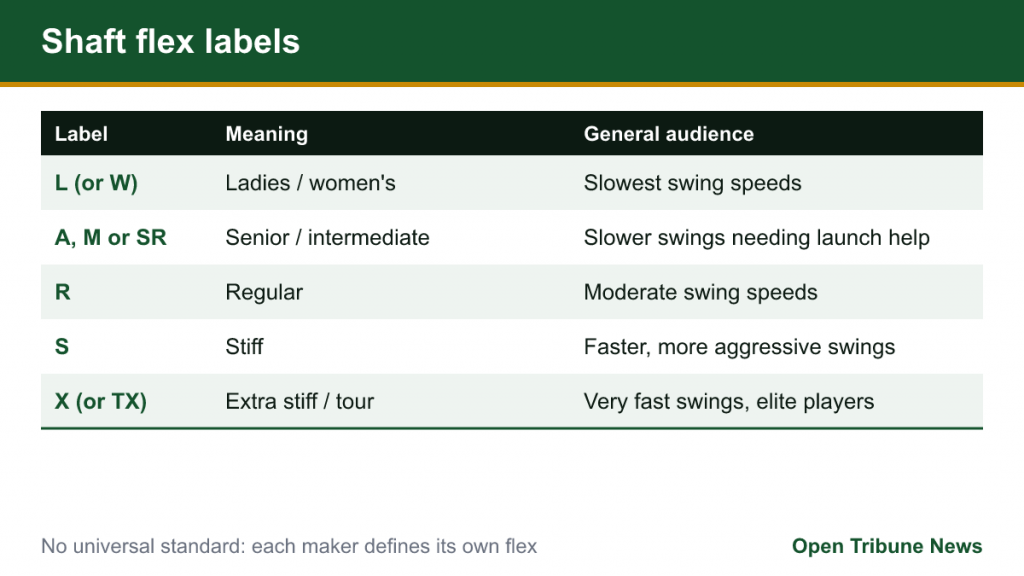
| Label | Meaning | General audience |
|---|---|---|
| L (sometimes W) | Ladies / women’s | Slowest swing speeds |
| A, M or SR | Senior, “amateur” or intermediate | Slower swings that need more help launching |
| R | Regular | Moderate swing speeds |
| S | Stiff | Faster, more aggressive swings |
| X (also TX on some shafts) | Extra stiff / tour extra stiff | Very fast swings, typically elite players |
The general relationship is widely accepted: slower swing speeds tend to perform better with more flexible shafts, and faster swing speeds tend to need stiffer ones. A shaft that is too soft for a fast swing can feel loose and may contribute to inconsistent direction and higher launch than intended. A shaft that is too stiff for a slower swing can feel boardy, launch the ball lower and give a dead sensation at impact.
Here is the catch that confuses many golfers: there is no universal standard for flex labels. Each manufacturer defines its own ranges, so one company’s “stiff” can be noticeably firmer or softer than another’s. A label is a starting point for a conversation, not a precise measurement. Fitters who want to compare shafts accurately often measure the frequency (how fast the shaft oscillates when clamped and plucked) or bend profiles rather than trusting the letter.
Swing speed is also only one input. Tempo matters: a golfer who changes direction abruptly at the top loads the shaft harder and earlier than a smooth swinger at the same speed, and often prefers a firmer profile.
Shaft Weight: Often More Important Than Flex
Shaft weight is listed in grams and can vary enormously within the same club category. Weight influences both swing speed and control:
- Lighter shafts are easier to swing faster for many golfers, which is why many drivers ship with relatively light graphite. The trade-off is that a shaft that feels too light can make it harder to sense where the clubhead is during the swing, and some players get quick or loose with their tempo.
- Heavier shafts can promote a steadier tempo and a more stable feel through impact for strong players. If a shaft is too heavy for your strength, however, your technique can suffer as you fight to swing it, and fatigue can set in late in the round.
A common progression in a well-built set is that shaft weights get gradually heavier as clubs get shorter: lightest in the driver, a little heavier in the fairway woods and hybrids, heavier again in the irons and wedges. The idea is a consistent feel across the bag rather than a sudden jump from one club to the next.
Torque: Resistance to Twisting
Torque measures how much a shaft twists along its length when a turning force is applied, and it is usually expressed in degrees. Because the clubhead’s center of gravity sits away from the shaft axis, the head tries to rotate the shaft during the downswing and at impact.
- Low torque (roughly two to three degrees on many graphite shafts) means the shaft twists relatively little. These shafts often feel firmer and are common among faster swingers.
- Higher torque (around five degrees or more) means more twist. These shafts often feel softer or smoother, and they are typically paired with slower swings.
Steel shafts generally have low torque by nature of the material, so torque is discussed mainly with graphite. Stiffer shafts generally torque less, and manufacturers can tune torque along the length, for example by reinforcing the tip section near the head.
How much torque actually affects ball flight is debated; some equipment makers argue its measurable effect is small and shows up mostly as feel. Treat it as one part of the overall profile, judged on a launch monitor and in your hands rather than by number alone.
Kick Point and Bend Profile
The kick point, sometimes called the bend point or flex point, is the area of the shaft that bends the most. Shafts are commonly described as low, mid or high kick:
- Low kick point: the most bend happens nearer the clubhead. These shafts are typically associated with a higher launch and can feel more active in the head. They are often recommended for players who struggle to get the ball airborne.
- Mid kick point: a balance between the two and the most common profile in mainstream shafts.
- High kick point: the most bend happens nearer the grip. These shafts usually feel firmer, and they tend to be linked with a lower, more penetrating flight and a sense of control. Stronger players who launch the ball too high often look here.
Kick point influences both how the club feels and the trajectory at which the ball launches, but its effect on launch is generally modest compared with loft, attack angle and where you strike the face. A single number also simplifies a more complicated reality. Modern shafts are designed with a full bend profile: the relative stiffness of the butt, mid-section and tip. Two shafts with the same “mid” kick label can still feel quite different if one has a soft tip and firm butt and the other is the opposite.
How the Pieces Fit Together
Flex, weight, torque and kick point do not act alone. A fitter will usually think about the combination:
- Start with weight. Find a weight range that lets you swing with good speed while keeping control and a repeatable tempo.
- Then flex and profile. Within that weight, look for the flex and bend profile that produces the best launch and the most consistent face delivery for your tempo.
- Use launch and spin data. If the ball launches too low with too little spin, a softer tip or lower kick profile may help. If it balloons with too much spin, a firmer tip or higher kick profile might bring it down.
- Do not ignore feel. Confidence matters. A shaft that numbers well but feels wrong can be hard to trust under pressure.
Length matters too: a longer shaft can add speed in theory but often makes centered contact harder. Our guide to choosing a driver covers the length limit and how adjustable hosels interact with shaft choice.
Common Mistakes When Choosing Shafts
- Choosing flex out of pride. Many golfers play shafts that are too stiff because “stiff” sounds like a better player’s spec. A shaft that is too firm often leads to low, weak shots that drift to the right for a right-handed golfer.
- Trusting labels across brands. Because flex standards differ between manufacturers, switching brands without testing can mean a real change in stiffness even if the letter is the same.
- Ignoring tempo. Swing speed alone does not tell the whole story. A smooth swinger and a jerky swinger at the same speed may need different shafts.
- Expecting a shaft to fix a swing. The right shaft can make good swings more effective and poor ones a little less punishing. It will not cure a major swing fault. Lessons with a qualified coach do that.
Frequently Asked Questions
Do beginners need to worry about shafts?
Not much at first. A beginner’s swing changes quickly, so the most important thing is to avoid shafts that are obviously too heavy or too stiff. Most beginner sets use regular or senior flex for that reason. Our guide to building your first golf set covers this in more detail.
Should my driver and irons have the same flex?
Often, but not necessarily. Because labels differ between product lines, consistent feel and performance matter more than matching letters.
Is a fitting worth it for shafts alone?
For golfers who play regularly, a fitting is the most reliable way to compare shafts because a launch monitor shows the actual effect on launch, spin and dispersion. Without data, it is easy to mistake a good swing for a good shaft.