Tiger Woods’ Legacy: The Tiger Slam and 15 Majors
Tiger Woods' record amateur run, the 1997 Masters, the 2000-01 Tiger Slam, 82 PGA Tour wins, the 2019 Masters and his lasting impact on golf.
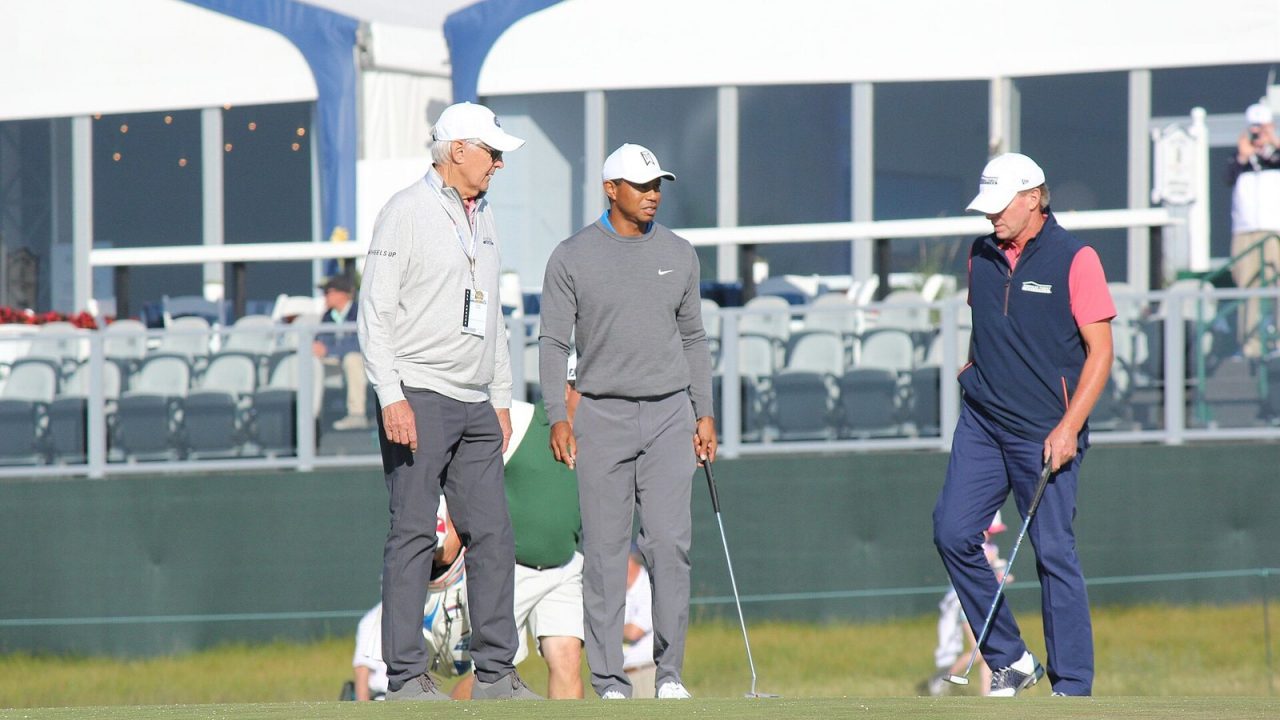
Few athletes have changed their sport as completely as Tiger Woods changed golf. He arrived as a prodigy with unprecedented expectations and exceeded most of them. Over roughly a decade at his peak, he won majors by margins nobody had seen before, held all four major titles at once and spent years at the top of the world ranking. His career has also included serious injuries, long absences and one of sport’s most celebrated comebacks.
This profile focuses on the golf: the amateur record, the major championships, the records and the ways the professional game changed around him. All counts are as of 2026.
A Record-Breaking Amateur Career
Woods was famous in golf circles before he was a teenager, but his amateur record is what set him apart. He won the U.S. Junior Amateur three years in a row, from 1991 to 1993, and remains the only three-time champion of that event. He then won the U.S. Amateur three consecutive times, in 1994, 1995 and 1996, becoming the first player to do so.
He attended Stanford University before turning professional in August 1996 at the age of 20. He won twice on the PGA Tour before that season was out, a fast start that hinted at what was to come.
The 1997 Masters: Twelve Strokes
Woods’s first major as a professional came at the 1997 Masters, and it was a statement. He finished at 18 under par with a 72-hole total of 270, winning by 12 strokes. At 21, he became the youngest Masters champion. His victory as the first champion of African American and Asian heritage at Augusta National also carried significance far beyond the scoreboard.
That June, on June 15, 1997, he reached No. 1 in the world ranking for the first time. Our history of the Masters places the 1997 win in the context of the tournament’s traditions.
The Tiger Slam, 2000–01
The modern Grand Slam means winning the Masters, U.S. Open, Open Championship and PGA Championship in one calendar year. No man has done it in the professional era. Woods came as close as anyone, winning four consecutive majors across two seasons:
| Major | Venue | Result |
|---|---|---|
| 2000 U.S. Open | Pebble Beach | Won by 15 strokes, a record margin for a major championship |
| 2000 Open Championship | St Andrews (Old Course) | Won by 8 strokes at 19 under par |
| 2000 PGA Championship | Valhalla | Won a three-hole playoff over Bob May |
| 2001 Masters | Augusta National | Completed four consecutive major titles |
The run became known as the “Tiger Slam.” Because it spanned two calendar years, it did not meet the traditional definition of a Grand Slam, and there was debate about what to call it. What nobody disputed was the scale of the achievement: he held all four major trophies at the same time.
Several details stand out:
- Pebble Beach: Woods’s 15-stroke victory remains the largest winning margin in major championship history, covered in our U.S. Open history.
- St Andrews: his 19-under total was the lowest score to par in any major at the time, a mark that stood until 2015. With that win he completed the career Grand Slam at 24, the youngest to do so.
- Valhalla: Woods and Bob May both finished at 18 under. Woods birdied the first playoff hole and parred the next two to win by one stroke. It was also the first successful PGA Championship title defense since 1937, and it made Woods the first player since Ben Hogan in 1953 to win three majors in a calendar year.
Fifteen Major Championships
Woods’s 15 majors rank second all time to Jack Nicklaus’s 18. Our profile of Jack Nicklaus explains the benchmark Woods spent his career chasing.
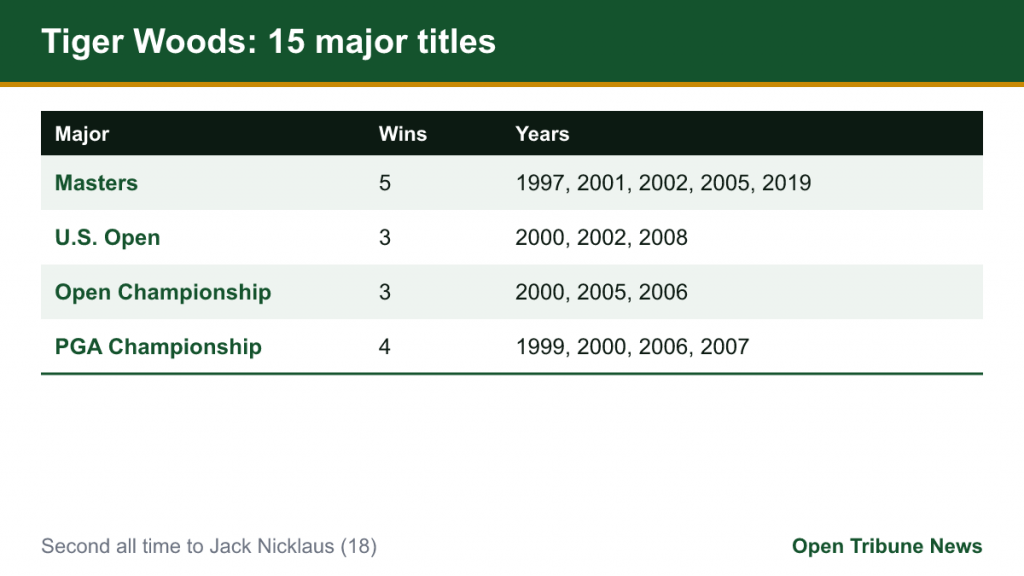
| Major | Wins | Years |
|---|---|---|
| Masters | 5 | 1997, 2001, 2002, 2005, 2019 |
| U.S. Open | 3 | 2000, 2002, 2008 |
| Open Championship | 3 | 2000, 2005, 2006 |
| PGA Championship | 4 | 1999, 2000, 2006, 2007 |
The 2008 U.S. Open at Torrey Pines became one of his most famous wins. Playing with a serious knee injury, he tied Rocco Mediate after 72 holes, and after an 18-hole Monday playoff they were still tied. Woods won on the first sudden-death hole. Surgery and a long layoff followed.
82 PGA Tour Wins and Other Records
In October 2019, Woods won the Zozo Championship in Japan for his 82nd PGA Tour victory, tying Sam Snead’s all-time record. Other career landmarks include:
- 683 weeks as world No. 1, by far the most in the history of the ranking, including runs of 264 consecutive weeks (1999–2004) and 281 consecutive weeks (2005–2010).
- PGA Tour Player of the Year 11 times.
- PGA Tour money list leader 10 times.
- Vardon Trophy for lowest scoring average nine times.
- 18 World Golf Championships titles, in the series of elite, limited-field events that ran alongside the majors during his peak years.
Numbers like these help explain why the “Tiger era” is treated as a distinct period in golf history.
Beyond the Majors: Consistency at a New Level
Major titles define legacies, but Woods’s week-to-week record was just as remarkable. In the 2006 season he won eight PGA Tour events, and he followed it with seven more in 2007. He contended so often that a finish outside the top ten became news.
His approach to winning was also distinctive. With a lead going into the final round of a major, he was famously difficult to catch, and he built a reputation for closing out tournaments rather than letting them slip. Rivals regularly described the challenge of playing alongside him on a Sunday, and many of the best players of his generation finished their careers with multiple runner-up finishes to him.
Off the course, he founded a golf course design firm, Tiger Woods Design, in 2006, with projects in several countries. His charitable work runs through his TGR foundation.
Career timeline at a glance
- 1991–93: three straight U.S. Junior Amateur titles.
- 1994–96: three straight U.S. Amateur titles; turns professional in August 1996.
- 1997: wins the Masters by 12; reaches world No. 1 in June.
- 2000–01: wins four consecutive majors, the “Tiger Slam.”
- 2008: wins the U.S. Open at Torrey Pines in a playoff, then misses the rest of the season.
- 2014–17: four back surgeries.
- 2019: wins the Masters for a 15th major; wins the Zozo Championship for an 82nd PGA Tour title.
- 2021: serious leg injuries in a car crash.
- 2022: returns at the Masters and makes the cut.
Injuries and the 2019 Masters
Woods’s later career was shaped by injuries. He underwent four back surgeries between 2014 and 2017, and between August 2015 and January 2018 he played just one tournament. Many observers believed his days of winning at the highest level were over.
Instead, he returned to contention in 2018 and won the Tour Championship that September. Then, in April 2019, at age 43, he won the Masters for a fifth time. It was his first major title since the 2008 U.S. Open, nearly 11 years earlier, and the scenes as he walked off the 18th green are among the most replayed images in golf. Later that year he received the Presidential Medal of Freedom.
In February 2021, Woods suffered serious leg injuries in a single-car crash, including compound fractures to his right leg. He later said his full-time career was over, but he returned to play at the 2022 Masters, where he made the cut and finished 47th. Since then he has played only a very limited schedule, and he has been involved in new ventures, including the TGL indoor team league, where he played for Jupiter Links.
How Woods Changed the Professional Game
Woods’s influence extends well beyond his trophies.
Prize money and television
His arrival coincided with a major expansion in PGA Tour purses and television interest. His presence in a tournament field reliably boosted viewership, and when he was absent, as during his injury layoff in the second half of 2008, television ratings for the rest of the season fell significantly compared with the year before. Sponsors, broadcasters and tournament organizers all understood the “Tiger effect.”
Competition
His dominance also affected rivals. Economic research by Jennifer Brown found that other players, on average, scored worse when Woods was in the field, a measurable sign of how intimidating his presence was during his peak.
Athleticism and preparation
Woods’s emphasis on physical conditioning, practice and preparation is often cited as having helped change how professional golfers approach the sport. A generation of players who grew up watching him treats fitness as a normal part of preparing to compete.
A new audience
Woods attracted people to golf who had never paid attention to it before, including younger fans and fans from communities that had felt excluded from a traditionally exclusive game. Many of today’s leading professionals cite him as the reason they took up the sport.
Where Woods Stands in History
Comparisons between eras are always difficult, but the core facts are clear. Woods holds a share of the PGA Tour wins record, ranks second on the men’s major championship list, held all four major titles at once and set records for margin of victory that still stand. Whether he or Nicklaus is the greatest player of all time remains one of golf’s favorite debates. Nicklaus has the major count; Woods has the peak, the margins and the weeks at No. 1.
What is not debated is his impact. The modern professional game, from its prize money to its athletes to its audience, looks very different because of the decade Tiger Woods spent at the top.