Chipping vs Pitching: Short Game Basics Explained
The difference between chips, pitches and lobs, how to choose a club, set up and pick a landing spot, plus the bump-and-run and common faults.

Ask a group of golfers where they lose the most strokes and many will point at the driver. Yet a large share of a typical round is played within a short distance of the green, where a single fluffed chip or skulled pitch can turn a bogey into a double. The short game is also the part of golf where steady practice pays off fastest, because it depends more on technique and judgment than strength.
This guide explains the main short-game shots, especially the difference between a chip and a pitch, and the widely taught basics of club choice, setup, landing spots and rollout. It is general instruction; a qualified coach watching your motion will always give more specific help.
Chip, Pitch, Lob: What Is the Difference?
The terms are used loosely, but standard golf usage draws a clear distinction based on how much of the shot is spent in the air versus on the ground.
- Chip: a short shot, usually played from just off the green, that flies a short distance and then rolls most of the way to the hole. Think of it as a putt with a little loft to carry the fringe.
- Bump-and-run: a low running shot, similar to a chip but played from farther away, designed to land short of the green and roll along the fairway or fringe onto the putting surface.
- Pitch: a higher shot, often from a bit farther out, played with a more lofted club and a less-than-full swing. It spends more of its journey in the air and rolls less.
- Lob or flop shot: a very high, soft shot, typically with a lob wedge and an open face, used when there is little green to work with or an obstacle to clear. It should only be attempted from a good lie.
A simple way to remember it: chips mostly roll, pitches mostly fly. Many coaches teach the principle “get the ball on the ground as soon as you sensibly can,” because a rolling ball is more predictable than one flying through the air.
Choosing the Right Shot and Club
The choice depends on three things: the lie, what is between you and the hole, and how much green you have to work with.
- Is there anything to carry? If there is only fringe or short grass between your ball and the green, a chip or bump-and-run is usually the safest option. If a bunker, rough or a ridge is in the way, a pitch may be needed.
- How much green is there? With plenty of green between the edge and the hole, use a less lofted club and let the ball roll. With very little green, more loft and a softer landing are needed.
- What is the lie like? A clean lie on firm turf allows almost any shot. A ball sitting down in rough often needs more loft and a slightly steeper strike. Tight, bare lies favor simple, low-risk shots.
A useful concept for chipping is the one-motion, many-clubs approach. Rather than changing your technique, you keep the same chipping motion and change the club to vary the ratio of carry to roll. A lower-lofted club, such as an 8-iron or 9-iron, produces less carry and more roll. A sand wedge produces more carry and less roll. Golfers who use this method learn roughly how each club behaves and pick accordingly.
The alternative approach is to use one favorite wedge for most shots and vary ball position, face angle and swing length. Both methods are widely taught. The best choice depends on your preferences and how much you practice. Our guide to wedges, loft and bounce explains how different wedges interact with the turf.
Chipping Setup and Technique
Commonly taught chipping fundamentals include:
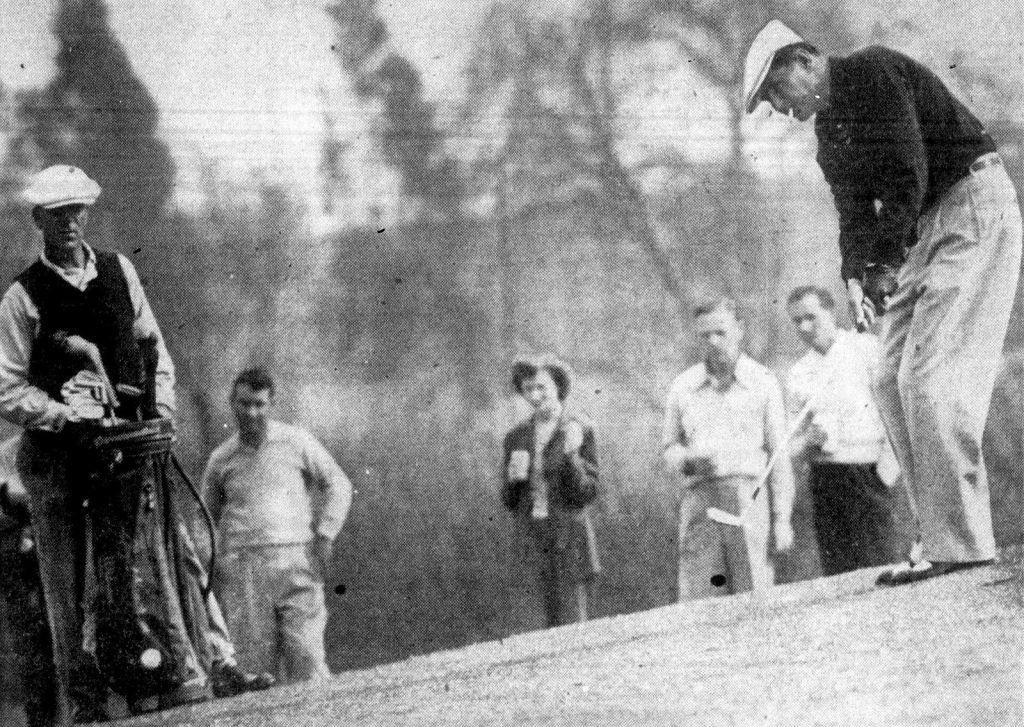
- Narrow stance: feet fairly close together, because the swing is small and stability matters more than power.
- Weight favoring the lead side: with more pressure on the front foot, which helps produce a slightly descending strike and crisp contact.
- Ball position back of center: often around the middle of the stance or slightly behind, so the club meets the ball before the turf.
- Hands slightly ahead of the ball: the shaft leans a little toward the target at address.
- Grip down: choking down on the grip gives more control.
- Stand closer: the club sits more upright, a little like a putting posture.
The motion itself is often compared to a putting stroke: the shoulders rock the club back and through, with quiet wrists and a steady lower body. The finish is short and controlled, with the hands still leading the clubhead. The goal is consistent, solid contact, not scooping the ball into the air. Loft on the club does the lifting.
Many golfers find it helpful to treat chipping as an extension of putting. Our putting fundamentals guide covers stroke tempo and distance control ideas that transfer directly.
Pitching Setup and Technique
Pitches use a bigger motion with more wrist hinge and body rotation. Common checkpoints:
- Slightly wider stance than for a chip, though still narrower than a full swing.
- Ball near the center of the stance.
- Weight a little toward the lead side but more balanced than in a chip.
- Some wrist hinge on the backswing, allowing the club to swing up and through rather than being pushed.
- Body rotation: the chest turns back and through, so the arms and body work together.
- Accelerate through the ball: deceleration is one of the most common causes of poor pitches.
Distance control on pitches often comes from swing length. Many coaches teach a “clock” system, using backswing lengths such as hands to hip height or chest height, combined with an even tempo. Over time golfers learn roughly how far each length sends the ball with each wedge. Pitching shares many elements with the full swing described in our guide to the golf swing in stages, just on a smaller scale.
Landing Spots and Rollout
Good short-game players do not aim at the hole. They aim at a landing spot. Once you choose a landing spot and a club, the ball’s rollout takes care of the rest.
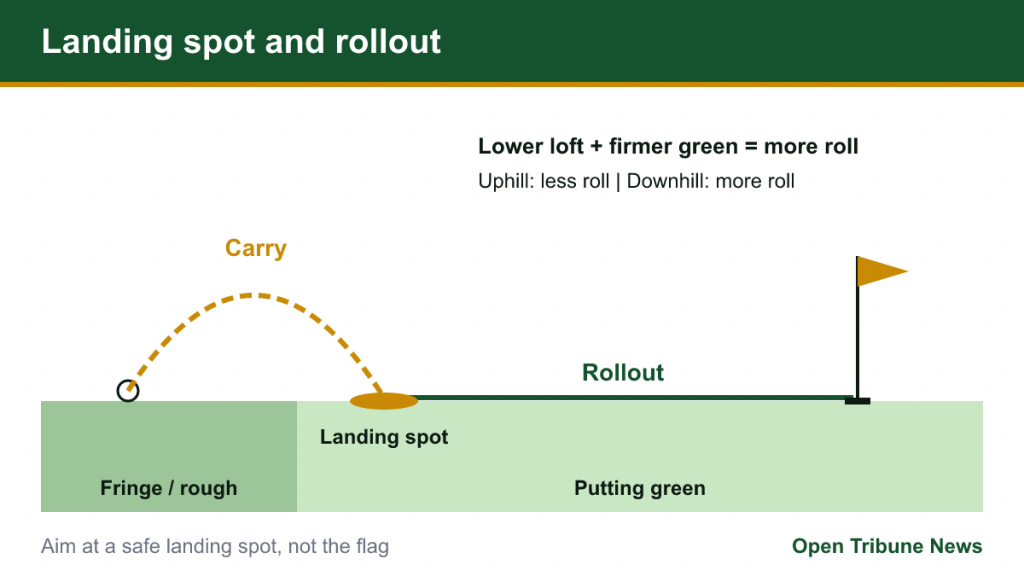
To pick a landing spot:
- Read the green as you would for a putt. Slope affects how the ball releases and breaks after landing.
- Choose a safe landing zone. Usually a flat area on the green, a short distance onto the putting surface, so the ball lands on predictable ground.
- Estimate rollout. The lower the loft and the firmer the green, the more the ball runs. Uphill slopes reduce rollout; downhill slopes increase it.
- Focus on the spot, not the flag. Commit to landing the ball on your chosen spot with the chosen club.
Some golfers use rough rules of thumb for the carry-to-roll ratio of each club. Because these vary with green speed, firmness, lie and ball, the most reliable way to learn them is to practice and observe how your shots behave on the greens you play.
The Bump-and-Run
The bump-and-run is a staple of links golf, where firm, fast ground lets the ball run long distances, but it is useful anywhere conditions are firm. Using a mid or short iron with a chipping motion, the ball is played low so it lands short of the green and runs on.
When it works best:
- Firm, closely mown ground between ball and green.
- Windy conditions, where a high pitch would be blown around.
- Uphill approaches into a green with no hazard in front.
- Nervous moments, because the margin for error on contact is larger than with a high pitch.
When to avoid it: soft, wet ground; thick rough or long grass in the path; or a hazard in front of the green.
Common Short-Game Faults
- Trying to lift the ball: flicking the wrists at impact to help the ball up leads to fat shots (hitting the ground first) and thin or skulled shots (catching the ball with the leading edge). Trust the loft.
- Deceleration: a long backswing followed by a slowing downswing, often from fear of hitting it too far. A shorter backswing with a positive through stroke is more reliable.
- Weight hanging back: leaning away from the target encourages scooping. Keep the pressure on the lead side, especially for chips.
- Ball too far forward on chips: makes it hard to strike the ball before the ground.
- Always choosing the lob wedge: the highest-lofted club is often the hardest to control. Use the least loft that safely gets the job done.
- Not reading the green: golfers who read putts carefully often ignore slope on chips, which affects the roll just as much.
Practice Ideas
These simple routines are widely used by coaches and players:
- Landing spot drill: place a towel or small target on the green and try to land balls on it with different clubs. Watch how far each club rolls out.
- Up-and-down game: drop balls around the practice green in different lies and try to get each one up and down in two shots (a chip or pitch followed by a putt).
- Ladder pitching: pitch to targets at increasing distances to learn how swing length relates to carry.
- One club, many shots: spend a session with one wedge, varying ball position and face angle to learn its full range.
- Bad lie practice: deliberately practice from rough, tight lies and slopes so you are prepared on the course.
Short sessions with clear goals usually beat long, unfocused ones. Keeping a simple record of how many up-and-downs you convert during practice gives you a way to track progress.
Quick Questions
Should I chip with a putter from the fringe?
Often, yes. If the fringe is short and smooth, putting from just off the green is a safe, legitimate option and is widely recommended for beginners.
Do I need a lob wedge?
Not necessarily. Many golfers score well with a pitching wedge and sand wedge for all their short shots. A lob wedge adds options but also requires precise contact.
How do I hit a higher pitch?
Typically by opening the clubface slightly, positioning the ball a little more forward and making a fuller, accelerating swing. It requires practice and a decent lie, so play the safer, lower shot when in doubt.