
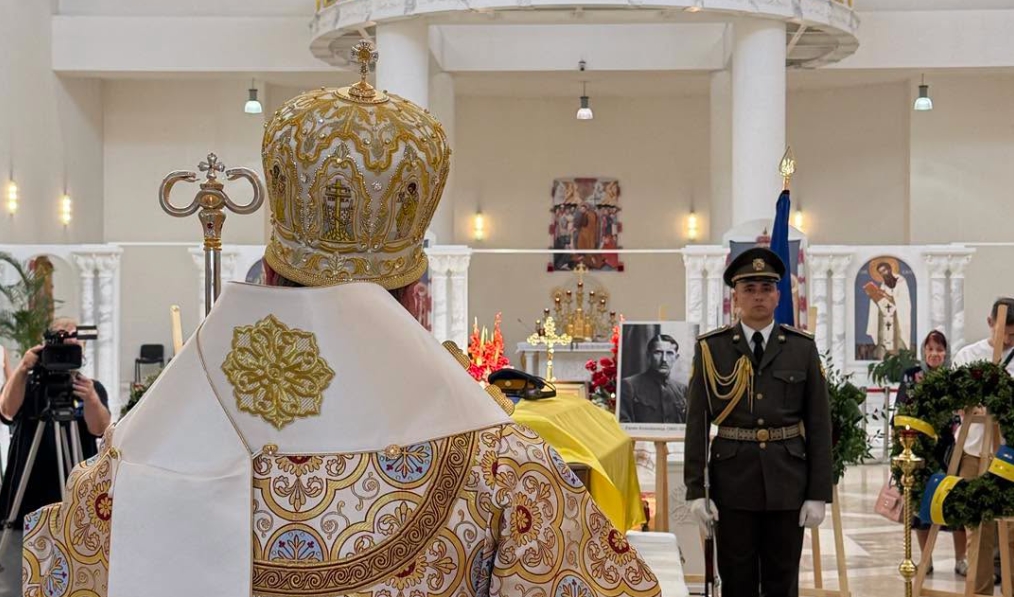
In a ceremony marking the 87th anniversary of a pivotal moment in Ukrainian history, the head of the Ukrainian Greek Catholic Church (UGCC) conducted a memorial service in Kyiv honoring Colonel Yevhen Konovalets, a prominent figure in Ukraine’s early 20th-century independence movement. The service was attended by Kyrylo Budanov, the head of Ukraine’s Presidential Office, who joined other officials and dignitaries in paying respects to the military leader who played a crucial role in the struggle for Ukrainian sovereignty during a turbulent period of European history.
Who Was Yevhen Konovalets?
Yevhen Konovalets (1891-1938) remains one of the most significant and controversial figures in Ukrainian military and political history. Born in Galicia, then part of the Austro-Hungarian Empire, Konovalets served as an officer in the Austrian army during World War I before becoming a leading figure in Ukraine’s fight for independence. He commanded the Sich Riflemen, an elite Ukrainian military unit that fought for the Ukrainian People’s Republic (UNR) against Bolshevik forces following the collapse of the Russian Empire. His military leadership during the chaotic post-war period earned him the rank of colonel in the UNR Army and established his reputation as a dedicated nationalist leader.
Following the defeat of Ukrainian independence forces and the establishment of Soviet control over most of Ukraine, Konovalets went into exile in Western Europe. There, he founded and led the Organization of Ukrainian Nationalists (OUN) in 1929, which sought to continue the struggle for Ukrainian independence through various means. The organization would later become highly influential in Ukrainian politics, though its legacy remains debated by historians due to some of its activities and alliances during the 1930s and 1940s.
The Assassination and Historical Context
Konovalets met a violent end on May 23, 1938, when he was assassinated by Soviet agent Pavel Sudoplatov in Rotterdam, Netherlands. According to historical accounts, Sudoplatov presented Konovalets with a box of chocolates containing a concealed bomb, which detonated and killed the Ukrainian leader instantly. The assassination was part of Stalin’s broader campaign to eliminate perceived threats to Soviet power abroad, particularly leaders of nationalist movements from Soviet-controlled territories. The operation was considered a major success by the NKVD, the Soviet secret police, and Sudoplatov was later decorated for carrying out the mission.
The killing of Konovalets had significant implications for the Ukrainian nationalist movement. Leadership of the OUN eventually passed to younger, more radical figures, and the organization split into factions during World War II. Despite his death over eight decades ago, Konovalets continues to be remembered in Ukraine as a symbol of the independence struggle, particularly since Ukraine gained independence in 1991 and especially following the Revolution of Dignity in 2014 and the ongoing conflict with Russia.
Modern Significance and Commemoration
The attendance of Kyrylo Budanov, who heads the Presidential Office and has become one of Ukraine’s most prominent wartime officials, underscores the contemporary relevance of historical figures like Konovalets in modern Ukrainian identity. Since Russia’s full-scale invasion began in February 2022, Ukraine has increasingly emphasized its historical struggles against Russian and Soviet domination as part of building national unity and resilience. Memorial services and commemorations of independence fighters have taken on new meaning as the country faces what many Ukrainians view as a continuation of centuries-long struggles for sovereignty.
The Ukrainian Greek Catholic Church, which conducted the memorial service, has itself been a significant institution in preserving Ukrainian national identity, particularly in western Ukraine. The church was banned and persecuted during the Soviet era, with its properties confiscated and many of its clergy imprisoned or killed. Its revival after independence has been closely tied to Ukraine’s broader national awakening. The participation of church leadership in commemorating military figures like Konovalets reflects the intertwining of religious and national identity that characterizes much of Ukrainian society today.
Expert Opinion: The commemoration of figures like Konovalets reflects Ukraine’s ongoing effort to construct a national narrative centered on resistance to external domination, particularly from Moscow. As the current conflict continues, these historical commemorations serve both as acts of remembrance and as symbolic statements about Ukraine’s determination to maintain independence. The presence of senior government officials at such events signals that historical memory remains a key component of Ukraine’s wartime strategy for maintaining national cohesion and international support.