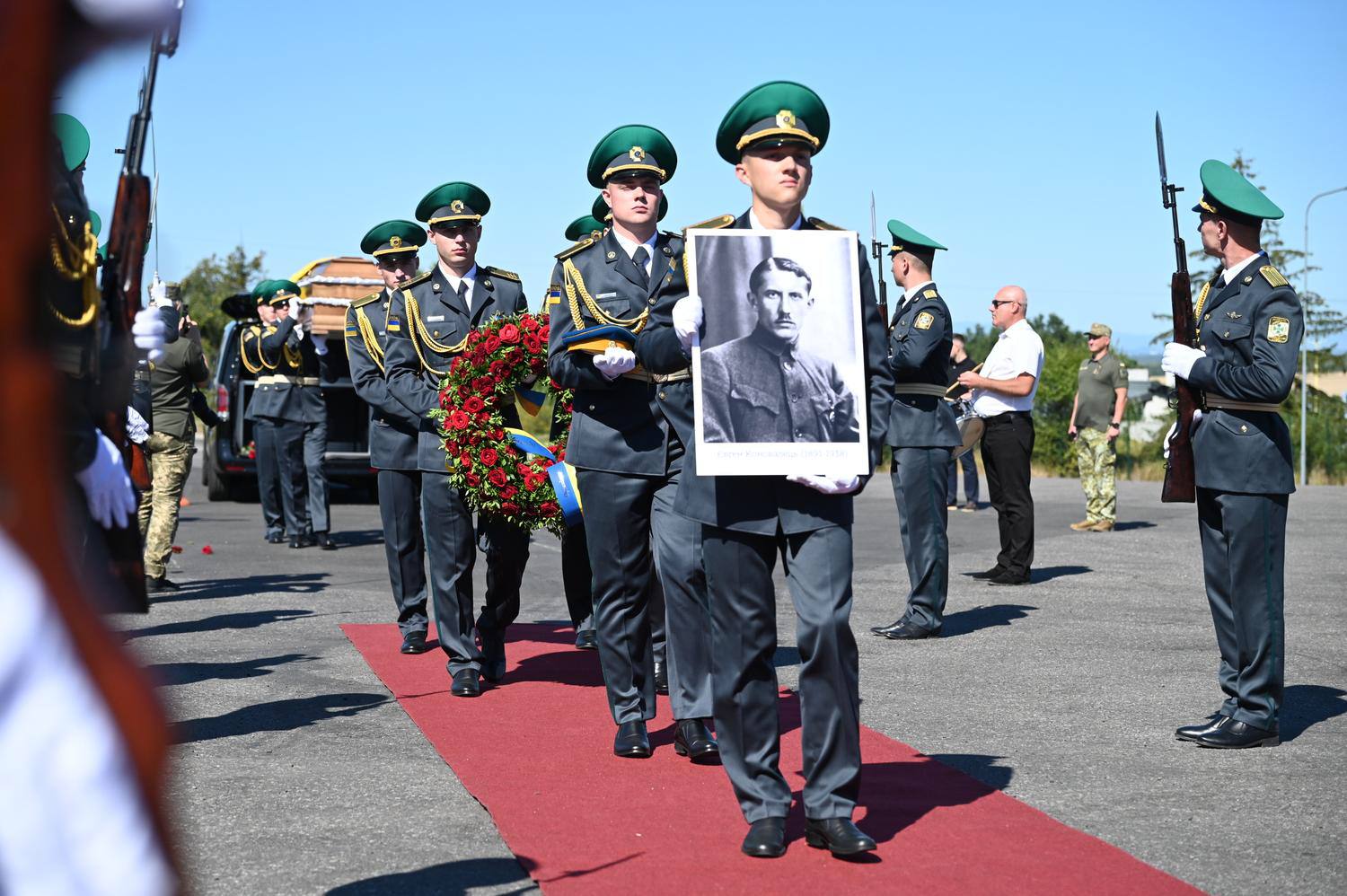
In a historically significant moment for Ukraine, the remains of Yevhen Konovalets, the founder of the Organization of Ukrainian Nationalists (OUN), have been returned to his homeland after more than eight decades abroad. The coffin containing his ashes was transported from the Netherlands, where he had been buried following his assassination in 1938, marking the completion of a long-awaited journey home for one of the most prominent figures in Ukrainian nationalist history.
The repatriation of Konovalets’s remains carries profound symbolic weight for Ukraine, particularly amid the ongoing conflict with Russia and a renewed emphasis on national identity and historical memory. For many Ukrainians, Konovalets represents the struggle for independence and national sovereignty that has defined much of the country’s modern history. His return comes at a time when Ukraine is actively reassessing its historical figures and seeking to honor those who fought for its independence.
The Life and Legacy of Yevhen Konovalets
Yevhen Konovalets was born in 1891 in the village of Zashkiv, in what was then part of the Austro-Hungarian Empire and is now the Lviv region of western Ukraine. He emerged as a military leader during the tumultuous period following World War I, commanding the Sich Riflemen, an elite Ukrainian military unit that fought for Ukrainian independence during the Ukrainian War of Independence from 1917 to 1921. His military prowess and organizational abilities made him a natural leader in the nationalist movement.
Following the failure to establish an independent Ukrainian state and the subsequent Soviet takeover, Konovalets went into exile in Western Europe. In 1929, he founded the Organization of Ukrainian Nationalists in Vienna, Austria, bringing together various émigré nationalist groups under one umbrella organization. The OUN would go on to become one of the most influential and controversial nationalist movements in Ukrainian history, advocating for Ukrainian independence through various means, including armed resistance.
The Rotterdam Assassination
Konovalets’s life came to a violent end on May 23, 1938, in Rotterdam, Netherlands. He was assassinated by Pavel Sudoplatov, a Soviet NKVD agent who had infiltrated nationalist circles by posing as a sympathetic Ukrainian émigré. Sudoplatov presented Konovalets with a gift box that concealed a bomb, which detonated and killed the nationalist leader instantly. The assassination was part of the Soviet Union’s broader campaign to eliminate émigré leaders who posed ideological threats to the communist regime.
The killing of Konovalets was considered a major success for Soviet intelligence and demonstrated the lengths to which the Stalin regime would go to suppress nationalist movements. Sudoplatov later detailed the operation in his memoirs, describing how he spent months gaining Konovalets’s trust before carrying out the assassination. Following his death, Konovalets was buried in Rotterdam, where his remains would stay for more than 85 years.
The Journey Home and Its Modern Significance
The decision to repatriate Konovalets’s remains reflects Ukraine’s ongoing efforts to reclaim its historical narrative and honor figures who contributed to the struggle for national independence. Since gaining independence in 1991, and particularly since the Revolution of Dignity in 2014 and the full-scale Russian invasion in 2022, Ukraine has undertaken significant steps to commemorate nationalist leaders and resistance fighters who were previously suppressed or vilified during the Soviet era.
The return of Konovalets’s remains is expected to be accompanied by official ceremonies and will likely include his reburial in Ukraine with full honors. For supporters, this represents the closing of a historical chapter and the proper recognition of a leader who dedicated his life to Ukrainian sovereignty. The event also serves as a powerful statement about Ukraine’s determination to forge its own path and remember its own heroes, regardless of how they may have been portrayed by foreign powers throughout history.
Expert Opinion: The repatriation of Konovalets’s remains represents more than a symbolic gesture—it reflects Ukraine’s broader process of historical reconciliation and nation-building during an existential conflict. This act of reclaiming historical figures demonstrates how wartime often accelerates the crystallization of national identity, with countries turning to foundational leaders as sources of inspiration and continuity. The timing suggests that Ukraine is actively constructing a post-Soviet historical narrative that emphasizes resistance and independence over accommodation with its eastern neighbor.